28 Best Free Next.js Admin Dashboard Templates 2026
Next.js has become the default React framework for building production-grade web apps, and admin dashboards are no exception. Between the App Router, server components, and built-in API routes, you get a full-stack foundation that most standalone React setups simply can’t match. The ecosystem has caught up too — there are now enough free and premium Next.js dashboard templates that you don’t need to start from scratch.
We went through dozens of GitHub repos and commercial offerings to pull together the 28 best ones. Every template on this list is actively maintained, and most ship with a working live demo. The UI library diversity is worth noting: you’ll find options built with shadcn/ui, Material UI, Tailwind CSS, Mantine, Chakra UI, Ant Design, and Bootstrap — so whatever design system your team prefers, there’s a Next.js admin panel that fits.
Whether you’re spinning up an internal tool, prototyping a SaaS admin panel, or just need a head start on your next client project, one of these should save you a few weekends of boilerplate work.
Quick Picks
- Best overall: Next.js shadcn Dashboard Starter — 5.9k stars, weekly commits, shadcn/ui + Next.js 16 with Kanban, analytics, and auth pages
- Best free: Shadboard — Most comprehensive free template with inbox, chat, calendar, kanban, file manager, and multiple dashboard variants
- Best premium: Apex Dashboard — 216 prerendered pages, 12 dashboard variations, theme customizer, i18n, Storybook, and Cmd+K command palette
- Best with shadcn/ui: Next.js shadcn Admin Dashboard — Polished collapsible sidebar, breadcrumbs, and notification system built on shadcn/ui
- Best with MUI: Devias Kit — 5.6k stars, enterprise-grade Material Design with Firebase/Auth0 integration paths
- Best for SaaS: Horizon UI shadcn Boilerplate — AI-themed dashboard with ChatGPT-style chat UI, perfect for AI/SaaS products
Best Free Next.js Admin Dashboard Templates
1. Apex Dashboard
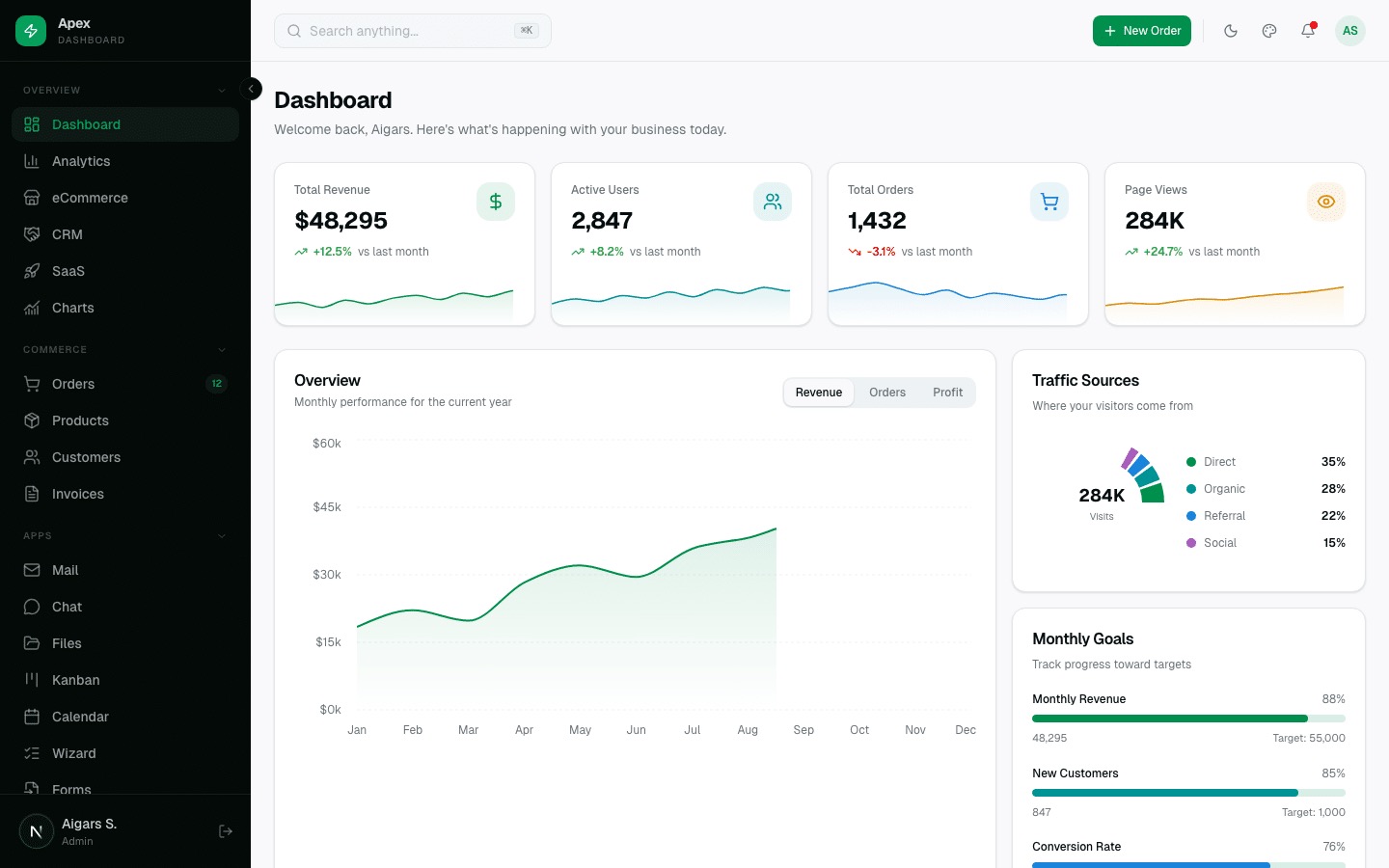
Why we like it: 216 prerendered pages, 12 dashboard variations, Cmd+K command palette, Storybook with 80 component stories, and i18n support — the most complete premium Next.js dashboard available.
Apex Dashboard is a production-ready Next.js 16 admin template built with React 19, TypeScript 6, Tailwind CSS v4, and shadcn/ui components. It comes with 12 dashboard variations (Overview, Analytics, eCommerce, CRM, SaaS, Project, Finance, HR, Marketing, Academy, Logistics and AI Usage), 20+ application pages including Chat, Mail, File Manager, Kanban Board, and Calendar, plus a live theme customizer with 6 color presets, dark/light modes, and RTL support.
Under the hood, Apex uses Recharts 3 for 10 chart types, TanStack Table v8 for a pro data grid with column pinning, inline editing, saved views and XLSX export, React Hook Form with Zod 4 for type-safe forms, and Framer Motion for smooth animations. It also includes a Cmd+K command palette, internationalization (3 languages), built-in documentation, and Storybook with 80 component stories. With 216 prerendered pages and an MIT license, it’s perfect for building any data-driven application. Version 3.0 adds 114 copy-paste blocks across 14 categories, six layout presets, a world map built from public-domain Natural Earth data with no runtime map library, an AI assistant with tool calls and streaming citations, and role-based access control with a permission matrix.
2. Admindek Dashboard Next.js
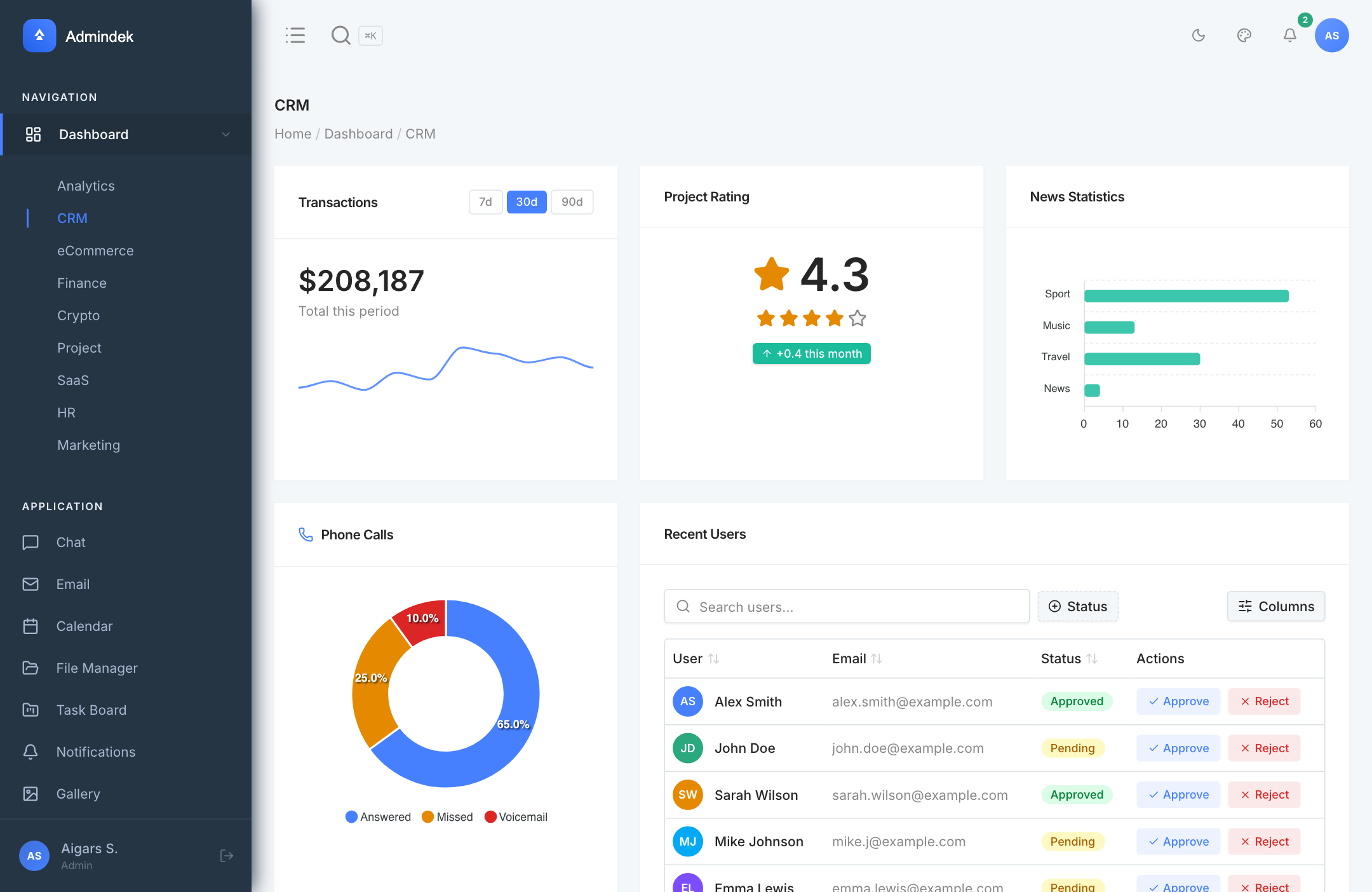
Why we like it: Free public demo lets you explore all 30+ pages and nine dashboard variants before committing — premium source unlocks full customization and production use.
Admindek Next.js is a full-stack Next.js 16 App Router admin with Server Components, Route Handlers, and the new Turbopack dev server. Free live demo at admindek-next.dashboardpack.com; premium source at $69+. Pairs React 19 + TypeScript 6 strict mode with 35+ vendored shadcn/ui primitives, TanStack Table v8 for server-side data grids, React Hook Form + Zod v4 validation, and Recharts 3 for data viz. Nine dashboard variants, 30+ pages including chat, calendar, kanban, file manager, and a complete auth suite (2FA, OAuth, password reset).
3. Flux
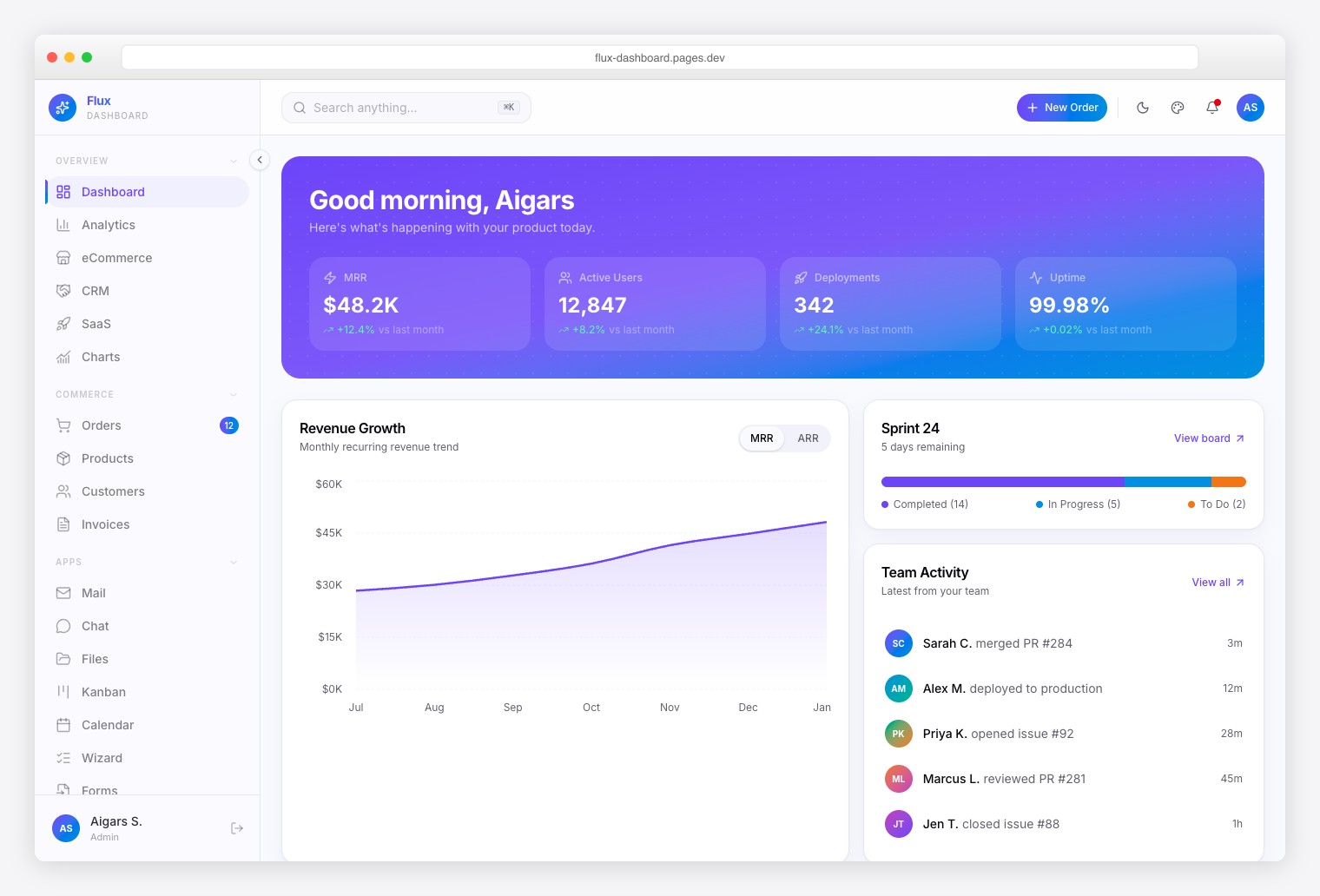
Why we like it: Gradient-forward design with 64+ pages, animated transitions, and unique DevOps pages like Feature Flags and Deployment Log.
A gradient-forward, animation-heavy admin dashboard purpose-built for dev tools, SaaS products, and startup teams. Ships 64+ pages with 5 dashboard variations plus 7 specialty pages: Roadmap, Feature Flags, Deployment Log, Team Feed, Feedback Board, Sprint Board, and Changelog. Animated page transitions via Framer Motion, command palette with fuzzy search, and CSV export.
4. Zenith
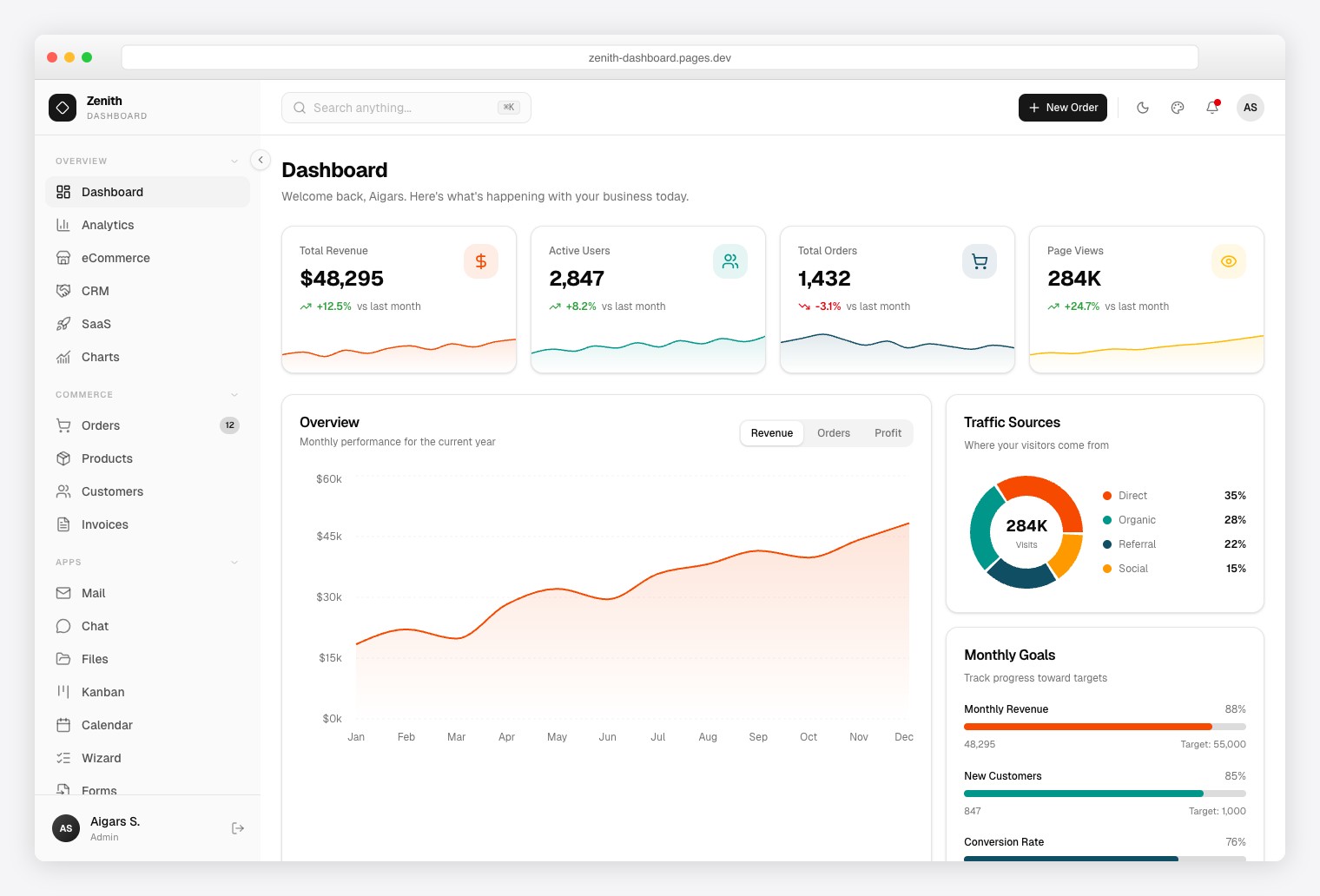
Why we like it: Ultra-minimal achromatic design with 50+ pages, 34 vendored shadcn/ui primitives, TipTap 3 rich text editor, and Leaflet maps.
An ultra-minimal, achromatic design — no color noise, just clean typography and precise spacing. Ships 50+ pages with 6 dashboard variations (Overview, Analytics, eCommerce, CRM, SaaS, Finance), 34 vendored shadcn/ui primitives, TanStack Table for advanced data grids, TipTap 3 rich text editor, and Leaflet maps. React Hook Form + Zod for type-safe validation.
5. Haze Dashboard — Next.js Edition
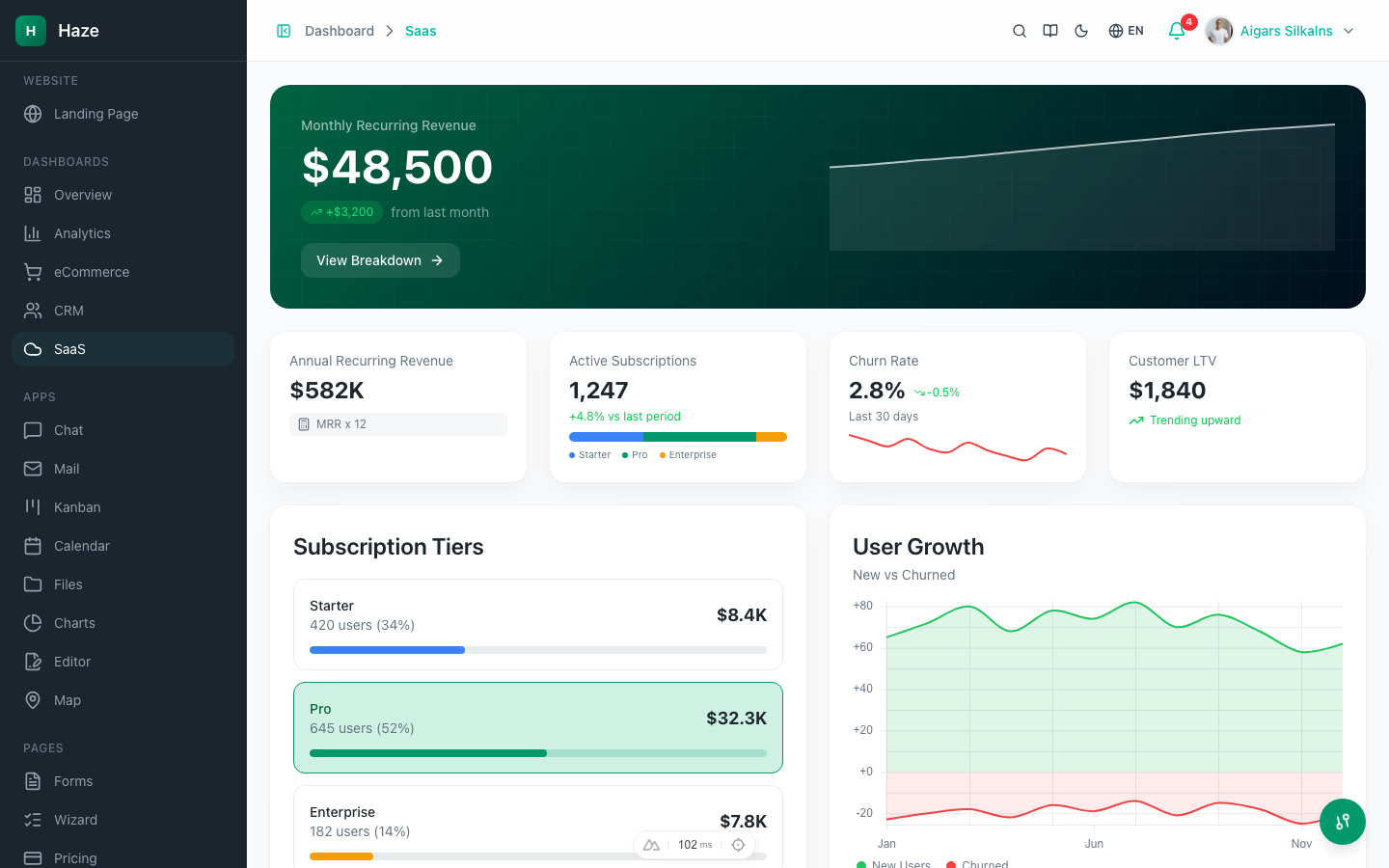
Why we like it: Built on Next.js 16 App Router with Turbopack from day one — five dashboards, eight app modules, eleven auth flows, and 33 mock API routes that actually paginate and filter.
Closing out this list with the most current stack on the page. Haze is purpose-built for the latest Next.js — App Router everywhere, Turbopack as the dev bundler, React 19 with Server Components and Suspense, TypeScript 5 in strict mode, and Tailwind CSS v4 with OKLCh color tokens. The SaaS dashboard shown above is one of five variants (Overview, Analytics, eCommerce, CRM, SaaS), each pre-populated with realistic mock data that demos MRR tracking, subscription metrics, and conversion funnels out of the box.
The application surface is broad: 96 pages total covering eleven authentication layouts, eight interactive modules (chat, mail, kanban, calendar, files, charts, Tiptap editor, react-leaflet maps), six CRUD resources backed by 33 mock API routes, and a 14-page in-app docs section. A live theme customizer exposes color, accent, density, and RTL controls at runtime. next-intl ships English, German, and French translations. From the same team behind AdminLTE.
6. Ember
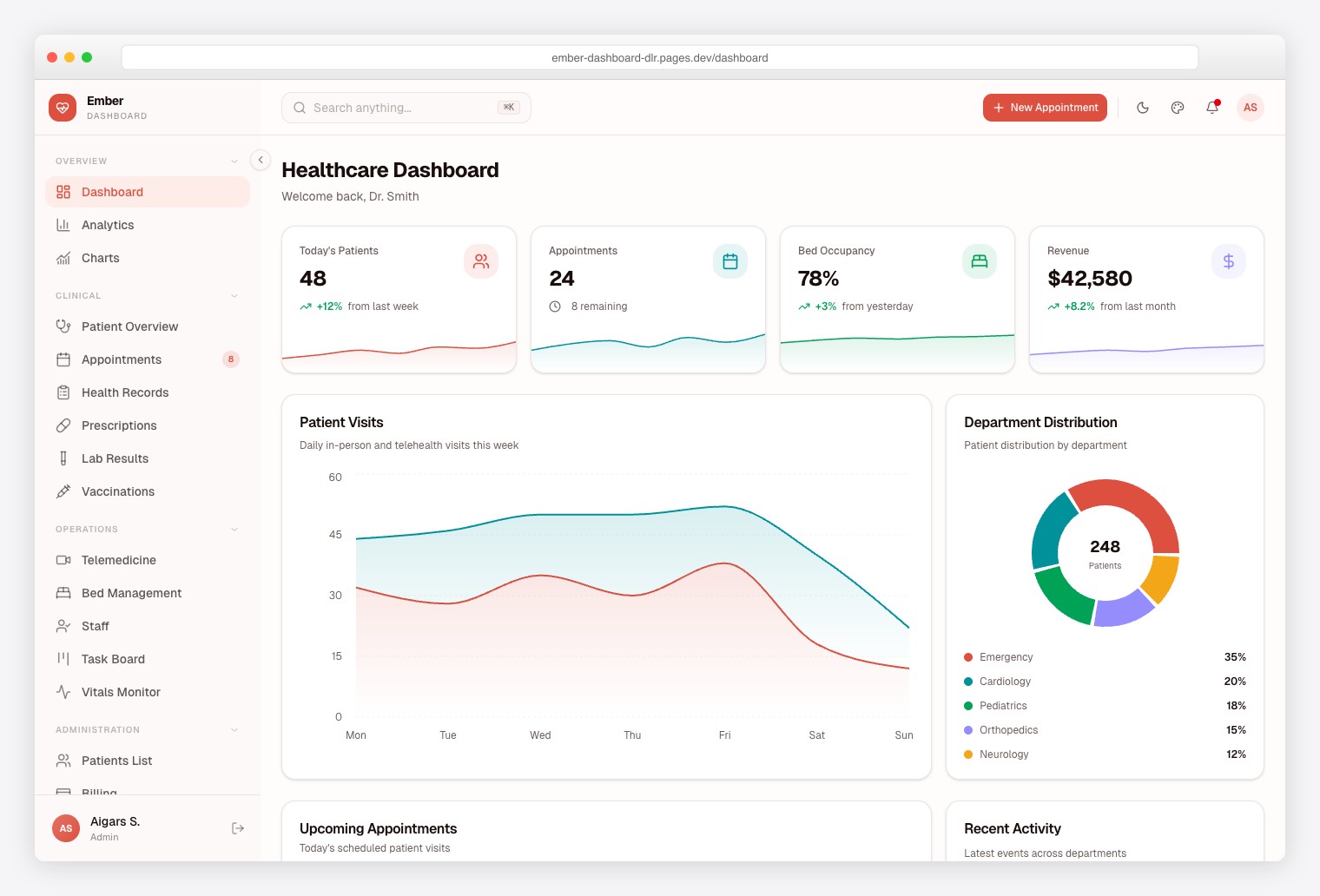
Why we like it: Domain-specific modules for Patient Management, Telemedicine, Prescriptions, and Lab Results — a rare healthcare-focused dashboard.
Purpose-built for medical practices, clinics, and healthcare SaaS platforms. Ships 50+ pages with domain-specific modules for Patient Management, Appointments, Telemedicine, Prescriptions, Lab Results, and Vaccinations. Also includes 5 general dashboard variants, Recharts 3 for clinical data visualization, Leaflet maps, and full auth flows with 2FA. i18n and RTL support included.
7. Signal
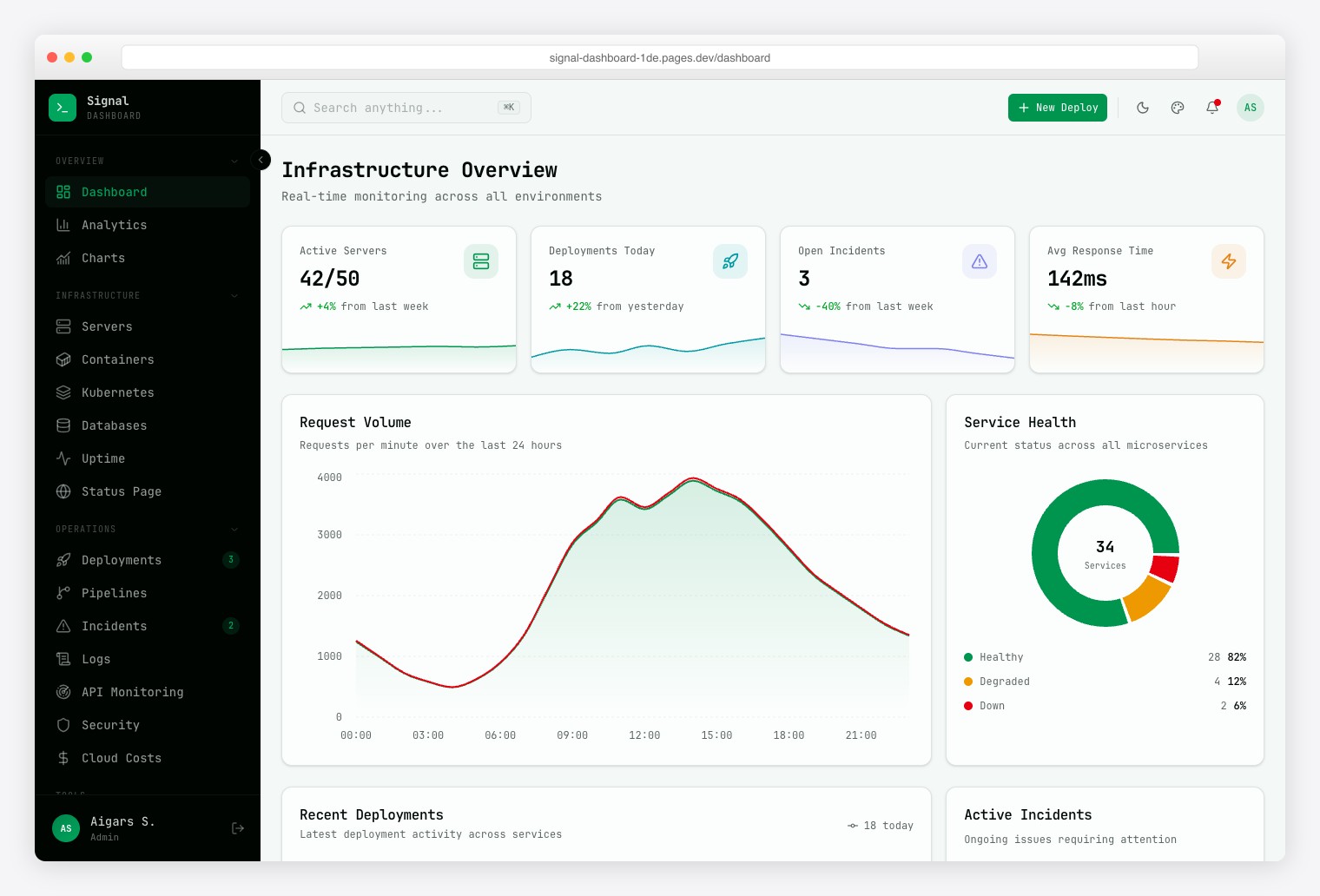
Why we like it: Terminal-inspired dark-first aesthetic with 13 DevOps modules including Kubernetes status, Cloud Costs, and API latency percentiles.
A terminal-inspired DevOps dashboard with dark-first, neon green aesthetic and JetBrains Mono typography. Ships 57+ pages with 13 DevOps modules: Server Fleet, Containers, Deployments, Incidents, Log Explorer, Uptime Monitor, Kubernetes status, Cloud Costs, and API Monitoring with latency percentiles (p50/p95/p99). Command palette, 6 color presets, and 3 density modes.
8. Vault
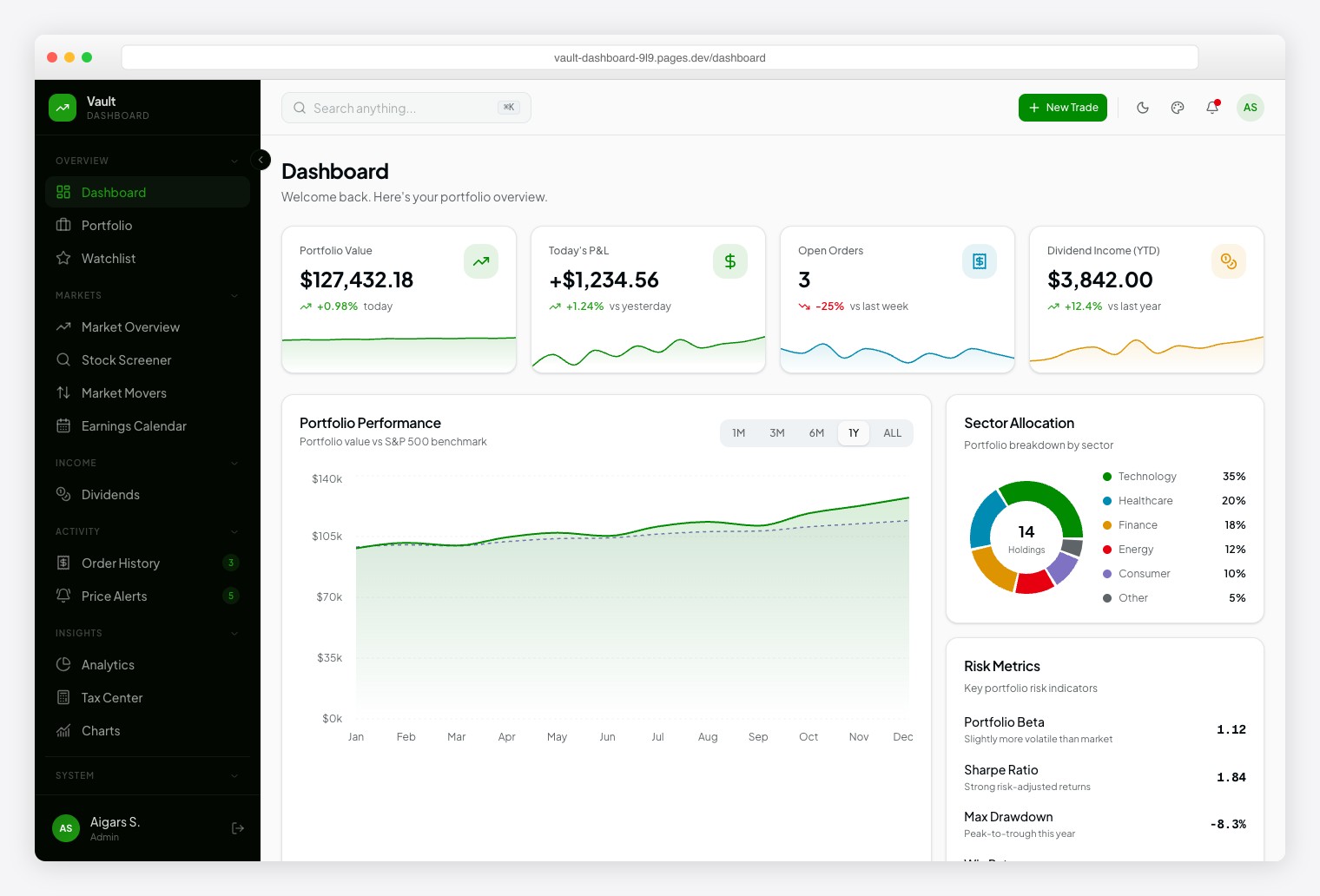
Why we like it: Robinhood-inspired design with 13 investment modules including Stock Screener, Earnings Calendar, and Tax Center.
A Robinhood-inspired investment dashboard with Plus Jakarta Sans for readability and Geist Mono for financial data precision. Ships 57+ pages spanning 13 investment modules: Portfolio, Watchlist, Market Overview, Stock Screener, Market Movers, Earnings Calendar, Dividends, Order History, Price Alerts, Analytics, Tax Center, and Stock Detail. Dark/light themes, 6 color presets, 10+ chart types.
9. Fortress
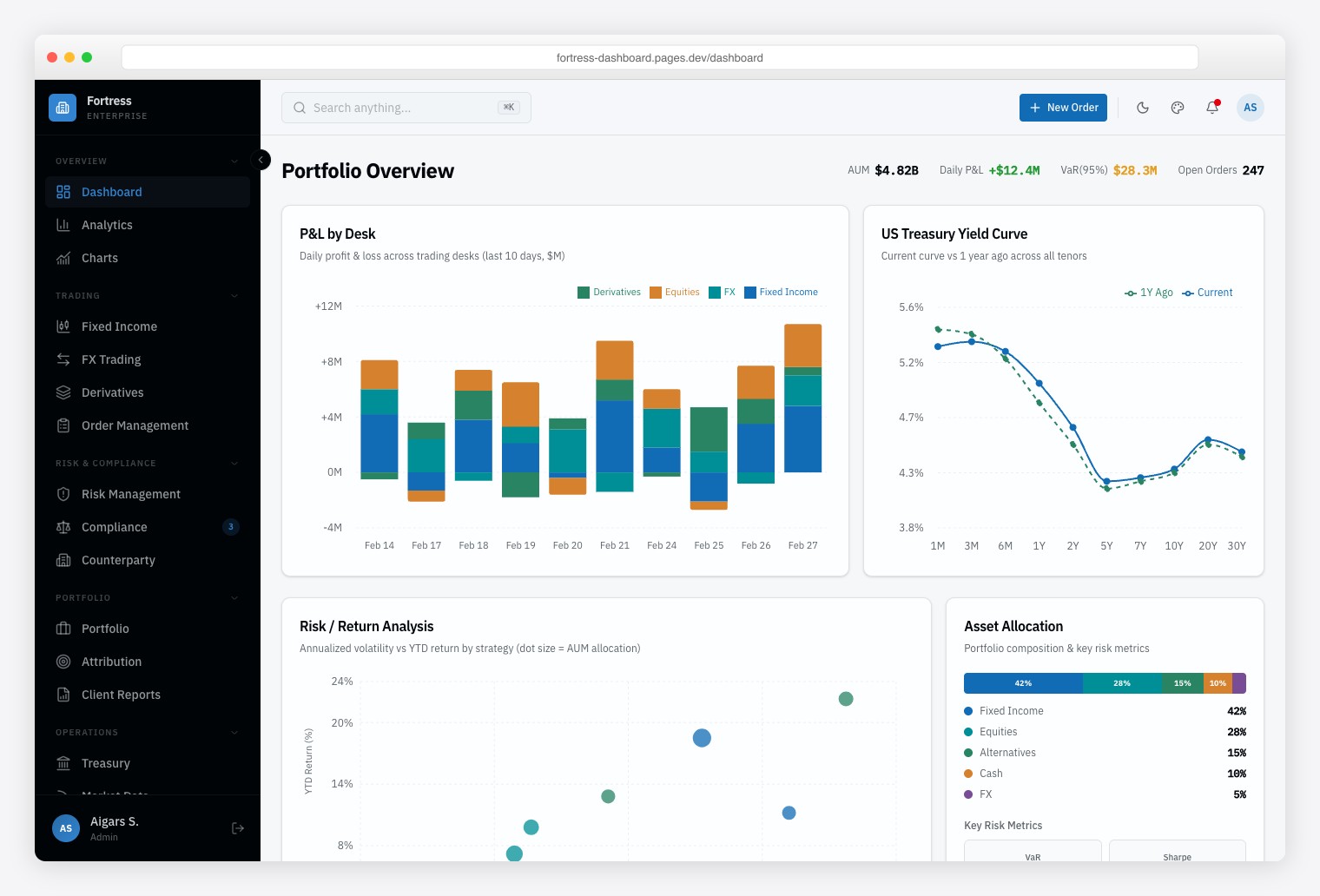
Why we like it: Bloomberg-inspired dense UI with multi-asset trading pages, risk analytics, compliance monitoring, and Vitest + Playwright testing.
A Bloomberg-inspired institutional finance dashboard built for trading desks, risk management teams, and compliance officers who need dense, data-heavy interfaces. Ships 57+ pages with 13 finance-specific pages covering multi-asset trading (Fixed Income, FX, Derivatives), risk analytics, and regulatory compliance monitoring. Framer Motion animations, Vitest + Playwright testing, and Storybook documentation.
10. Next.js shadcn Dashboard Starter
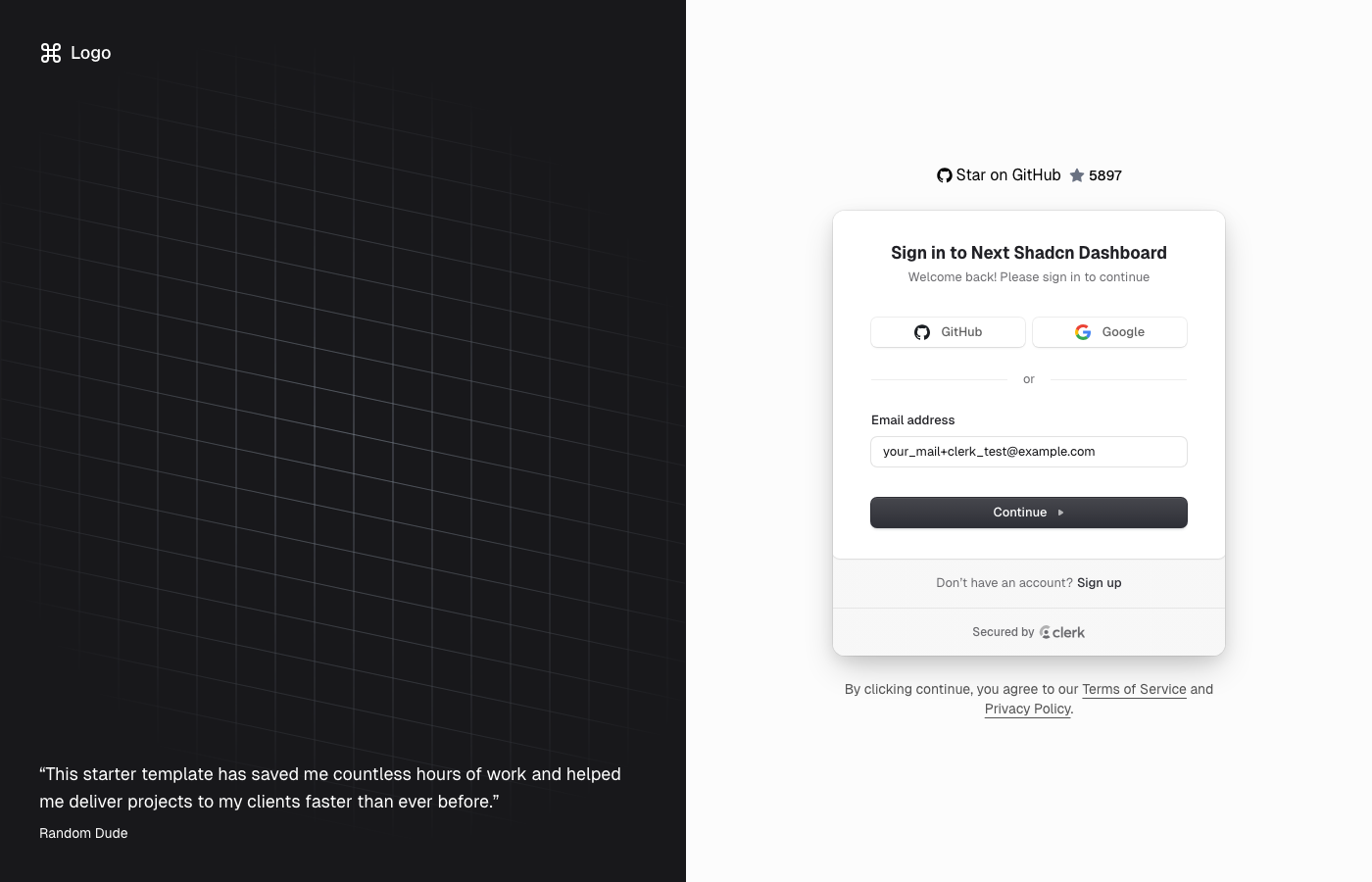
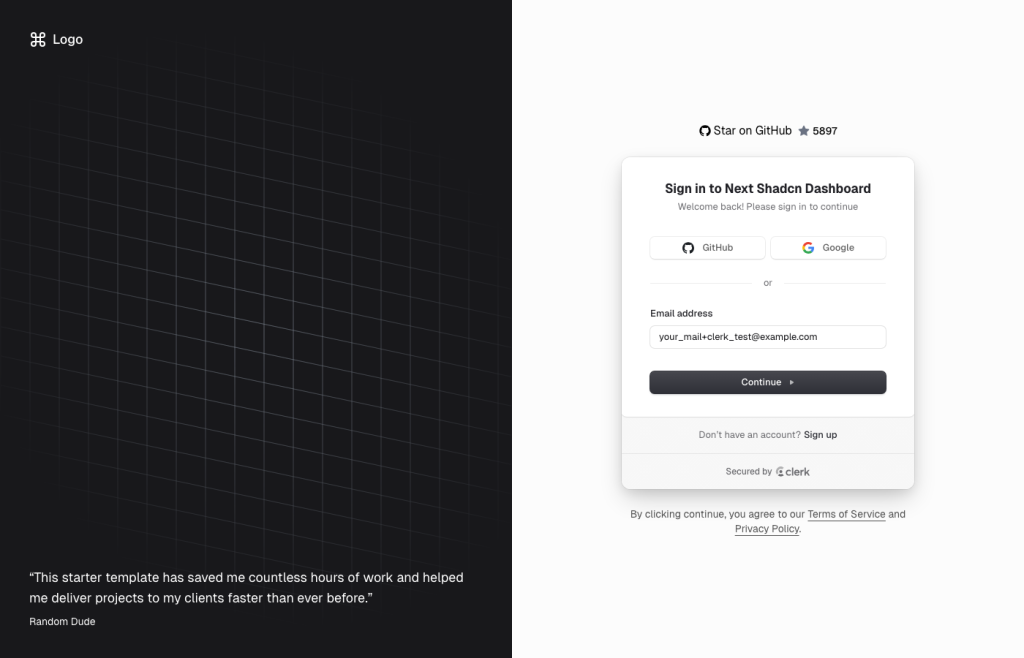
Why we like it: 5.9k GitHub stars, weekly commits, Kanban board, user management tables, analytics charts, and the safest bet for a new project in 2026.
The most popular open-source Next.js admin dashboard on GitHub, and it’s easy to see why. Built on Next.js 16 with shadcn/ui and Tailwind CSS, it includes a Kanban board, user management tables, analytics charts, authentication pages, and a collapsible sidebar with built-in search. The App Router setup means you get server components where they matter and client interactivity where you need it.
What really sets this apart is how actively it’s maintained — commits are landing weekly, and the codebase follows TypeScript best practices throughout. The Kanban board alone is worth studying if you’re building project management features. If you’re starting a new Next.js admin project in 2026 and want the safest bet, this is it.
11. Devias Kit
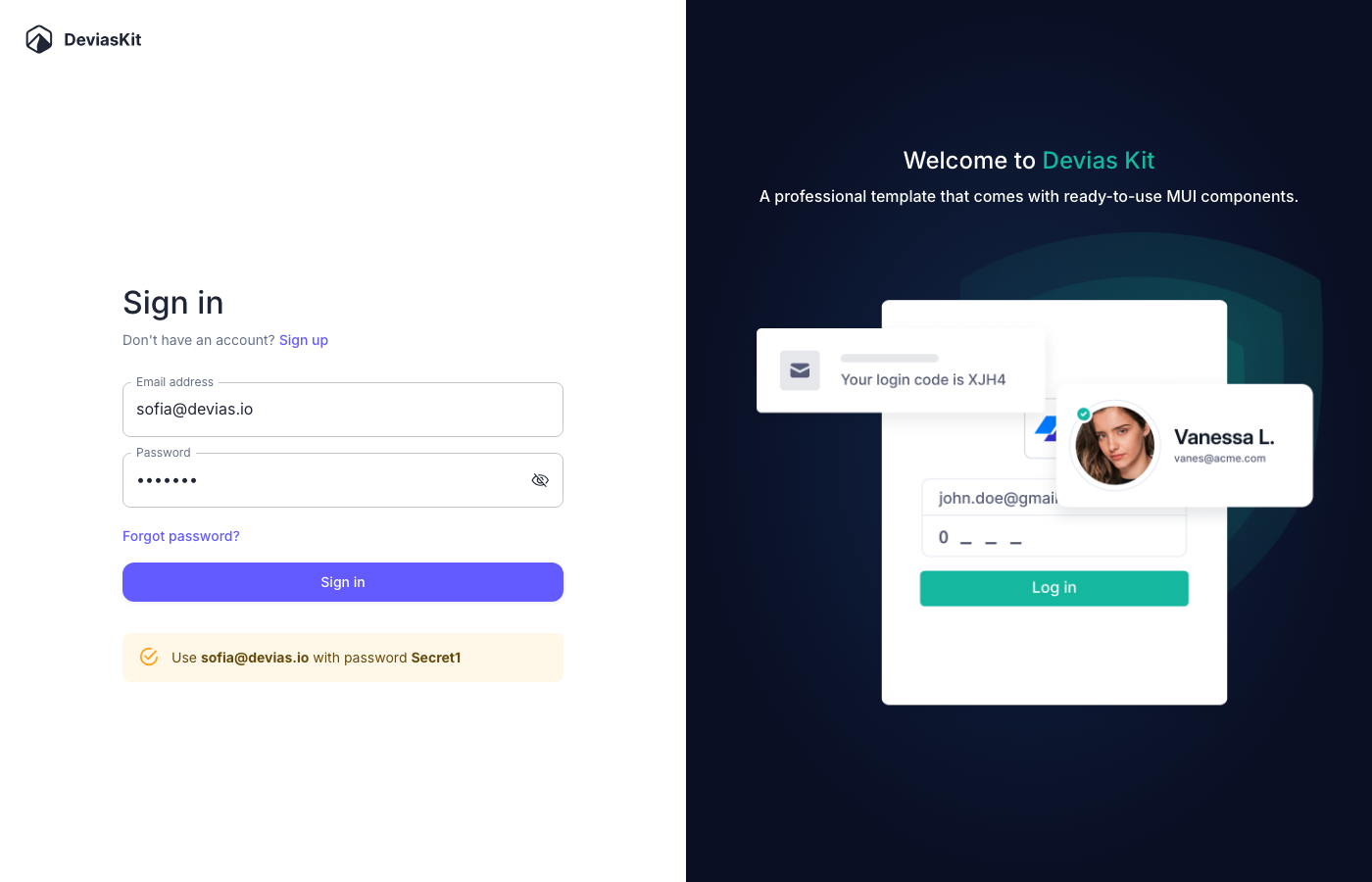
Why we like it: 5.6k stars, enterprise-ready MUI dashboard with intentionally designed dark/light modes and Firebase/Auth0 integration paths.
Devias Kit has been a staple in the React dashboard space for years, and the latest version pairs Next.js with Material UI for a polished, enterprise-ready admin panel. The free tier gives you an analytics overview, customer management tables, product listings, account settings, and full authentication pages with Firebase and Auth0 integration paths.
The dark theme toggle isn’t an afterthought here — both modes look intentionally designed. The sidebar navigation is responsive and well-organized, and the overall code architecture is clean enough to use as a reference for your own MUI projects. If your team is already invested in Material Design, this is the most complete free option available.
Looking for more admin panel options across different frameworks? Check out our roundup of the best admin templates.
12. TailAdmin Next.js
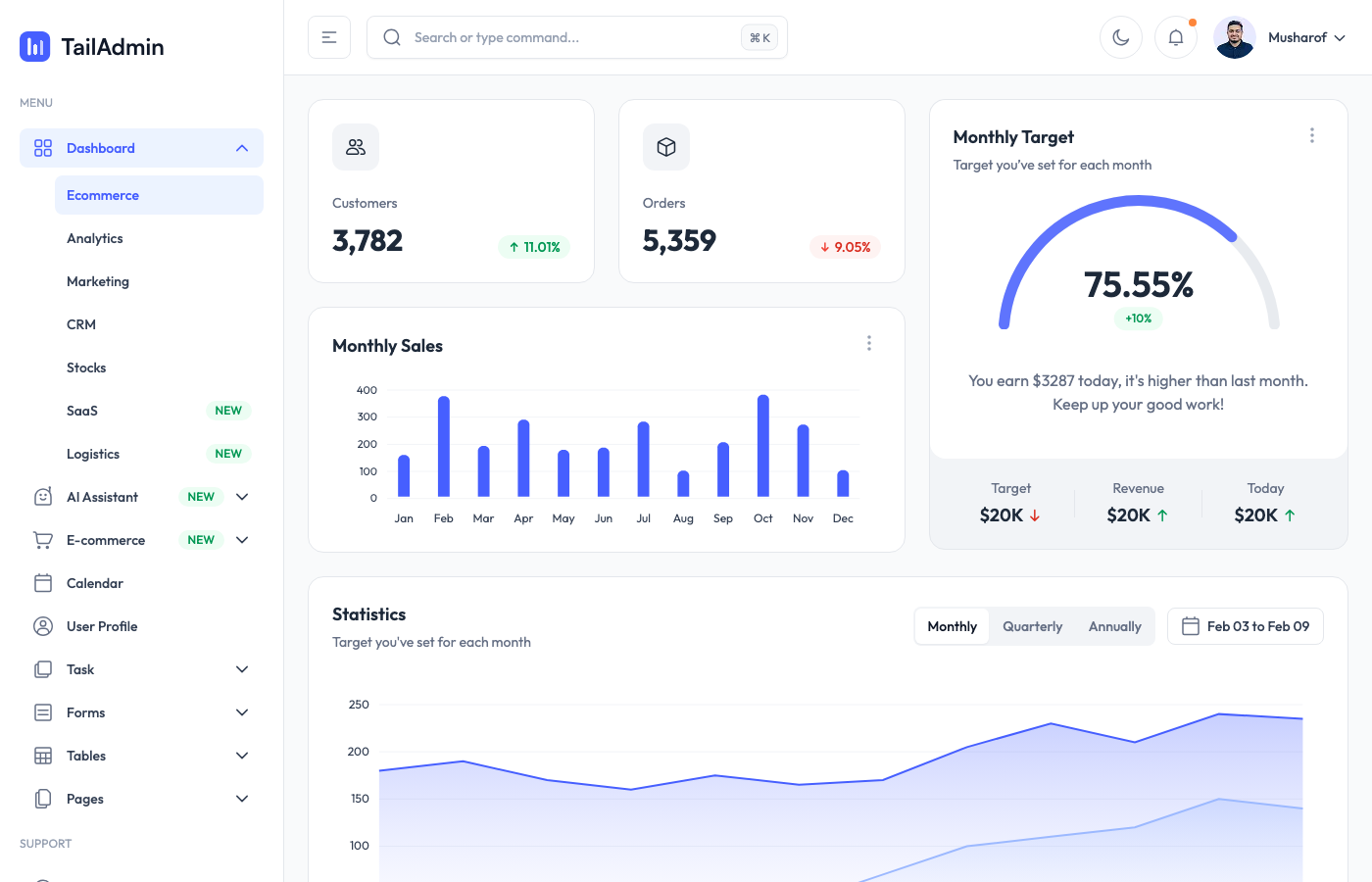
Why we like it: 2.3k stars, 200+ UI components, ApexCharts, calendar, data tables — more functionality than some paid templates.
TailAdmin’s Next.js version is arguably the most feature-rich free dashboard on this list. You get 200+ UI components, ApexCharts for data visualization, a calendar view, data tables with sorting and filtering, form elements, profile pages, auth flows, and a settings panel. That’s more functionality than some paid templates bother to include.
The Tailwind CSS styling is well-organized and the component structure follows Next.js conventions properly. Dark mode works across every component without visual glitches. If you need a dashboard that covers every standard admin use case without writing custom components for basic things like date pickers or chart widgets, TailAdmin will save you serious development time.
13. Materio MUI Next.js
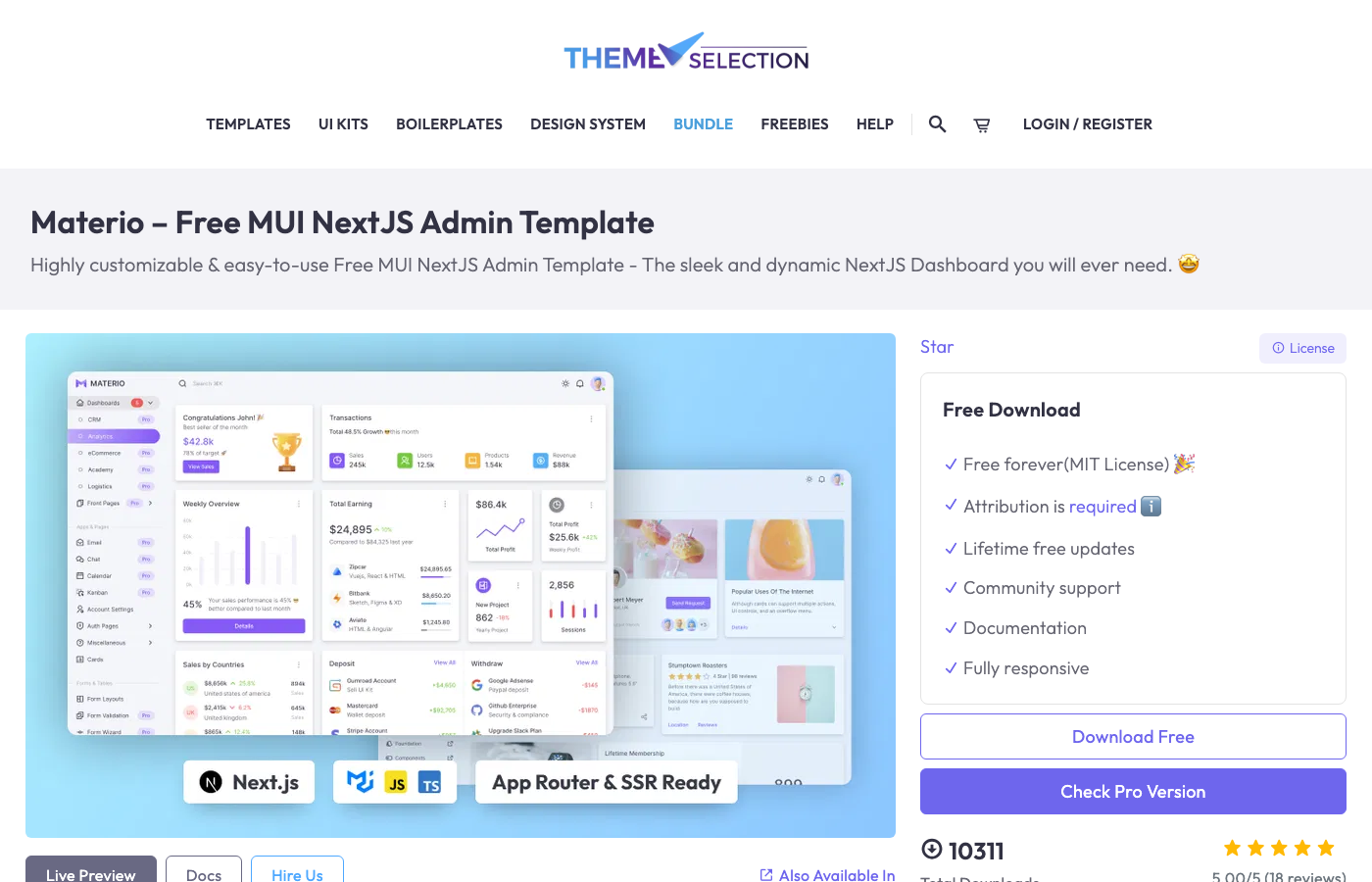
Why we like it: 1.9k stars, proper MUI theming through the theme provider, ships with ESLint + Prettier + VSCode configs pre-configured.
ThemeSelection’s Materio brings an enterprise-grade Material Design admin panel to Next.js 14 with the App Router. The free version includes dashboard analytics, form layouts, table management, account settings, authentication pages, and a comprehensive icon set. It ships with ESLint, Prettier, and VSCode configs pre-configured, which is a nice touch for team projects.
The MUI theming is handled properly — not just slapped on top of defaults. Color customization, spacing, and typography all flow through the theme provider. If you’ve worked with ThemeSelection’s other templates (Sneat, Vuexy), you know they care about code quality. Materio continues that standard in the Next.js ecosystem.
14. Next.js shadcn Admin Dashboard
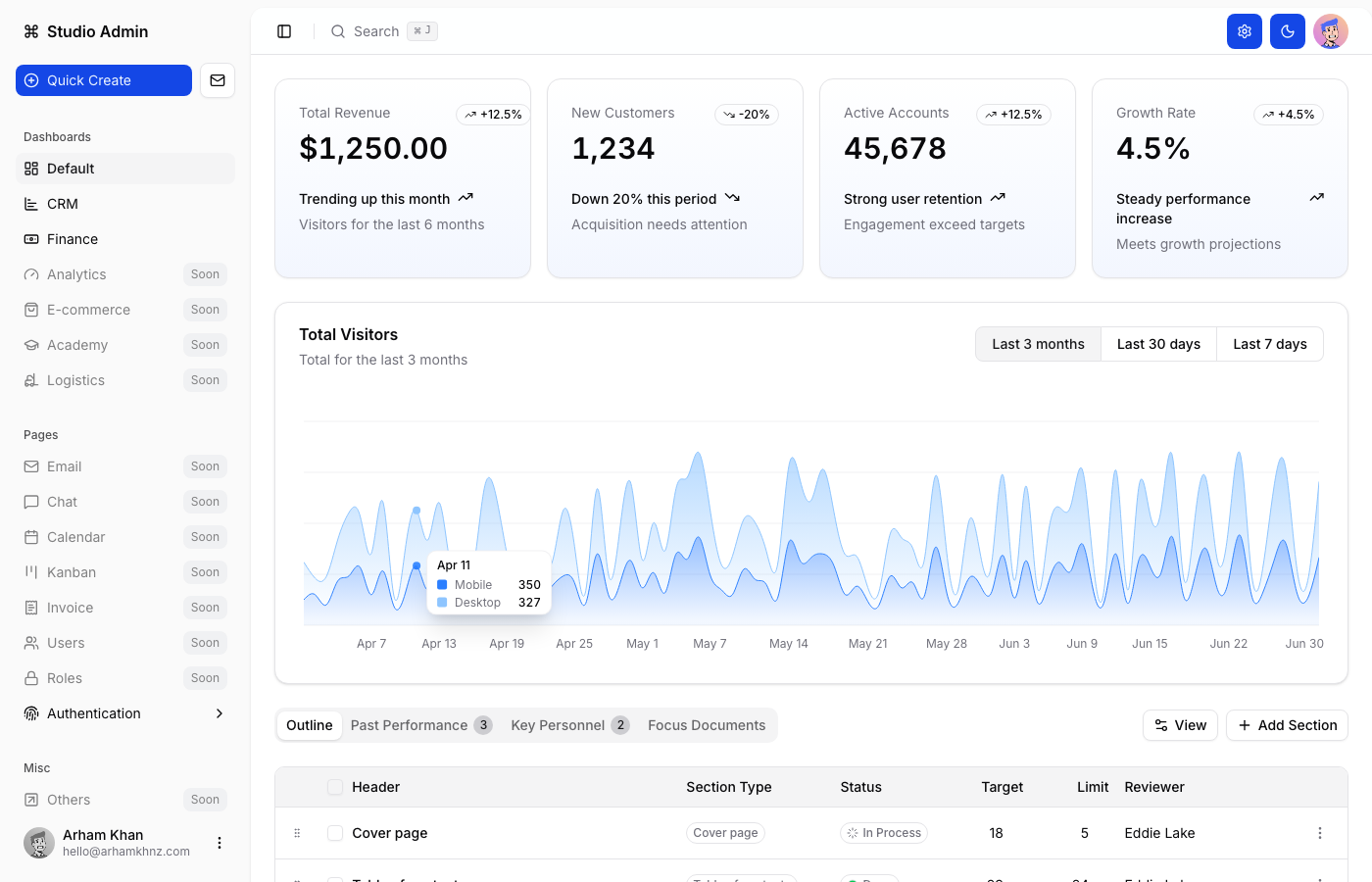
Why we like it: 1.6k stars, polished collapsible sidebar, breadcrumb navigation, and a more complete notification system than most free templates.
Another strong shadcn/ui entry, but this one differentiates itself with a polished collapsible sidebar, breadcrumb navigation, and a more complete notification system. The analytics charts look genuinely useful (not just decorative), and the data tables support pagination, sorting, and column visibility toggles out of the box.
Built on Next.js 16 with TypeScript throughout, the component architecture is clean and well-documented. Dark mode support is seamless. If you tried the #8 entry and want a slightly different layout approach or more emphasis on navigation patterns, this is worth comparing side by side.
For Tailwind-focused dashboard options beyond Next.js, see our list of Tailwind admin dashboard templates.
15. Vercel Admin Dashboard
Why we like it: 1.6k stars, straight from Vercel with working Postgres connection, auth flows, and server actions — the shortest path from clone to production.
This one comes straight from Vercel, so you know the Next.js patterns are going to be canonical. It’s a full-stack starter with NextAuth.js authentication, Vercel Postgres database integration, a user management table with search and filter, and a clean, minimal admin layout. Not a lot of pages, but everything that’s there is production-ready.
The real value here is the backend integration. Most templates give you a pretty frontend and leave you to figure out the data layer. This one ships with a working database connection, auth flows, and server actions. If you’re deploying on Vercel and want the shortest path from clone to production, this is your template.
16. Notus Next.js
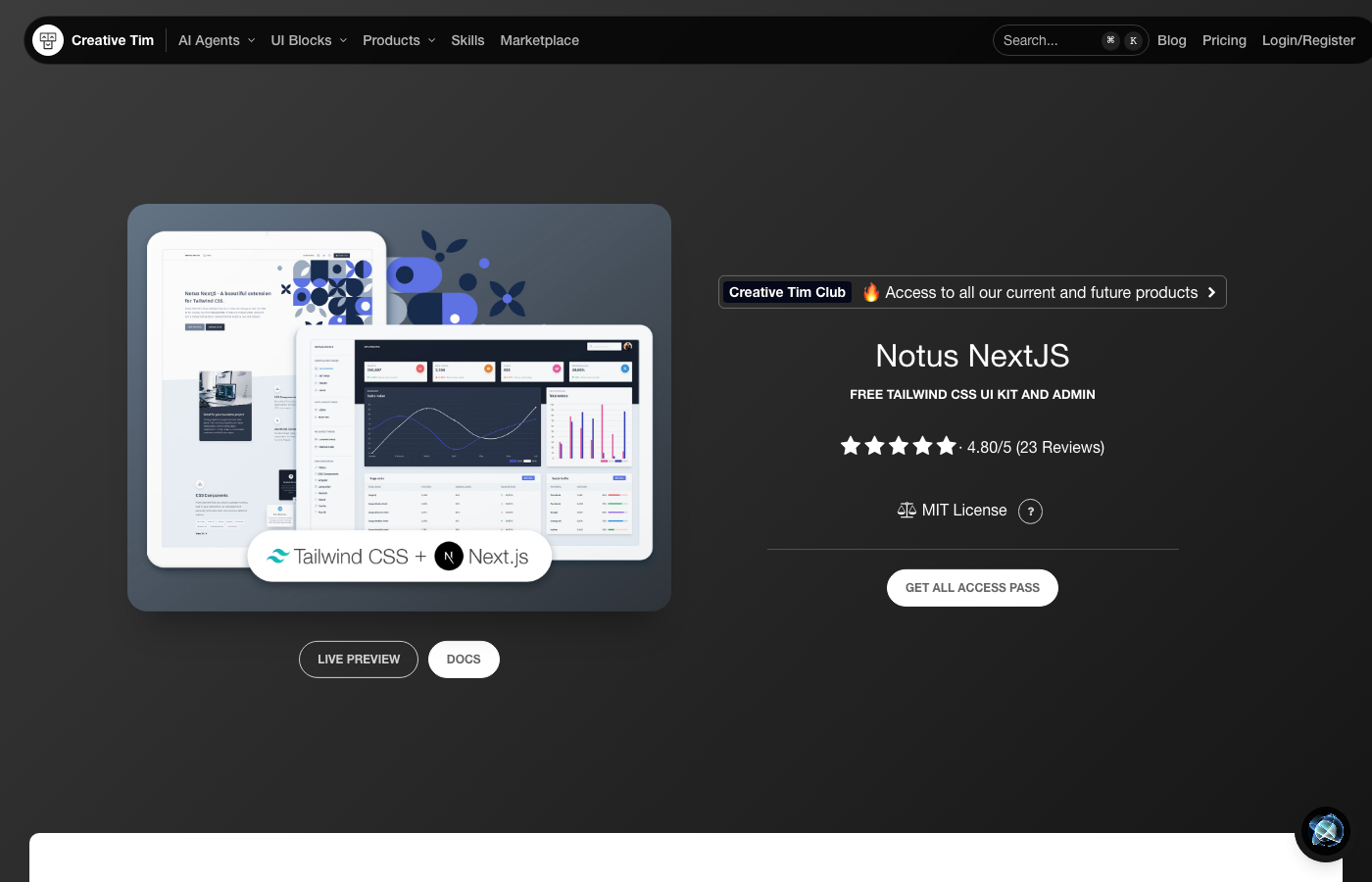
Why we like it: 1.5k stars, doubles as a UI kit with landing pages and profile views — not just an admin panel. 100+ components with multiple color variants.
Creative Tim’s Notus line is well-known in the template world, and the Next.js version bundles a dashboard with charts, card statistics, tables, maps, profile pages, and auth screens. Plus over 100 individual components with multiple color and style variants. It doubles as a UI kit, which means you’re not limited to admin pages — landing pages and profile views are included too.
The Chart.js integration handles the data visualization side, and the Tailwind styling is consistent throughout. It’s not the most modern Next.js architecture (no App Router), but the sheer volume of pre-built components makes it a solid choice if you need variety and don’t mind Pages Router patterns.
Maintenance note: Notus has not seen a release since 2024 and targets an older Tailwind and Next.js generation. The component set is still usable, but budget time for dependency upgrades rather than treating it as a current starter.
17. CoreUI Next.js Dashboard
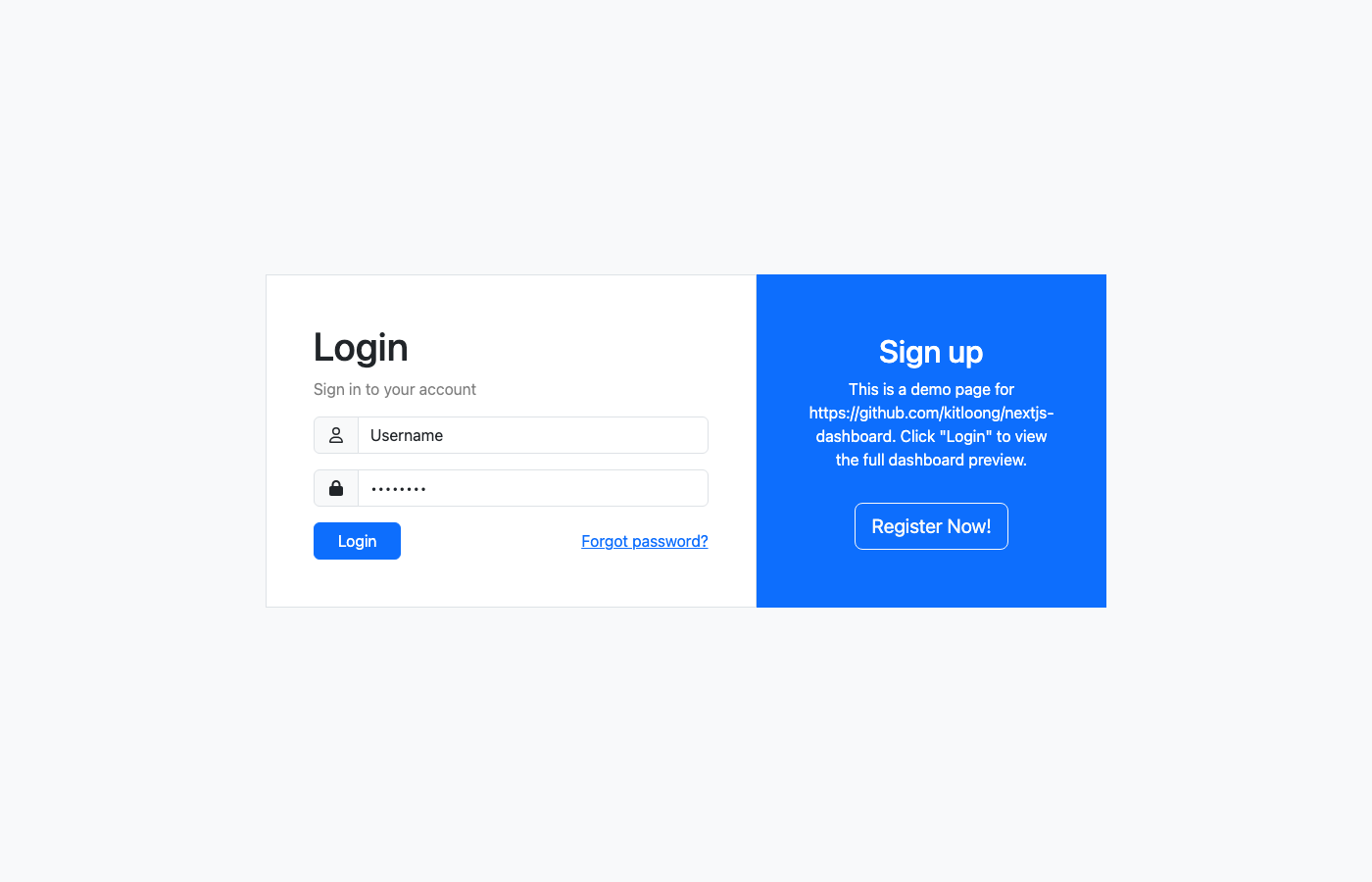
Why we like it: 684 stars, mature Bootstrap 5 component library with widgets, charts, forms, modals — no rough edges or half-finished pages.
If you prefer Bootstrap over Tailwind, CoreUI’s Next.js port gives you a battle-tested admin dashboard with widgets, charts (line, bar, doughnut), data tables, form elements, buttons, alerts, modals, and sidebar navigation with dropdown menus. CoreUI’s component library has been around for years and the design is mature — no rough edges or half-finished pages.
The Bootstrap 5 foundation means you get a familiar class-based styling approach, which can actually be an advantage if your team already knows Bootstrap. TypeScript support is included, and the folder structure maps cleanly to Next.js conventions. A pragmatic choice for teams that don’t want to learn Tailwind just to get an admin panel running.
Interested in React-specific admin solutions? Browse our curated list of React admin templates.
18. Horizon UI shadcn Boilerplate
Maintenance: last commit January 2025 — more than a year and a half ago. It still installs, but the framework has shipped major releases since, so budget time to update dependencies yourself and check anything that touches build tooling.
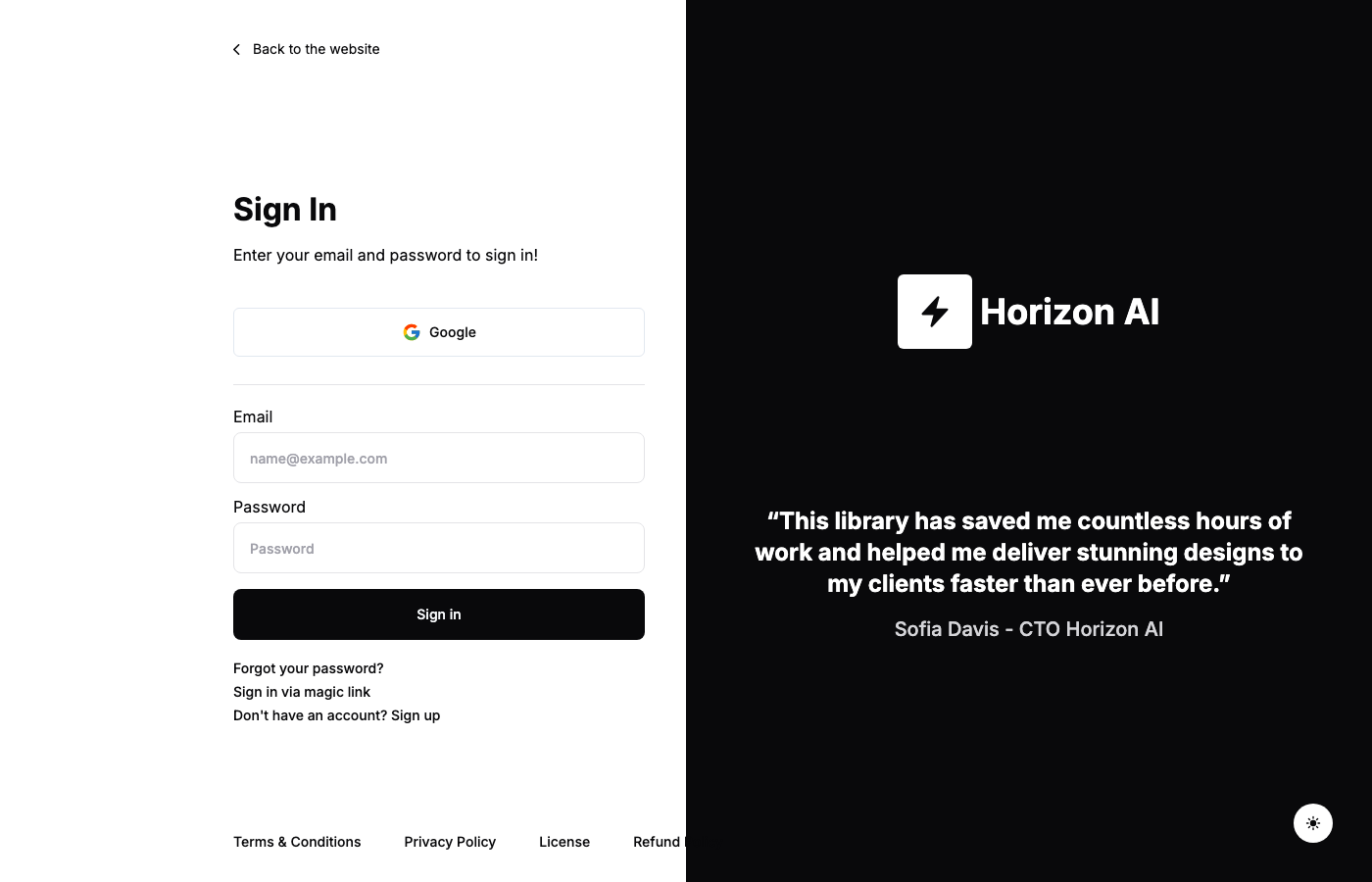
Why we like it: 621 stars, ChatGPT-style chat UI baked into the dashboard — perfect for AI-adjacent products without retrofitting a generic template.
Horizon UI’s shadcn boilerplate takes a different angle — it’s designed around AI product interfaces. The standout feature is a ChatGPT-style chat UI baked right into the dashboard, alongside analytics views, data tables, auth pages, and a sidebar with dark mode toggle. If you’re building an AI/SaaS product and want the admin panel to match that vibe, this saves you from retrofitting a generic dashboard.
The shadcn/ui and Tailwind CSS combo keeps the bundle lean, and the TypeScript codebase is well-organized. It’s more opinionated in its design direction than most entries on this list, which is either a pro or a con depending on your project. For AI-adjacent products, it’s a clear win.
19. Shadboard
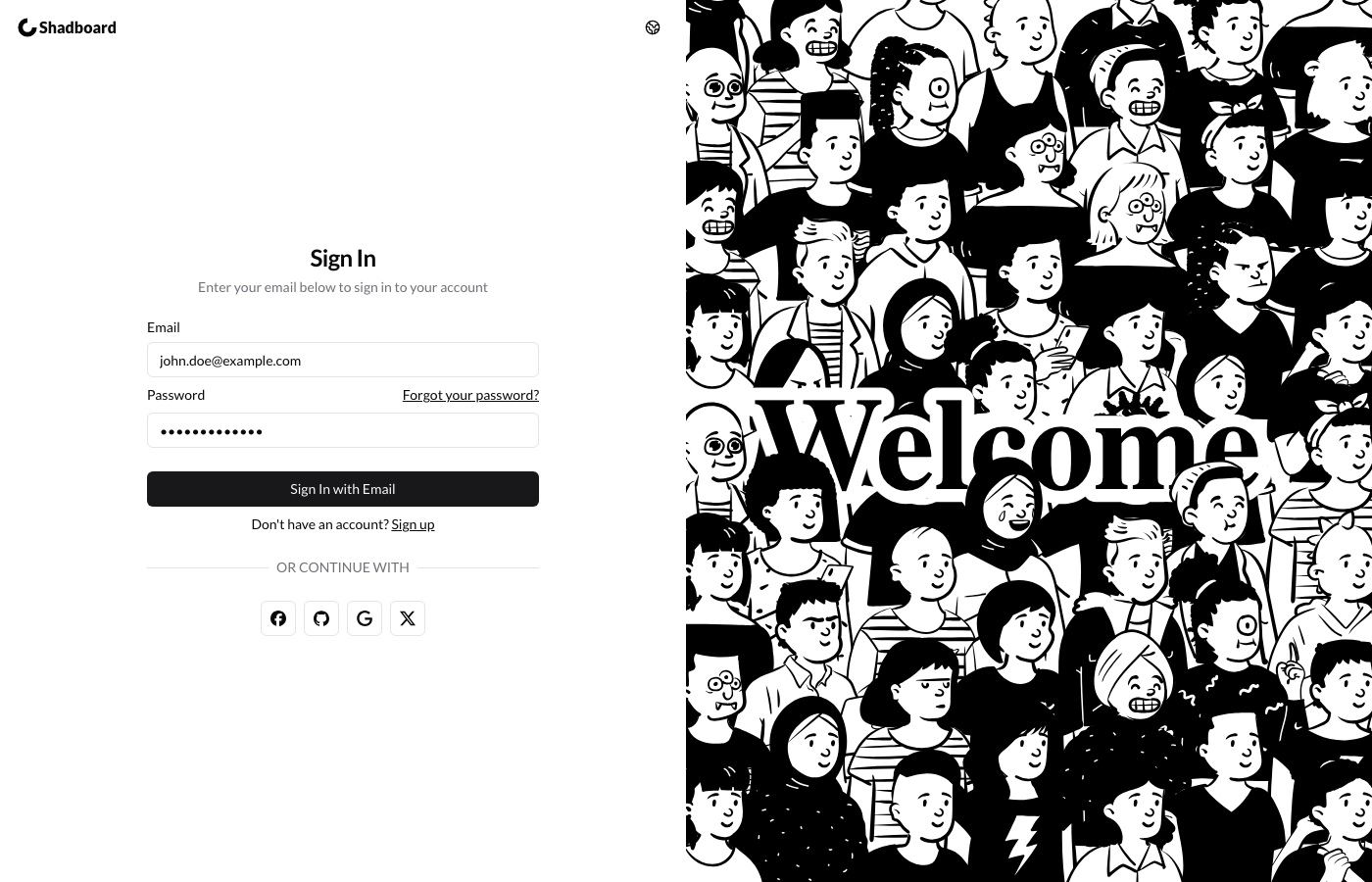
Why we like it: 580 stars, the most comprehensive free dashboard — inbox, chat, calendar, kanban, file manager, pricing, error pages. An entire SaaS skeleton.
Shadboard is arguably the most comprehensive free Next.js dashboard when it comes to page count. You get multiple dashboard variants (analytics, e-commerce, CRM), plus an inbox, chat interface, calendar, kanban board, file manager, user profile, settings, pricing pages, authentication flows, and even 404/500 error pages. That’s an entire SaaS application skeleton, not just a dashboard.
Built on Next.js 15 with shadcn/ui, Radix UI primitives, and Tailwind CSS, the architecture is modern and the component quality is high. The fact that this much functionality ships for free under MIT license is genuinely impressive. If you want the most pages out of the box and don’t mind a larger codebase, Shadboard delivers.
20. Admin One React Tailwind
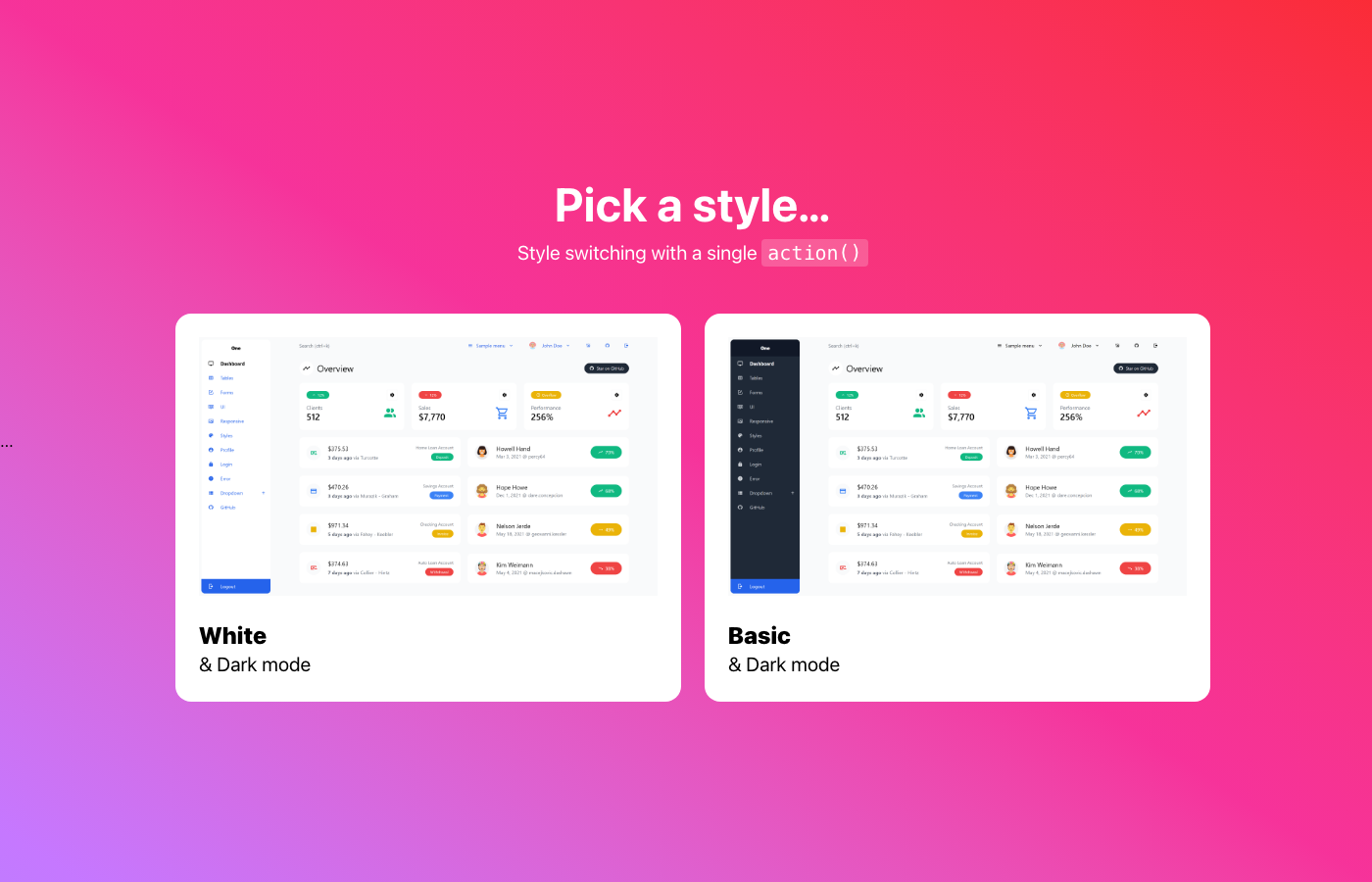
Why we like it: 575 stars, refreshingly lean — just Tailwind utilities and clean TypeScript with no heavy component library abstractions.
Admin One keeps things refreshingly lean. Chart widgets, tables, forms, profile page, login/signup, dark mode toggle, and a customizable sidebar — all built with Tailwind CSS 4.x and zero heavy UI framework dependencies. No MUI, no Chakra, no component library abstractions. Just Tailwind utility classes and clean TypeScript.
This lightweight approach means faster builds, smaller bundles, and a codebase you can actually read through in an afternoon. The responsive layout doesn’t just shrink things down — the mobile views are genuinely thoughtful. Developers who’d rather start lean and add complexity on their own terms will appreciate the philosophy here.
For a broader look at Tailwind-based web templates, check out our best Tailwind CSS templates collection.
21. Tremor Dashboard Template
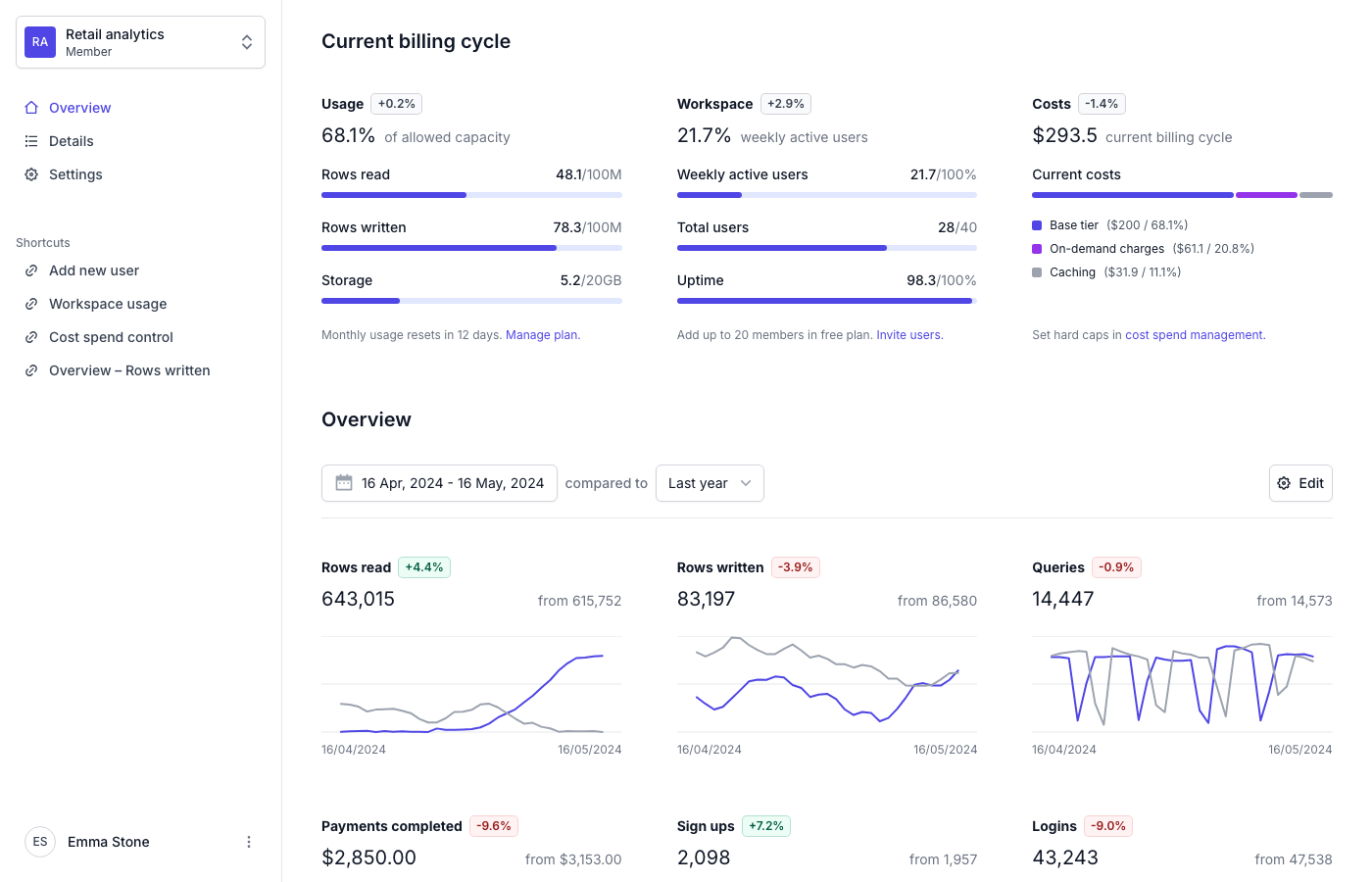
Why we like it: 498 stars, purpose-built for data visualization — KPI cards, area/bar/donut charts, and filterable tables with zero decorative noise.
The Tremor team (behind the popular React charting library) built this dashboard template to showcase what their components can do, and the result is one of the cleanest analytics interfaces you’ll find for free. KPI overview cards, area charts, bar charts, donut charts, and filterable data tables — all composed from Tremor’s Radix UI + Recharts primitives.
The design philosophy is “show the data, hide the chrome.” No flashy gradients or decorative elements — just clear data visualization in a minimal layout. If you’re building a metrics dashboard, an analytics product, or any interface where the charts are the main event, Tremor’s template is purpose-built for exactly that use case. Apache 2.0 licensed.
22. shadcn Dashboard + Landing Template
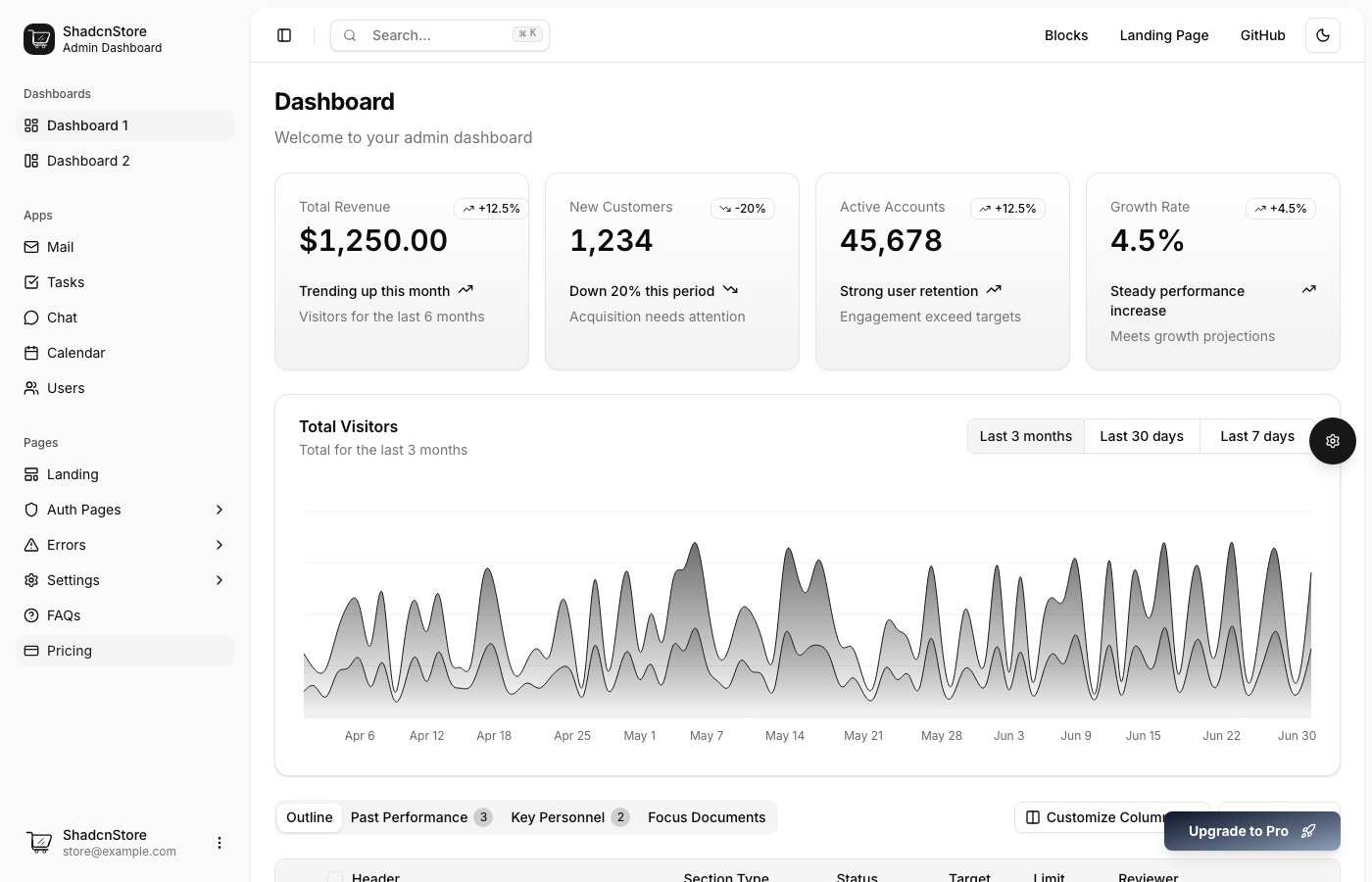
Why we like it: 472 stars, dual-purpose template with admin dashboard and marketing landing page sharing the same design system.
This template pulls double duty: you get both an admin dashboard and a marketing landing page in the same project. The dashboard side has analytics, charts, sidebar navigation, and data tables, while the landing page gives you a polished public-facing homepage. Dark mode is supported across both views.
It also ships with a Vite-React variant if you don’t need the Next.js server-side features. The dual-purpose approach is smart — most SaaS products need both a dashboard and a marketing site, and having them share the same design system from day one prevents the inevitable “redesign the landing page to match the app” phase later.
23. NextAdmin
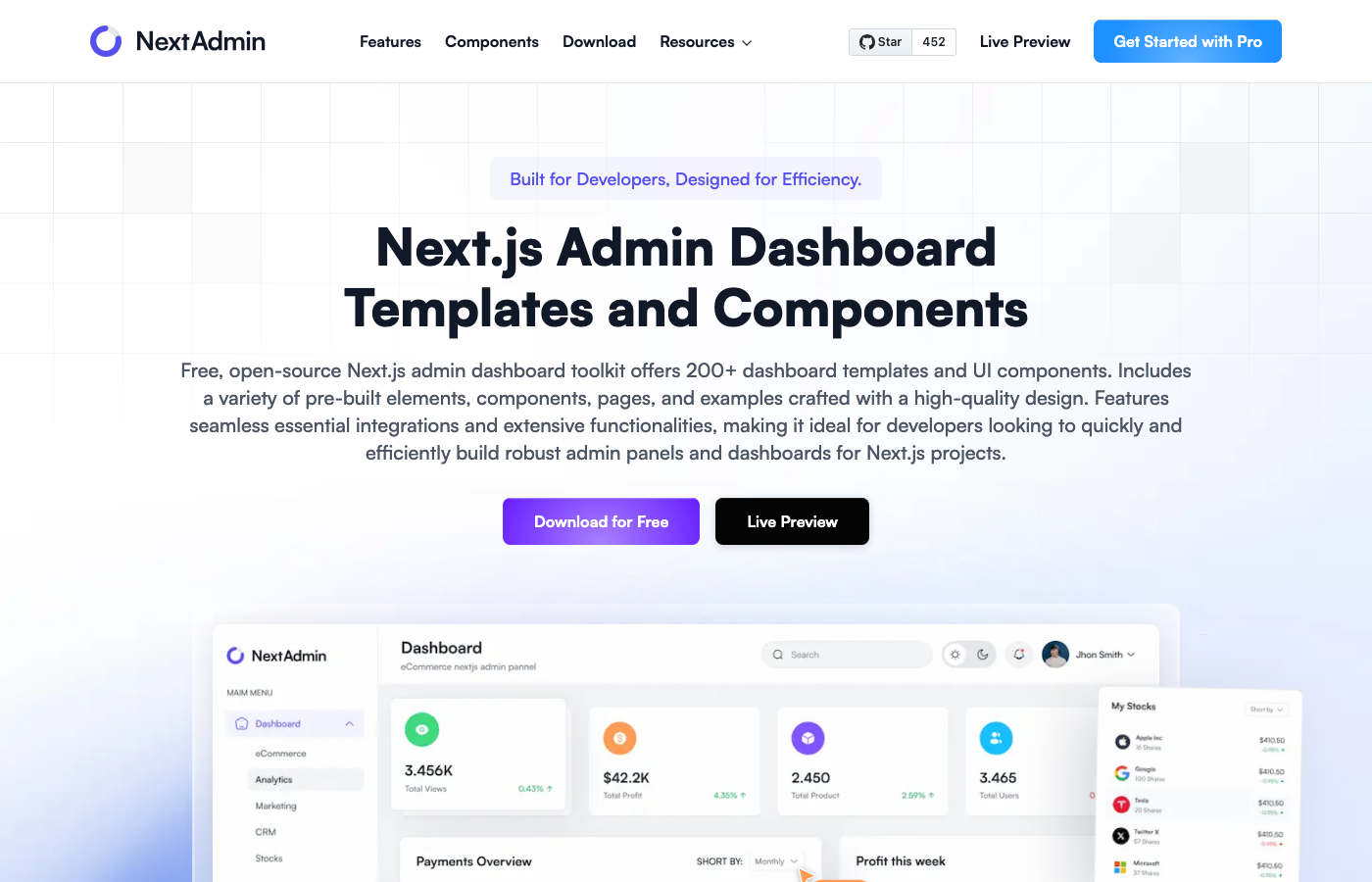
Why we like it: 451 stars, polished design that doesn’t look like a typical free template — actively growing component library.
NextAdmin is built on Next.js 16 with Tailwind CSS and ships with pre-built UI components, charts, form elements, tables, and authentication pages. The design is polished — not the typical “free template” look — and the layout system feels well thought out for real-world admin use cases.
The component library is growing actively, with new elements being added regularly. The one caveat: check the license situation before using it commercially, as the repo doesn’t specify a license file at the time of writing. For personal projects and prototyping, it’s a solid pick with a clean, modern aesthetic.
Need more options? Explore our comprehensive guide to free admin panels across all frameworks.
24. Modernize Next.js Free
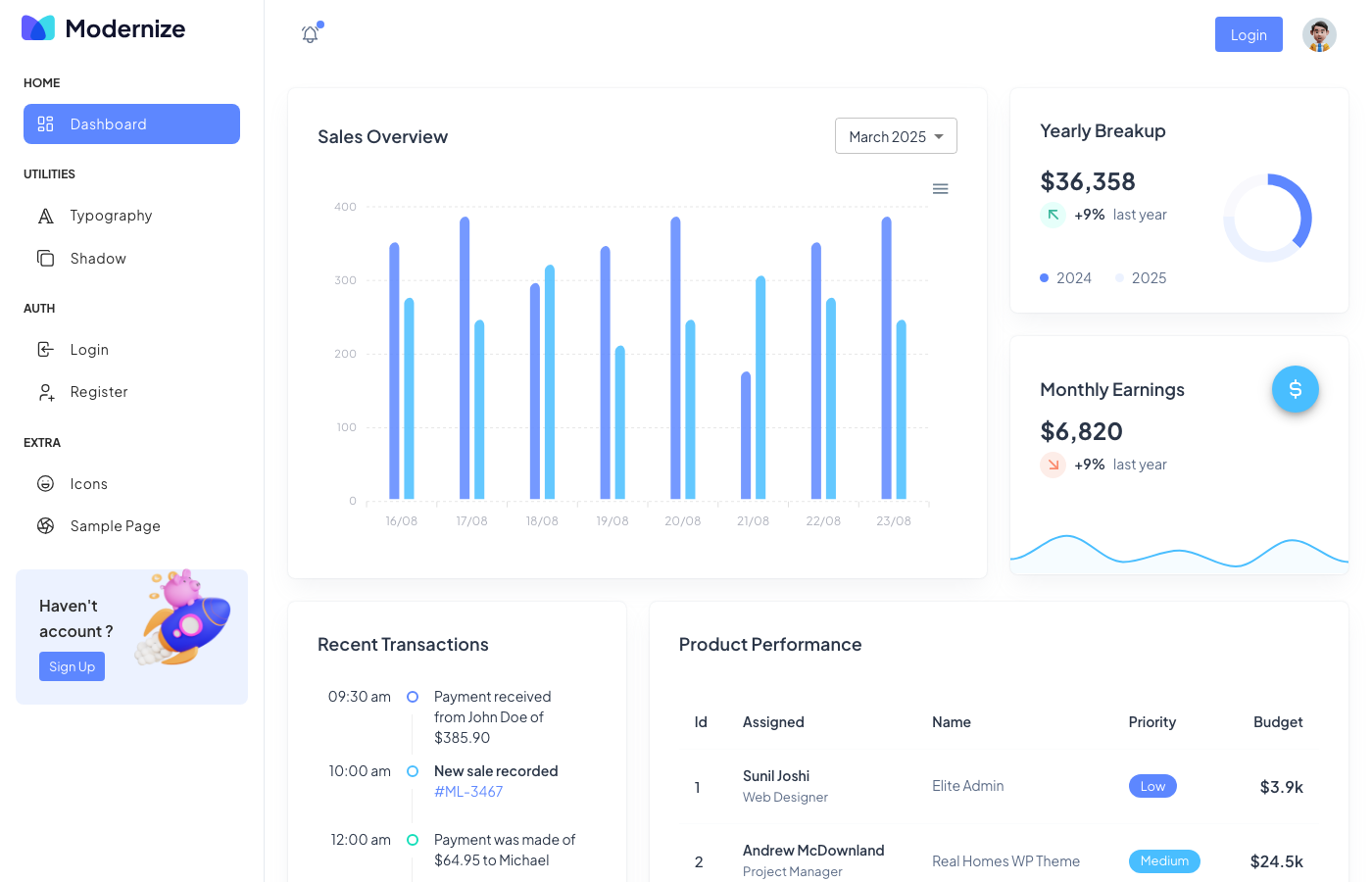
Why we like it: 403 stars, MUI + Tailwind combo gives you both structured components and low-level design control in one codebase.
AdminMart’s Modernize brings a clean Material Design aesthetic to Next.js without feeling heavy. The free version includes an analytics dashboard, data tables, form elements, icon sets, authentication pages, and a reusable component library. MUI handles the component layer while Tailwind CSS provides utility styling — a combination that gives you both structured components and low-level design control.
The codebase is organized for scalability, which matters more than people think when a “quick internal tool” turns into a product six months later. If you like Materio (#11) but want a different visual take on the Material Design + Next.js formula, Modernize is worth a look.
25. Mantine Analytics Dashboard
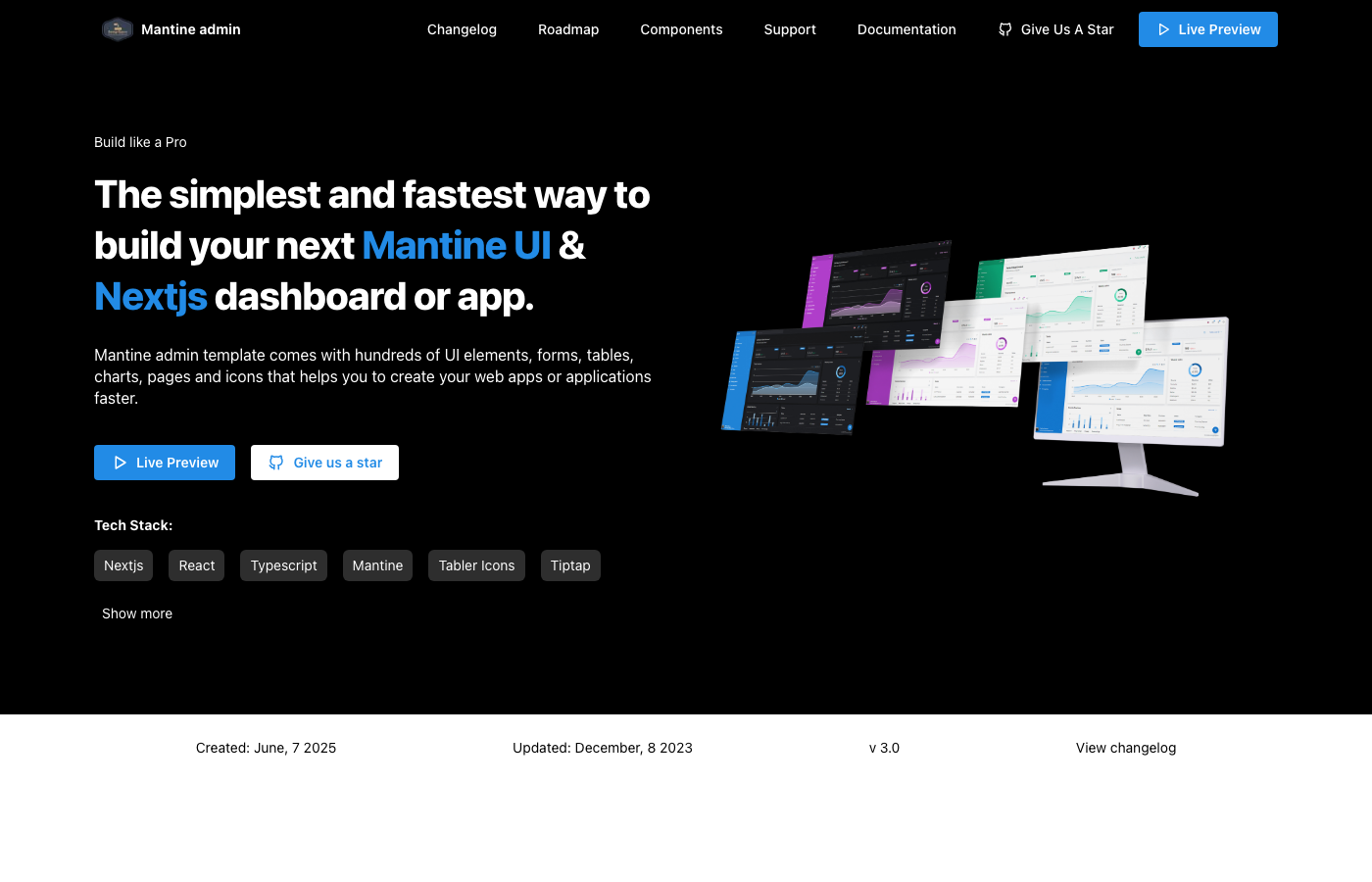
Why we like it: 354 stars, the best free Next.js dashboard in the Mantine ecosystem — drag-and-drop, rich text editor, calendar, and NextAuth included.
Here’s something different from the Tailwind and MUI crowd. This dashboard is built entirely on Mantine 9, a React component library with its own design system and PostCSS-based styling. The feature list reads like a premium template: ApexCharts visualizations, Mantine DataTable, drag-and-drop via dnd-kit, a full calendar, rich text editor (Tiptap), map visualization, and NextAuth authentication.
If your team prefers Mantine’s API over Tailwind’s utility classes or MUI’s sx prop, this is currently the best free Next.js admin template in that ecosystem. The analytics focus means charts and data displays are first-class citizens, not afterthoughts. Running on Next.js 16 and React 19 with TypeScript throughout.
26. Horizon UI Chakra Next.js
Maintenance: last commit January 2025 — more than a year and a half ago. It still installs, but the framework has shipped major releases since, so budget time to update dependencies yourself and check anything that touches build tooling.
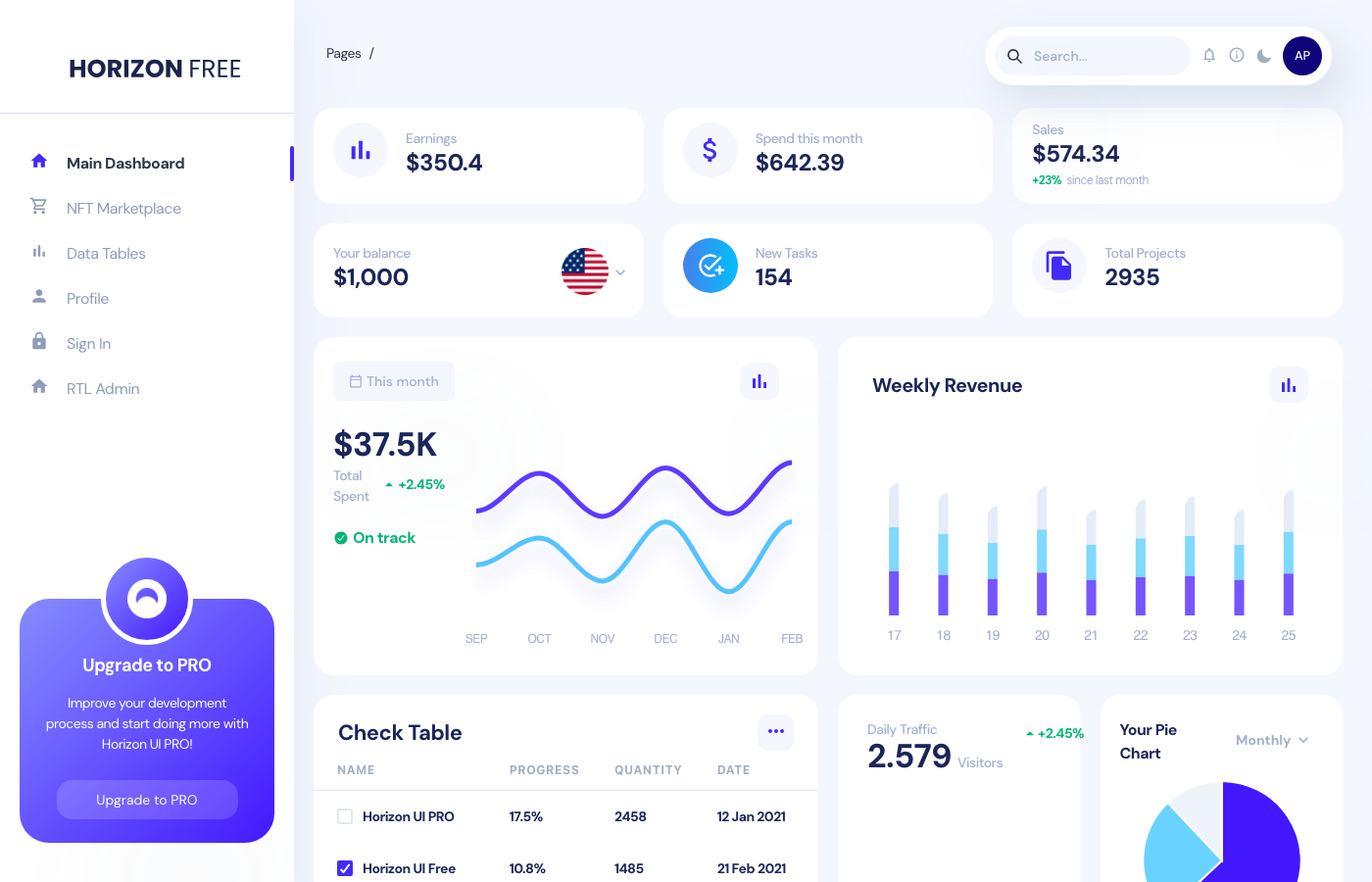
Why we like it: 310 stars, distinctive gradient-accented design with a unique NFT marketplace page you won’t find in other free templates.
Horizon UI’s Chakra variant stands out with a distinctive modern design — gradient accents, card-based layouts, and a visual direction that feels more “fintech app” than “corporate admin.” The free version includes dashboard analytics, an NFT marketplace page, data tables, a profile page, and authentication flows.
Chakra UI’s component system handles theming and responsiveness elegantly, and the TypeScript codebase is well-structured. The NFT marketplace page is a unique addition you won’t find in other free templates, which makes this particularly interesting for crypto/web3 projects. If you want your admin panel to look different from every other Material Design dashboard out there, Horizon’s aesthetic delivers.
For more React-specific admin solutions, see our collection of React admin templates.
27. Dash UI Next.js
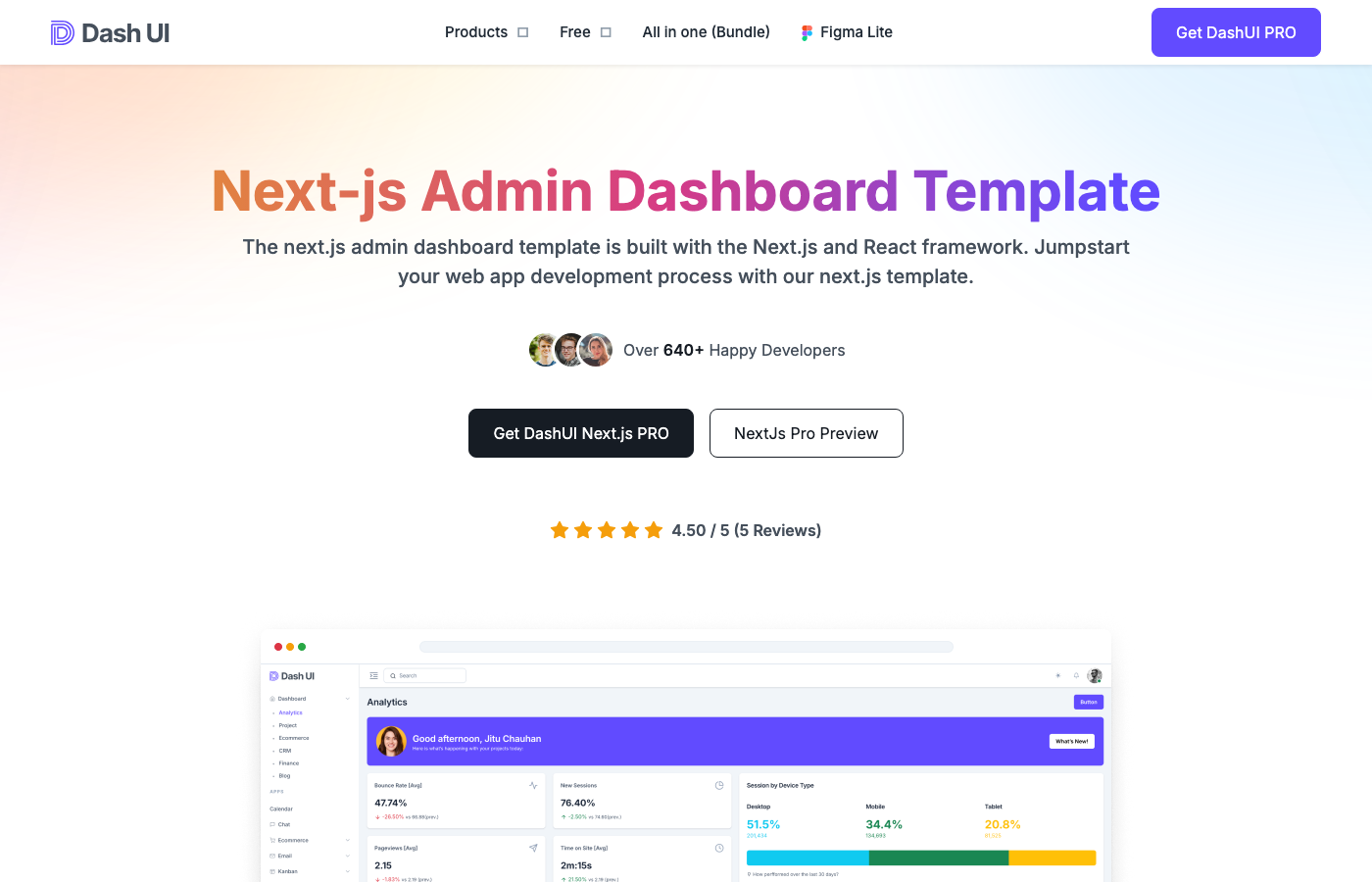
Why we like it: 172 stars, dependable and straightforward — multiple layout configs and reusable component library for rapid prototyping.
Dash UI by CodeScandy delivers a clean admin dashboard with an analytics overview, e-commerce product pages, user lists, form elements, and authentication pages. The navigation system supports multiple layout configurations, and the component set covers the essentials without bloating the codebase.
Built on Next.js 16+ with Bootstrap, it targets developers who want a familiar CSS framework paired with React’s component model. The reusable component library and multiple page layouts make it practical for quick prototyping. Not the flashiest option on this list, but dependable and straightforward — sometimes that’s exactly what a project needs.
Exploring different admin template ecosystems? Our guide to Tailwind admin dashboards covers the non-Next.js side of things.
28. Next.js Ant Design Admin
Why we like it: 162 stars, enterprise-grade Ant Design components with Auth0, Mapbox, and styled-components — a stack you’d expect from a production internal tool.
Rounding out the list, this Ant Design-based dashboard brings a distinct enterprise flavor to Next.js. Auth0 authentication, Mapbox map integration, data visualization, form management, and styled-components for custom theming — it’s a stack you’d expect from a production internal tool, not a free template.
Ant Design’s component library is massive and battle-tested in enterprise environments (it powers half the admin panels in Chinese tech companies). If your project leans toward data-heavy interfaces with complex form workflows, Ant Design’s form handling and table components are hard to beat. The styled-components layer gives you full control over visual customization without fighting the design system.
Maintenance note: this project has been quiet since 2023. It remains a reasonable reference for wiring Ant Design into Next.js (it predates the App Router), but verify the dependency versions before starting anything new on it.
Choosing the Right Next.js Admin Dashboard
Twenty-eight templates is a lot to sift through, so here’s the quick decision framework. For maximum community support and the most battle-tested codebase, Next.js shadcn Dashboard Starter (#10) and Devias Kit (#11) lead the pack with nearly 6k stars each. If you need the most pre-built pages and components, Shadboard (#19) and TailAdmin (#12) give you entire application skeletons. For analytics-heavy products, Tremor (#21) and Mantine Analytics Dashboard (#25) are purpose-built for data visualization. And if you want a full-stack starter with real database integration, the Vercel Admin Dashboard (#15) is the only template on this list that ships with a working backend.
For premium options with domain-specific features, the DashboardPack collection (#1-7) covers everything from healthcare (Ember) to DevOps (Signal) to institutional finance (Fortress), each with 50-125+ pages and production-ready architecture.
The UI library split is worth paying attention to: seven templates use shadcn/ui, six use standalone Tailwind CSS, three run on Material UI, three on Bootstrap, and you’ve got single entries for Mantine, Chakra UI, and Ant Design. Pick the design system your team already knows — switching UI libraries mid-project is nobody’s idea of a good time. And don’t sleep on the lower-starred entries. Templates like Shadboard and Admin One punch well above their star counts in terms of code quality and design. Always check the live demo and browse the source before committing — the right template is the one that fits your specific project, not the one with the highest star count.
Related reading: Next.js SaaS templates · Next.js ecommerce templates · Next.js portfolio templates · Next.js starter kits · Next.js templates complete guide.
Next.js Admin Dashboard FAQ
What is the best free Next.js admin dashboard template?
For most projects, a shadcn/ui-based template is the strongest starting point — you own the component code outright and it is built on the App Router with current React patterns. If you would rather install a maintained component library than copy code, the Material UI and Ant Design based options here are better fits. Check the last release date before committing: several well-known Next.js admin templates have been quiet since 2024.
Do these templates use the App Router or the Pages Router?
The newer entries target the App Router with React Server Components, while several older ones still use the Pages Router. This matters more than styling choice, because migrating a template between them is substantial work. Confirm which one a template targets before you start, and prefer App Router for anything new.
Are free Next.js admin templates good enough for production?
Yes, with two caveats. Free templates give you the interface, not the backend — authentication, authorisation, and data access remain yours to build. And maintenance varies enormously: an actively developed template saves you time, whereas an abandoned one quietly becomes your dependency-upgrade problem. Weigh the last commit date as heavily as the feature list.
What is the difference between a Next.js admin template and a starter kit?
An admin template is primarily UI — layouts, charts, tables, and app screens to wire to your own API. A starter kit typically bundles authentication, a database layer, and often billing, so it is closer to a working application. If your backend already exists, take the template; if you are starting a SaaS from zero, a starter kit removes more work.
Which UI library should I pair with Next.js for an admin panel?
shadcn/ui is the current default for teams that want control, since components are copied into your repository rather than installed. Material UI and Ant Design offer far more prebuilt components out of the box and are the pragmatic choice for data-heavy internal tools. Tailwind-based templates sit in between, giving styling freedom without prebuilt behaviour.
Can I use these templates commercially?
The free ones here are open source, mostly under MIT, which permits commercial and client use — check each licence, since a few use different terms. Premium templates are commercial licences with their own project limits. In both cases the licence covers the code, not the demo content, so replace placeholder images and copy before shipping.

You Might Also Like