Mantine vs Chakra UI vs MUI: React Component Library Comparison 2026
Mantine, Chakra UI, and MUI are the three most popular “batteries-included” React component libraries — each offering 50+ styled components, theming systems, and dark mode out of the box. But they’ve diverged significantly in 2026, with different approaches to CSS, performance, and ecosystem breadth.
We compared all three using current data: npm downloads, GitHub activity, component quality, bundle size, and real-world developer experience. This guide helps you choose the right library for your project without spending days evaluating each one. For another popular comparison, see our breakdown of shadcn/ui vs MUI vs Ant Design, which covers the headless component approach.
Quick Comparison
| Metric | Mantine | Chakra UI | MUI |
|---|---|---|---|
| GitHub Stars | 30,000+ | 38,000+ | 98,000+ |
| npm Weekly Downloads | ~700K | ~500K | ~6.7M |
| Current Version | v8.x | v3.x | v7.x |
| Components | 120+ | 60+ | 70+ (Core) |
| Hooks | 100+ | ~15 | ~10 |
| Styling | CSS Modules (v7+) | Panda CSS (v3) | Emotion / Pigment CSS |
| License | MIT | MIT | MIT (Core) / Paid (X) |
Mantine — Deep Dive
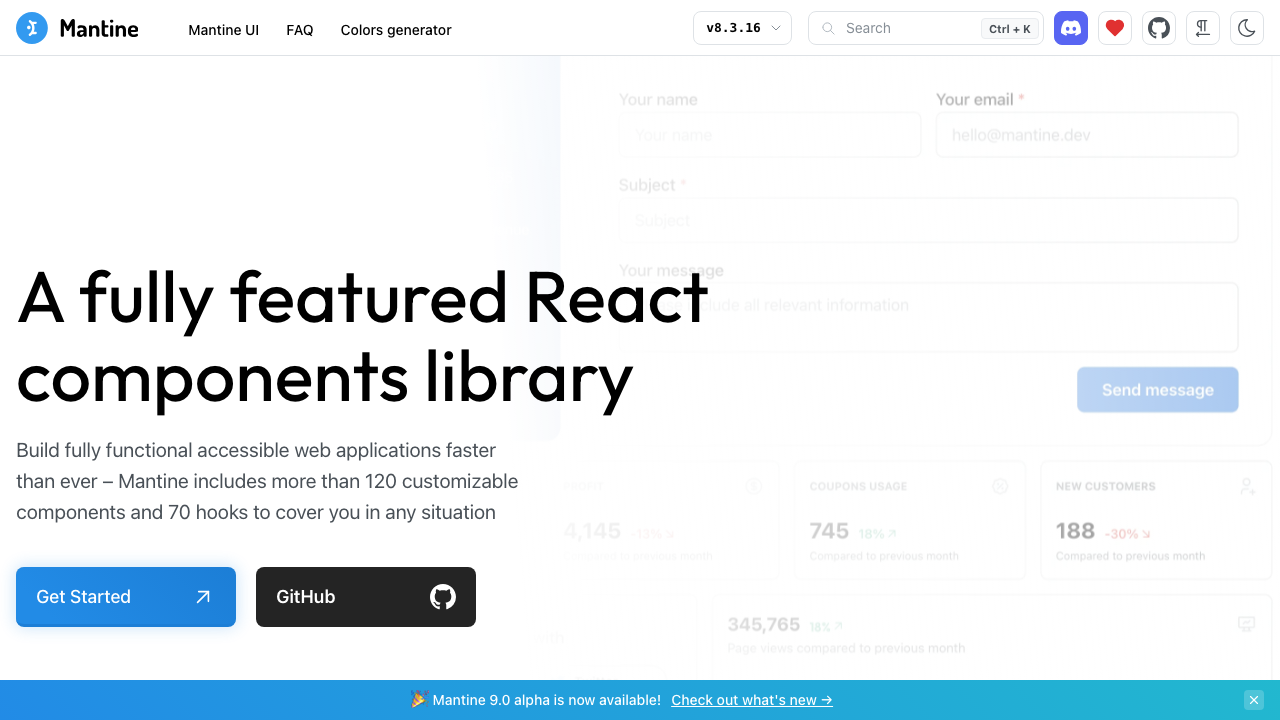
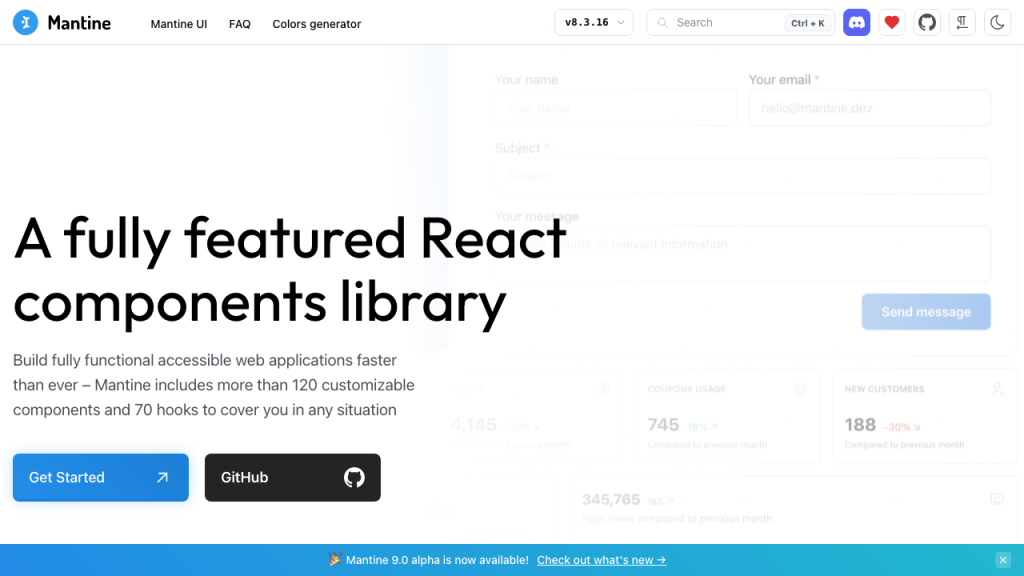
Mantine has quietly become the developer experience champion in the React component space. With 120+ components and 100+ hooks, it covers an extraordinary range — rich text editors (@mantine/tiptap), date pickers (@mantine/dates), notifications (@mantine/notifications), spotlight search (@mantine/spotlight), drag-and-drop, and code highlighting.
The v7 rewrite (late 2023) dropped Emotion for CSS Modules, eliminating the CSS-in-JS runtime entirely. This was a bold move that dramatically improved SSR performance and bundle size. The hooks library (@mantine/hooks) is valuable even if you don’t use the UI components — useLocalStorage, useIntersection, useClipboard, useDebounced, and dozens more.
Strengths
- Most components of any library — 120+ components covering use cases that MUI and Chakra require separate packages for.
- 100+ hooks — The
@mantine/hookspackage alone justifies the library. Standalone value. - No CSS-in-JS runtime — CSS Modules since v7. Better SSR performance than Emotion-based alternatives.
- Built-in form management —
@mantine/formhandles validation, dirty state, and error messages without extra libraries. - Rich text editor — Tiptap integration is pre-built. Neither MUI nor Chakra offer this.
Weaknesses
- Smaller community than MUI — Fewer StackOverflow answers, fewer third-party tutorials.
- CSS Modules migration — Teams on v6 (Emotion) face a non-trivial migration to v7+ patterns.
- Less enterprise adoption — Fewer Fortune 500 case studies compared to MUI.
- No premium data grid — No equivalent to MUI X Data Grid for complex enterprise tables.
Best For
Full-stack apps needing rich components (forms, dates, rich text, notifications), teams that value developer experience over enterprise pedigree, projects where SSR performance matters.
Chakra UI — Deep Dive
Chakra UI v3 (released late 2024) was a complete rewrite. It moved from Emotion to Panda CSS for styling, adopted Ark UI (built on Zag.js state machines) for component logic, and shipped as a modern design system. The migration from v2 was significant, and the community is still adjusting.
Chakra’s original value proposition was accessibility-first design with the simplest API in React. Style props like bg="blue.500" and px={4} made component styling intuitive. v3 maintains this philosophy but with a modernized architecture that addresses the CSS-in-JS performance concerns of v2.
Strengths
- Accessibility-first — Every component follows WAI-ARIA patterns. Historically the best a11y in the category.
- Simplest API — Style props are intuitive.
<Box bg="red.500" p={4}>reads like English. - Panda CSS (v3) — Zero-runtime CSS via build-time extraction. Best potential performance.
- Ark UI foundation — State machine-based component logic (Zag.js) is framework-agnostic and well-tested.
- Strong community — 38K+ stars, active Discord, extensive blog content.
Weaknesses
- v3 migration disruption — Complete API changes. Many teams still on v2. Ecosystem fragmented.
- Fewer components — 60+ components vs Mantine’s 120+. No built-in rich text, drag-and-drop, or spotlight.
- Declining downloads — npm downloads have decreased as developers evaluate the v2→v3 transition.
- Less TypeScript ergonomics — Style prop types can be verbose and harder to navigate than Mantine’s API.
Best For
Accessibility-critical applications, teams that love style props, projects starting fresh with v3 (don’t migrate existing v2 projects unless necessary).
MUI (Material UI) — Deep Dive
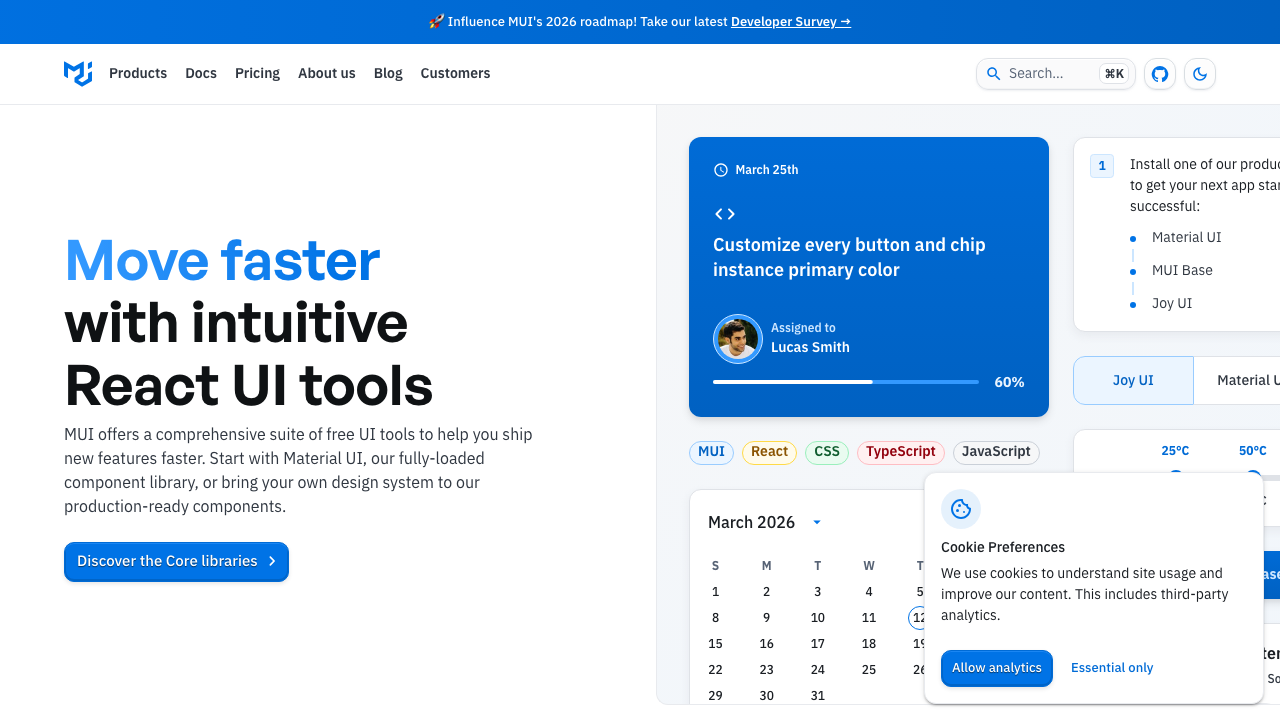
MUI remains the dominant React component library by a wide margin — 6.7 million weekly npm downloads, roughly 10x Mantine and 13x Chakra UI. Now at v7, it continues to evolve with CSS variables for runtime theming and Pigment CSS (experimental) for zero-runtime styling.
MUI X is the key differentiator for enterprise teams. The Data Grid (free and premium tiers), Date/Time Pickers, Charts, and Tree View are among the best React data components available. Netflix, Spotify, Amazon, and NASA use MUI in production.
Strengths
- Largest ecosystem by far — 6.7M weekly downloads. StackOverflow, tutorials, and third-party resources are abundant.
- MUI X enterprise components — Advanced Data Grid with grouping, aggregation, Excel export. No equivalent in Mantine or Chakra.
- Corporate backing — MUI SAS is a funded company. Commercial support, enterprise SLAs, long-term stability.
- Material Design system — Instant professional appearance for enterprise dashboards. See our React admin templates collection for dashboards built with MUI and other libraries.
- Most proven — Used by Fortune 500 companies in production for years.
Weaknesses
- Emotion runtime overhead — CSS-in-JS has measurable cost. Pigment CSS (zero-runtime) is still experimental.
- Complex API surface —
createTheme(),sxprop,styled(), component slots — many patterns to learn. - Material Design fatigue — Apps look “Google-like” without significant theme customization effort.
- Paid tier for advanced features — MUI X Pro/Premium requires commercial licenses for data grid power features.
- Painful migrations — v5→v6→v7 each required significant codebase changes.
Best For
Enterprise dashboards, teams needing advanced data grids, Material Design adherents, projects where ecosystem size and corporate backing matter most.
Head-to-Head
| Category | Winner | Why |
|---|---|---|
| Component Count | Mantine | 120+ vs 70+ (MUI) vs 60+ (Chakra) |
| Hooks Library | Mantine | 100+ hooks — no contest |
| Accessibility | Chakra UI | Accessibility-first philosophy since v1 |
| Enterprise Data | MUI | MUI X Data Grid is best-in-class |
| SSR Performance | Mantine | CSS Modules have zero runtime; Chakra v3 Panda CSS is close |
| API Simplicity | Chakra UI | Style props are the most intuitive API design |
| Community Size | MUI | 10x+ downloads vs alternatives |
| Form Handling | Mantine | Built-in @mantine/form with validation |
| Rich Text Editor | Mantine | Built-in Tiptap integration; others have nothing |
| Documentation | MUI | Most comprehensive, interactive examples |
| Bundle Size | Tie: Mantine/Chakra v3 | Both avoid CSS-in-JS runtime; MUI still uses Emotion |
| Growth Trajectory | Mantine | Fastest-growing of the three in 2025-2026 |
The Verdict
Choose Mantine if you want the most components and hooks out of the box, you need built-in rich text editing, forms, dates, or notifications, and you value SSR performance (CSS Modules, no runtime). Mantine is the strongest all-around choice for new projects in 2026.
Choose Chakra UI if accessibility is your top priority, you love the style props API, and you’re starting a new project (don’t migrate from v2 unless you have a specific reason). Chakra v3’s Panda CSS architecture is excellent, but the ecosystem is rebuilding after the rewrite.
Choose MUI if you need advanced data grid features (MUI X), your enterprise requires commercial support, or your team has existing MUI expertise. MUI’s ecosystem size means any problem you encounter has likely been solved before on StackOverflow. For ready-made dashboards using Material Design, explore our Material Design admin templates roundup.
The trend: Mantine is quietly winning the developer experience war. Its component count, hooks library, and CSS Modules approach put it in the strongest position for 2026-2027. But MUI’s enterprise moat (data grid, commercial support, ecosystem) and Chakra’s accessibility focus mean all three will remain relevant for different use cases.
You Might Also Like