
13 Best Next.js Starter Kits & Boilerplates 2026 (Free + Premium)
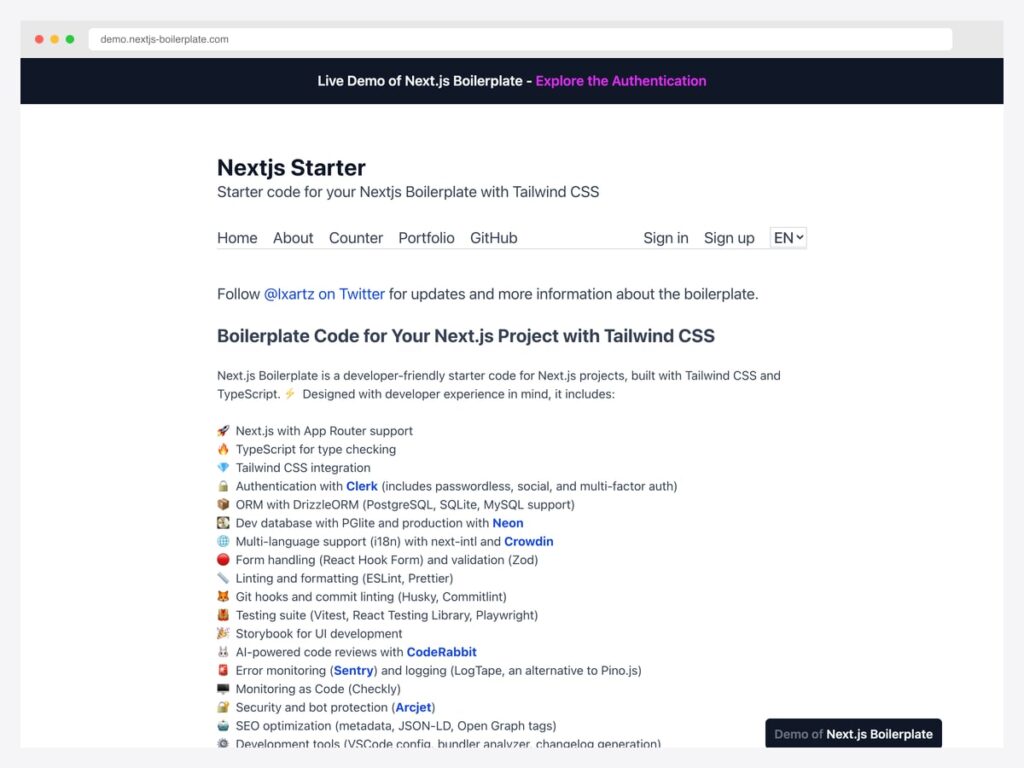
Looking for a Next.js starter kit or boilerplate that ships with TypeScript, Tailwind, testing, and CI all wired in — not just create-next-app defaults? These 13 picks are the foundational templates devs reach for when starting any new Next.js project: T3 Stack (28.9k stars) for type-safe full-stack, Refine (34.8k stars) for CRUD admin meta-framework, ixartz Next-js Boilerplate (12.9k stars) with developer experience first, plus premium options with multi-tenancy and Stripe pre-wired. Every demo and repository is re-checked before we republish this page.
A 2026-grade Next.js starter kit handles the framework-level plumbing every project needs regardless of vertical: TypeScript with strict mode, Tailwind CSS v4 (or your styling solution), ESLint + Prettier (or Biome), Husky + Lint-Staged git hooks, Vitest or Jest for unit tests, Playwright for E2E, Storybook for component dev, App Router with Server Components, environment variable validation (T3 Env or similar), and CI workflows via GitHub Actions. Wiring all of that yourself takes 40-80 hours — these starters give you a working baseline in minutes.
We’ve grouped the 13 picks below into premium Next.js boilerplates with multi-tenancy / billing (Next.js Boilerplate Pro by ixartz) and free / open-source starters and foundational kits (T3 Stack, Refine, ixartz Next-js Boilerplate, create-next-app, Vercel examples, Precedent, Saasfly, next-saas-stripe-starter, Skolaczk, hadrysm, ghbishal, shadcn next-template). Both opinionated CLIs (create-t3-app) and clone-and-customize templates included.
For product-specific boilerplates (SaaS, ecommerce, blog, portfolio, landing pages, AI chatbot), see our vertical roundups: Next.js SaaS templates, Next.js ecommerce templates, Next.js blog templates, Next.js portfolio templates, Next.js landing page templates, and Next.js AI chatbot templates.
Quick Picks
- Best DX-first foundation: ixartz/Next-js-Boilerplate — 12.9k stars, Next.js 16 + Tailwind 4 + Drizzle + Clerk + Vitest + Playwright + Storybook + Sentry
- Best type-safe full-stack: T3 Stack — 28.9k stars, CLI-driven Next.js + tRPC + Tailwind + Prisma/Drizzle + Auth.js
- Best CRUD admin framework: Refine — 34.8k stars, React meta-framework for admin panels / dashboards / internal tools with Next.js SSR
- Best official scaffold: create-next-app — Vercel’s official Next.js scaffold, zero opinions, infinite flexibility
- Best examples collection: Vercel Next.js Examples — 100+ official examples (with-typescript, with-tailwindcss, blog-starter, etc.) maintained by Vercel
- Best opinionated starter: Precedent (Steven Tey) — 5.1k stars, Next.js + Clerk + Radix + Framer Motion + Vercel Analytics curated by Steven Tey
- Best Turborepo monorepo: Saasfly — 2.9k stars, Turborepo + tRPC + Kysely + Bun + Clerk + Stripe
- Best Auth.js + Prisma reference: next-saas-stripe-starter — 3k stars, Auth.js v5 + Prisma + Stripe + Neon + shadcn/ui
- Best premium with multi-tenancy: Next.js Boilerplate Pro (ixartz) — paid Pro/Max tiers adding multi-tenancy + Stripe to the free ixartz boilerplate
- Best Next.js minimalist: Skolaczk/next-starter — 990 stars, Next.js 16 + React 19 + Tailwind 4 + Drizzle + Auth.js + Stripe + Playwright
- Best Biome-based modern: hadrysm/nextjs-boilerplate — 224 stars, Next.js 16 + Biome + Vitest + Storybook + Base UI + T3 Env
- Best community starter: ghbishal/nextjs-boilerplate — community starter with Next.js 16 + Tailwind 4 + next-intl + T3 Env
- Best historical reference: shadcn-ui/next-template — 1.5k stars, archived but the canonical “shadcn/ui in Next.js” reference (now superseded by
npx shadcn init)
1. ixartz Next-js-Boilerplate
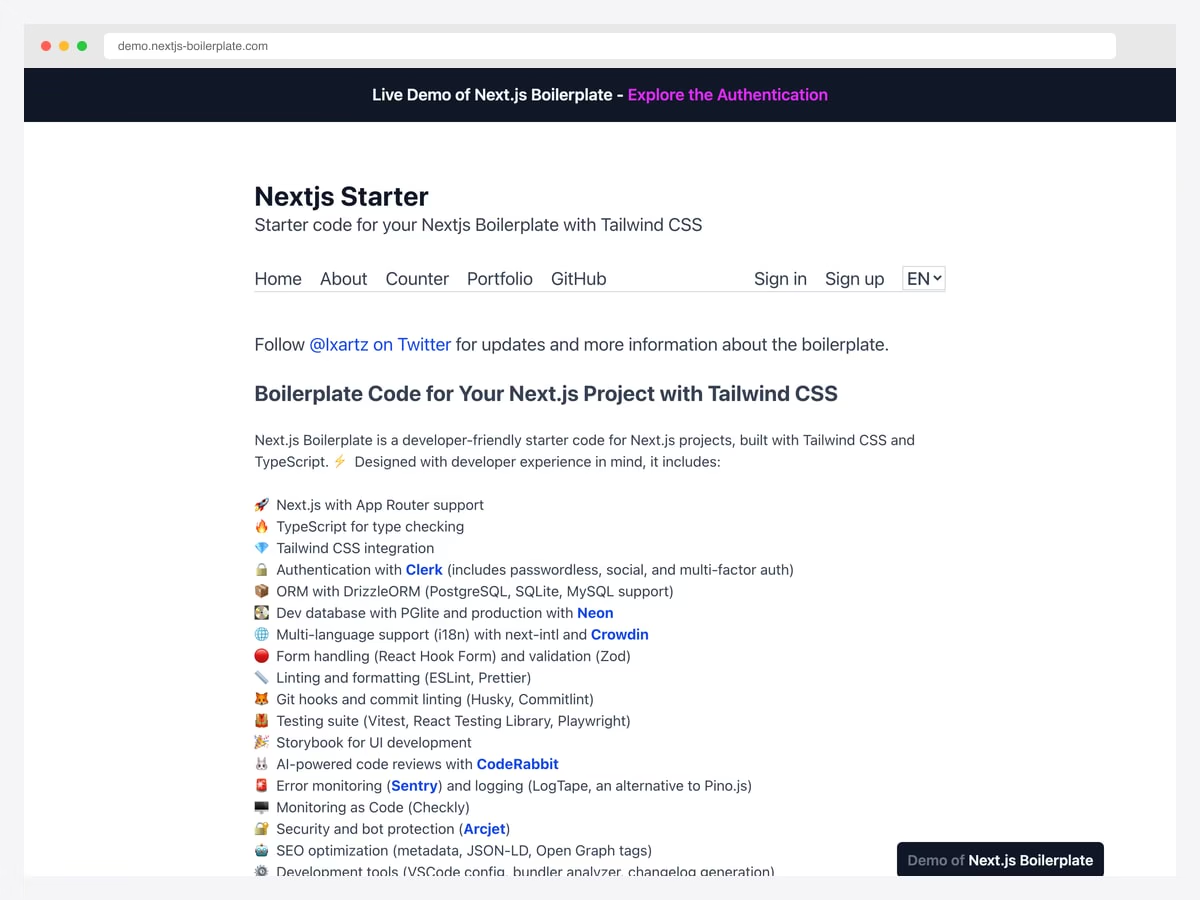
Why we like it: “Developer experience first” boilerplate with every tool you’d add yourself already wired in: Vitest + Playwright + Testing Library for tests, Oxlint + Oxfmt + ESLint + Prettier for code quality, Storybook for component dev, Clerk for auth, Sentry for monitoring, Arcjet for bot protection, Crowdin for i18n, and PGlite for local dev / Neon for production. App Router + Page Router both supported.
Note this is the frontend-focused ixartz boilerplate — not the same as ixartz/SaaS-Boilerplate, which builds on it with multi-tenancy and Stripe (see Next.js Boilerplate Pro / Max tiers below). Pick Next-js-Boilerplate when you want pristine tooling and will add SaaS-specific layers yourself.
2. T3 Stack (create-t3-app)
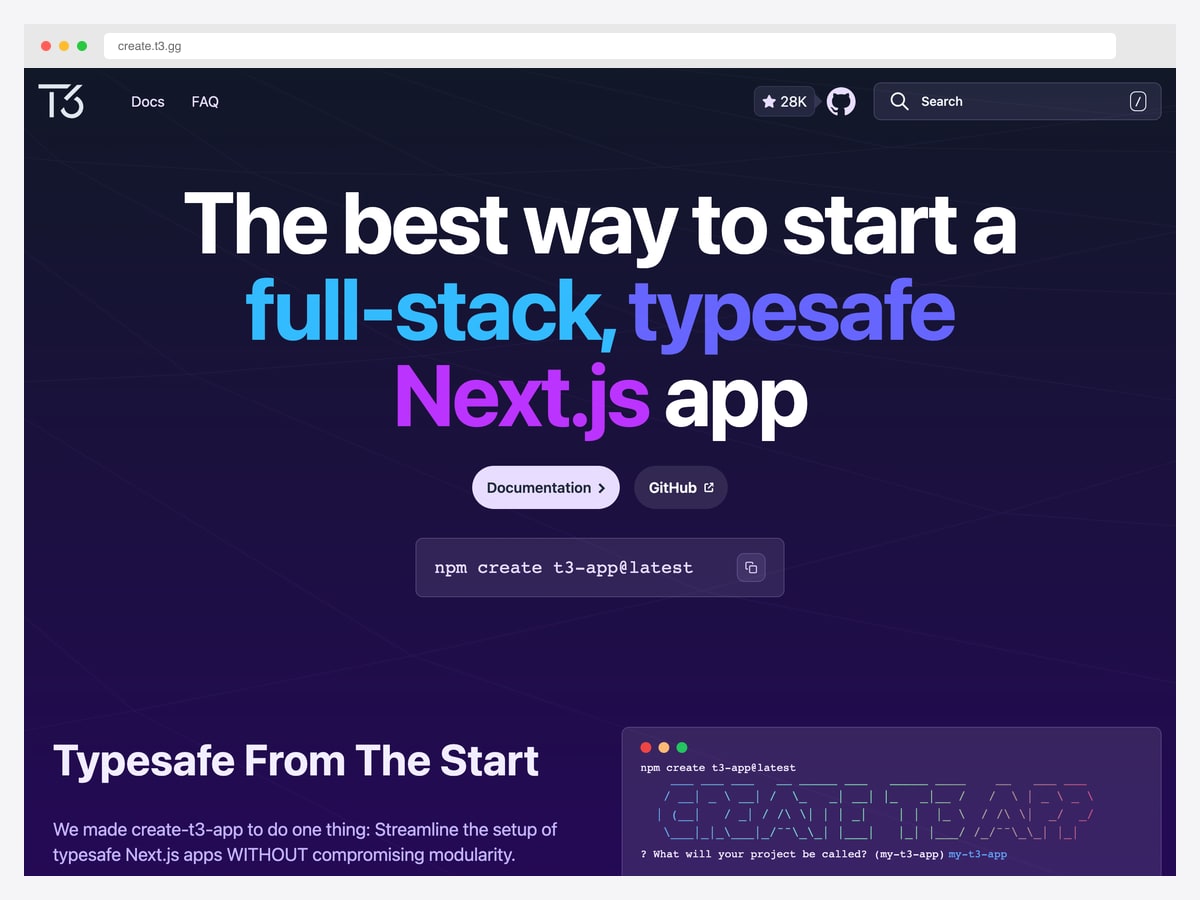
Why we like it: Interactive CLI (npm create t3-app@latest) that scaffolds a full-stack, type-safe Next.js application with your stack picks. Each technology component (tRPC, Tailwind, NextAuth, Prisma vs Drizzle) is optional — you opt into what you actually need. The T3 Stack philosophy: solve specific problems, bleed responsibly with emerging tech, enforce type-safety everywhere.
Caveat the README is explicit about: T3 is “NOT an all-inclusive template” — it’s a scaffolding layer. Pick T3 when you want to understand your full stack and customize every layer. Pick a more opinionated starter (Precedent, ixartz Boilerplate) when you want production decisions made for you.
3. Refine
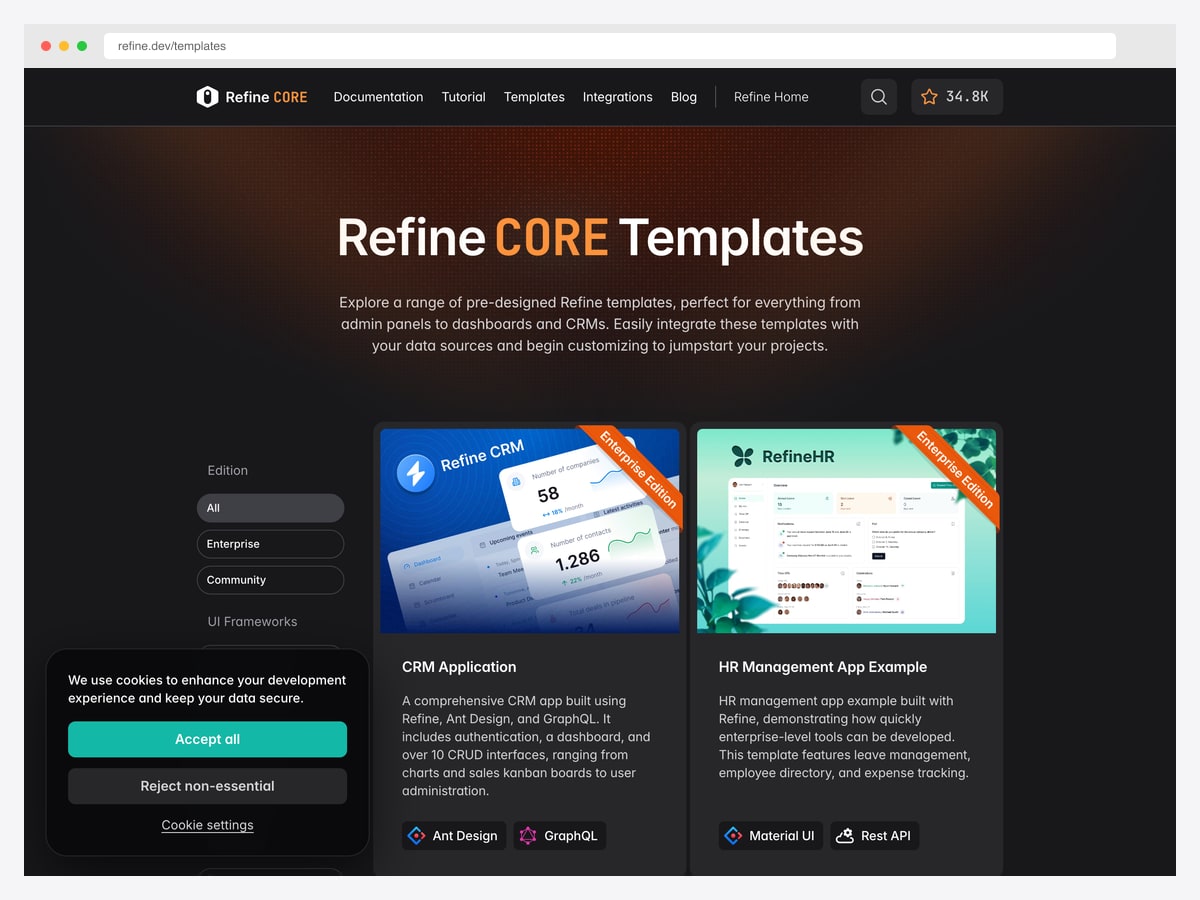
Why we like it: “A React meta-framework for CRUD-heavy web applications” with built-in support for SSR via Next.js (or Remix), authentication, access control, routing, and state management. “The sweet spot between low/no-code and starting from scratch.” Pre-built template examples: CRM, admin panel, PDF invoice generator, ecommerce storefront.
Best pick when your Next.js project is primarily admin / internal-tool / dashboard rather than customer-facing. Refine handles the CRUD boilerplate (lists, edit forms, validation, permissions, audit logs) so you focus on business logic. Supports any router library and many data providers (REST, GraphQL, Supabase, NestJS, Strapi).
4. create-next-app (Official)
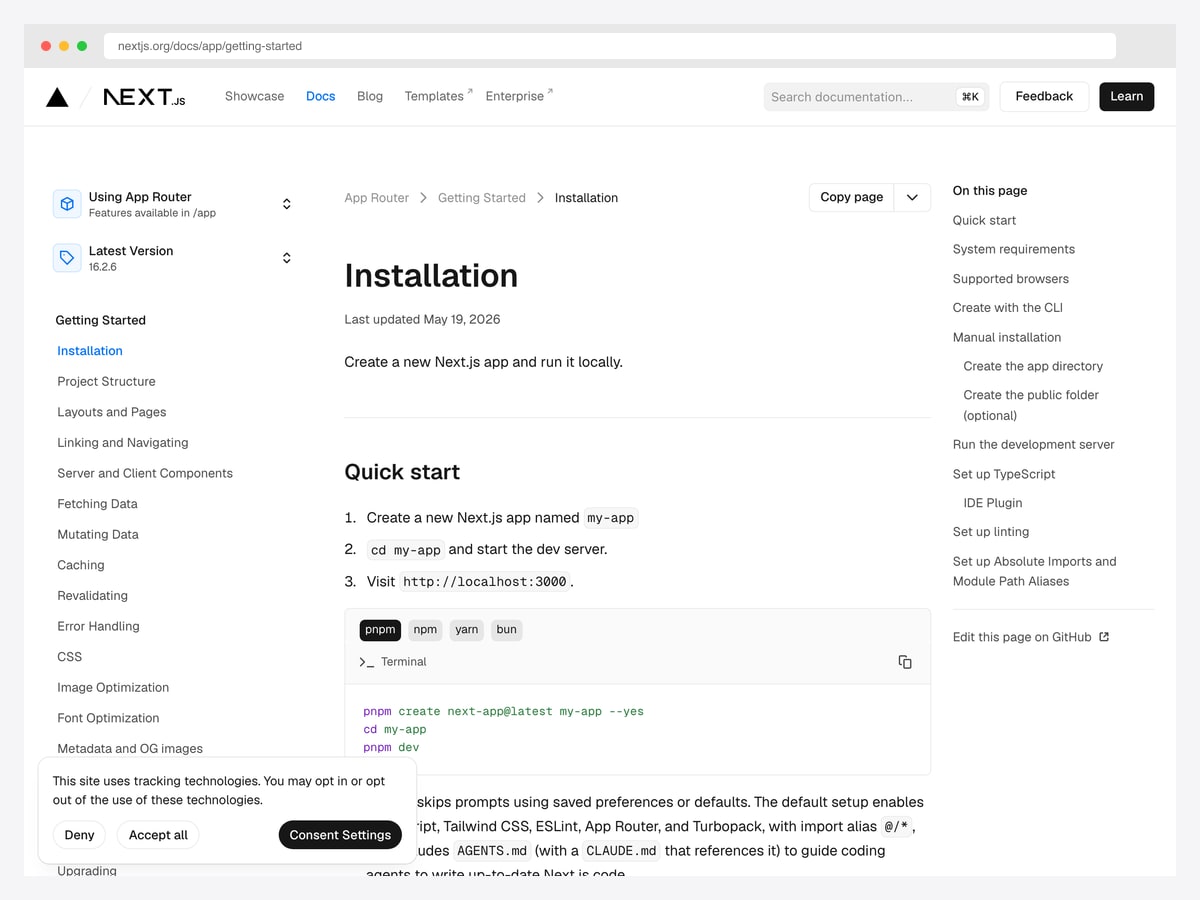
Why we like it: The official Next.js scaffold maintained by Vercel — npx create-next-app@latest gives you App Router, TypeScript, Tailwind CSS, ESLint, and the bare-minimum app shell with zero opinions about auth, payments, databases, or other infrastructure. The starting point Vercel themselves recommend for any new Next.js project.
Best when you want full control and minimal boilerplate to maintain — every other template on this list is built on top of create-next-app internally. Pick this when you’ll deliberately make every architectural decision yourself rather than inheriting someone else’s choices.
5. Vercel Next.js Examples Collection
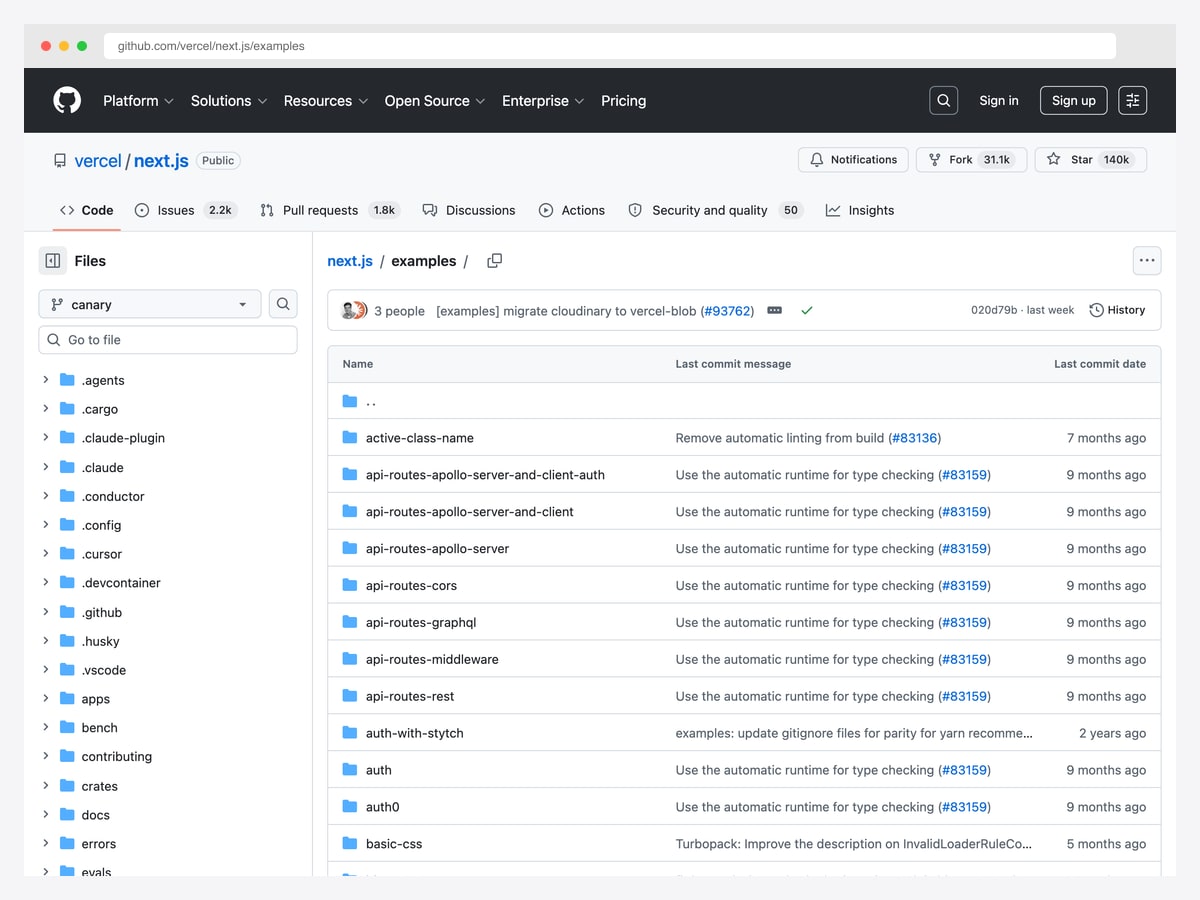
Why we like it: The examples/ directory in the official Next.js repo contains 100+ curated examples for common Next.js use cases. CMS integrations (Contentful, Sanity, Strapi, WordPress), styling solutions (Tailwind, Emotion, Chakra UI, Ant Design), API patterns (REST, GraphQL, Apollo), deployment (Docker, GitHub Pages), i18n routing, and minimal starters (hello-world, basic-css, custom-server).
Best when you want the canonical pattern for a specific integration rather than a complete boilerplate. Bootstrap any example with: npx create-next-app --example with-tailwindcss my-app (substitute the example name). These are maintained by Vercel + the Next.js community, so the patterns are always current with the latest Next.js release.
6. Precedent (Steven Tey)
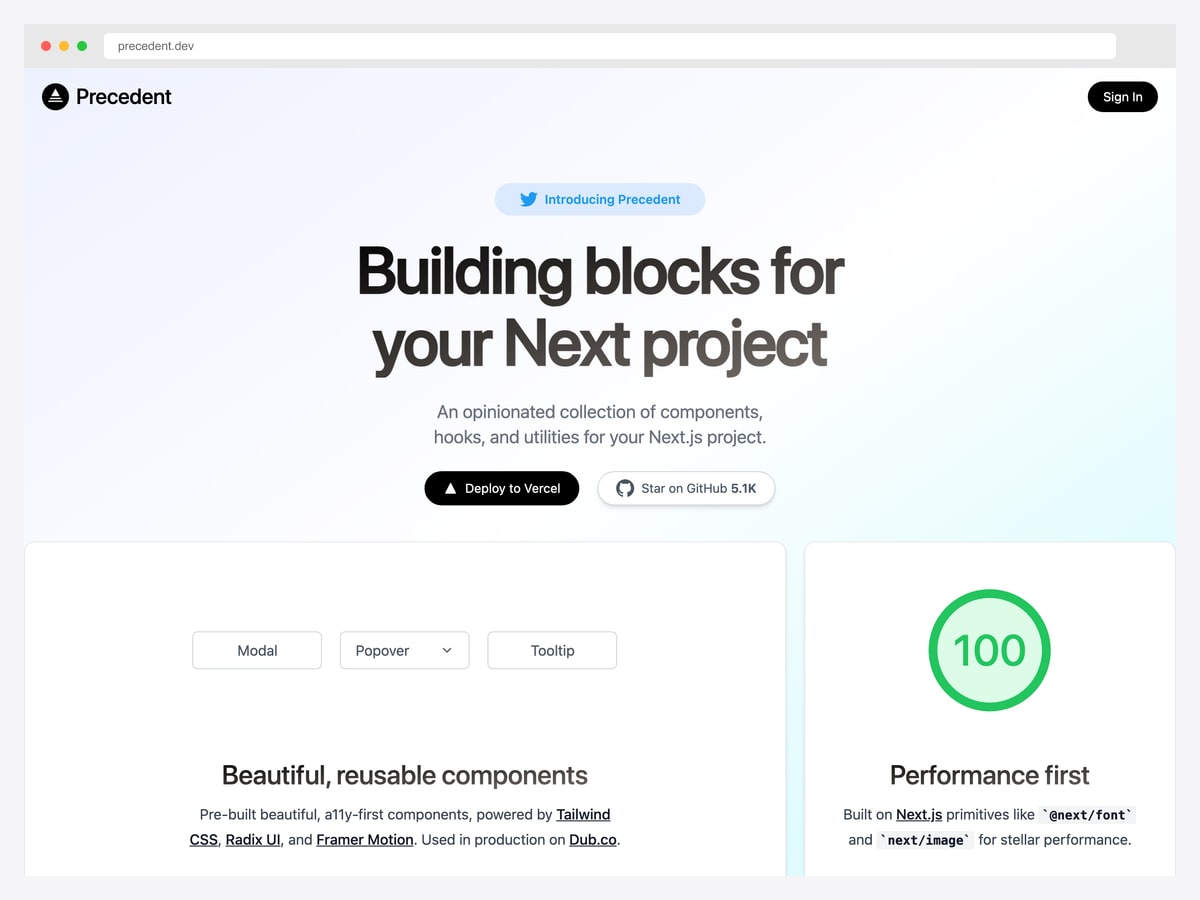
Why we like it: Steven Tey’s “opinionated collection of components, hooks, and utilities for your Next project.” Pre-built custom React hooks (useIntersectionObserver, useLocalStorage, useScroll), utility functions, and components. Clerk for auth, Radix UI primitives, Framer Motion animations, Lucide icons, dynamic Open Graph image generation, and Vercel Analytics integration baked in.
The opinionated curation is the value — Steven Tey shipped Dub.co, Novel, and other high-profile Next.js projects, and Precedent embodies the patterns he reaches for repeatedly. One-line install: npx create-next-app precedent. Best pick when you want a knowledgeable starting point rather than assembling tech choices yourself.
7. Saasfly
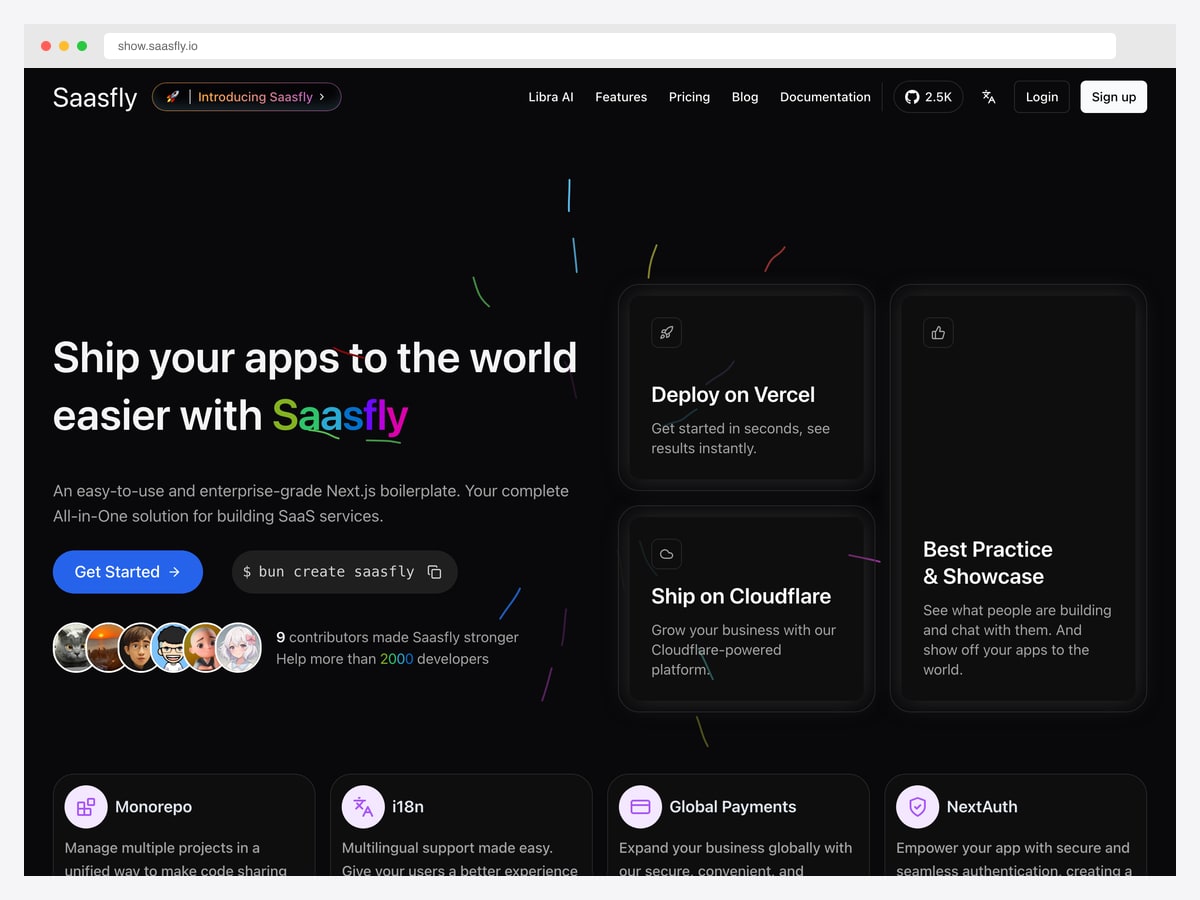
Why we like it: The cleanest monorepo starter in the Next.js ecosystem — Turborepo for build orchestration, tRPC for type-safe APIs, Kysely for SQL query building, and Bun as the package manager. Clerk handles auth, Stripe handles billing, Resend handles transactional email. App Directory throughout. Internationalization, SEO, and an admin dashboard (alpha) included.
Stable v1.0 released June 2025 by Nextify Ltd. — they offer enterprise support and free technical assistance to non-profit organizations. Best pick when you anticipate splitting frontend / backend / shared packages early in the codebase’s life, or when you want the modern Turborepo + Bun stack without configuring it yourself.
8. next-saas-stripe-starter (mickasmt)
Maintenance: last commit August 2024 — over two years ago. It still installs, but the framework has shipped major releases since, so budget time to update dependencies yourself and check anything that touches build tooling.
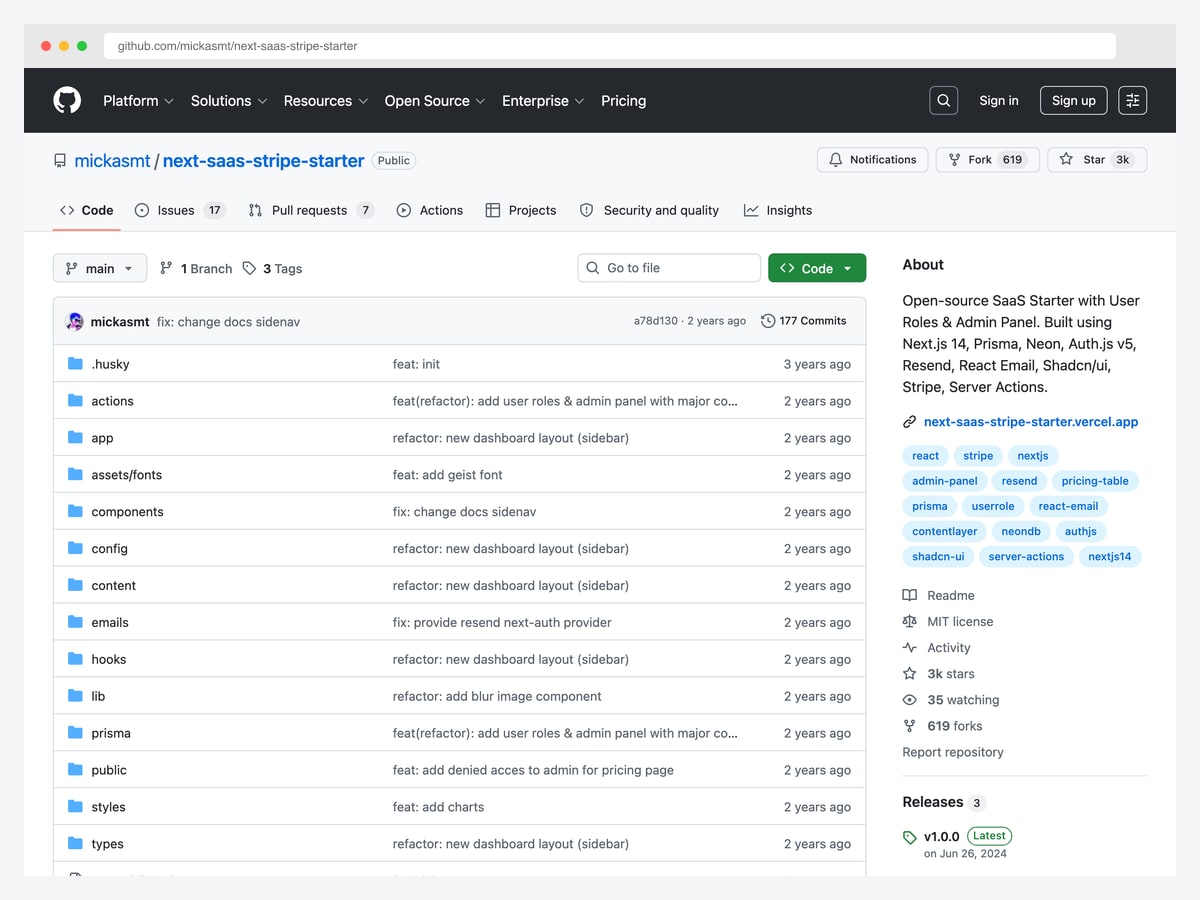
Why we like it: Open-source Next.js Starter with User Roles & Admin Panel — Auth.js v5 for authentication, Prisma for the ORM, Stripe for subscriptions, Resend for transactional email, Neon for serverless Postgres. shadcn/ui components and Framer Motion for animations. Server Actions throughout. The Auth.js v5 + Prisma + Stripe stack is what most tutorials reference, which makes this a strong learning template.
Built by @miickasmt in 2023, inspired by projects from shadcn, Steven Tey, and Antonio Erdeljac. One-line install: npx create-next-app my-project --example "https://github.com/mickasmt/next-saas-stripe-starter". Best when you’ve followed Auth.js docs and want a working complete example to learn from.
9. Next.js Boilerplate Pro / Max (ixartz)
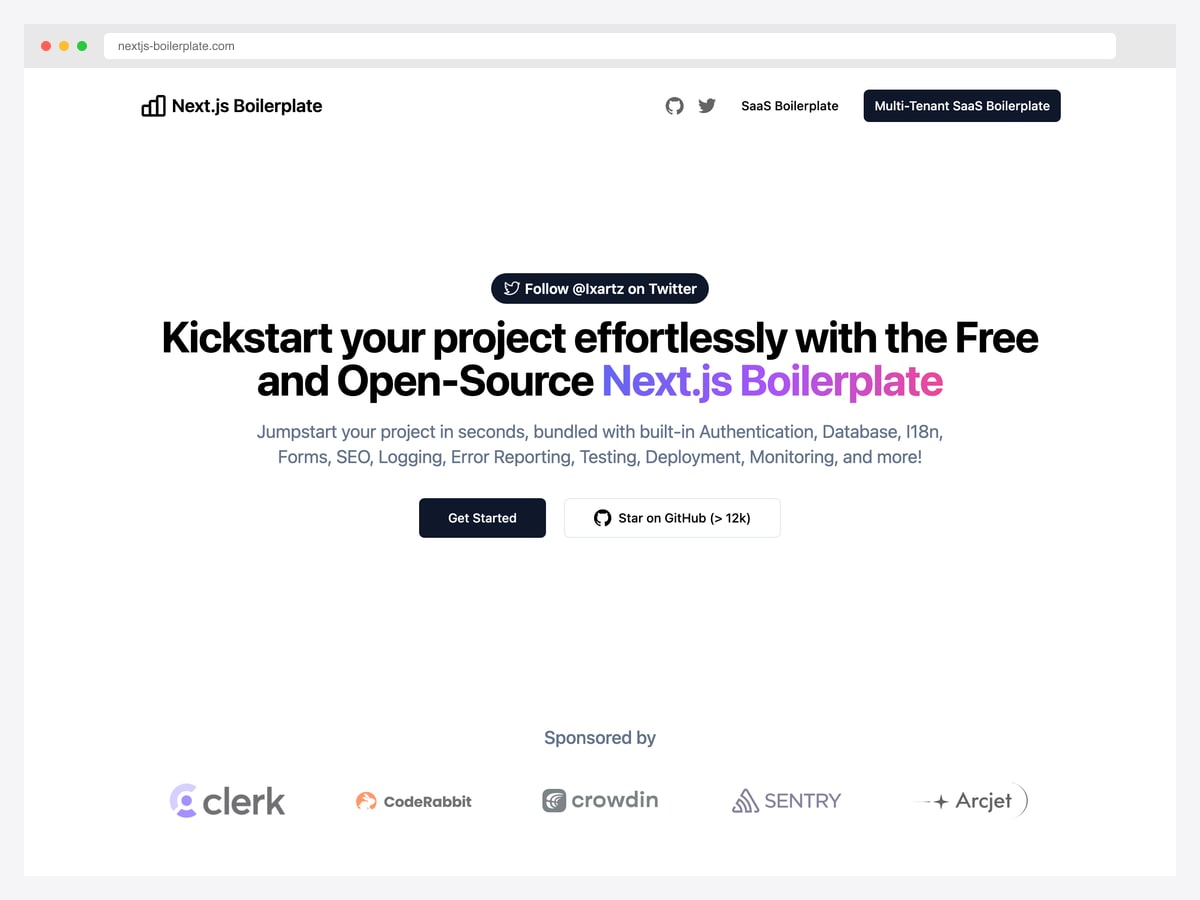
Why we like it: The paid upgrade path from the free ixartz/Next-js-Boilerplate (#1 above). Pro tier adds Next.js 16 + React 19 + dark mode + Stripe integration + multi-tenancy with organizations. Max tier swaps Clerk for self-hosted Better Auth, adds transactional emails and Bun support. Live demo at react-saas.com.
The tiered free → Pro → Max upgrade path is the cleanest “starter that grows with you” model in the React ecosystem. Start free, validate your product, pay only when the business case justifies the upgrade. No vendor lock-in — you own the code at every tier.
10. Skolaczk/next-starter
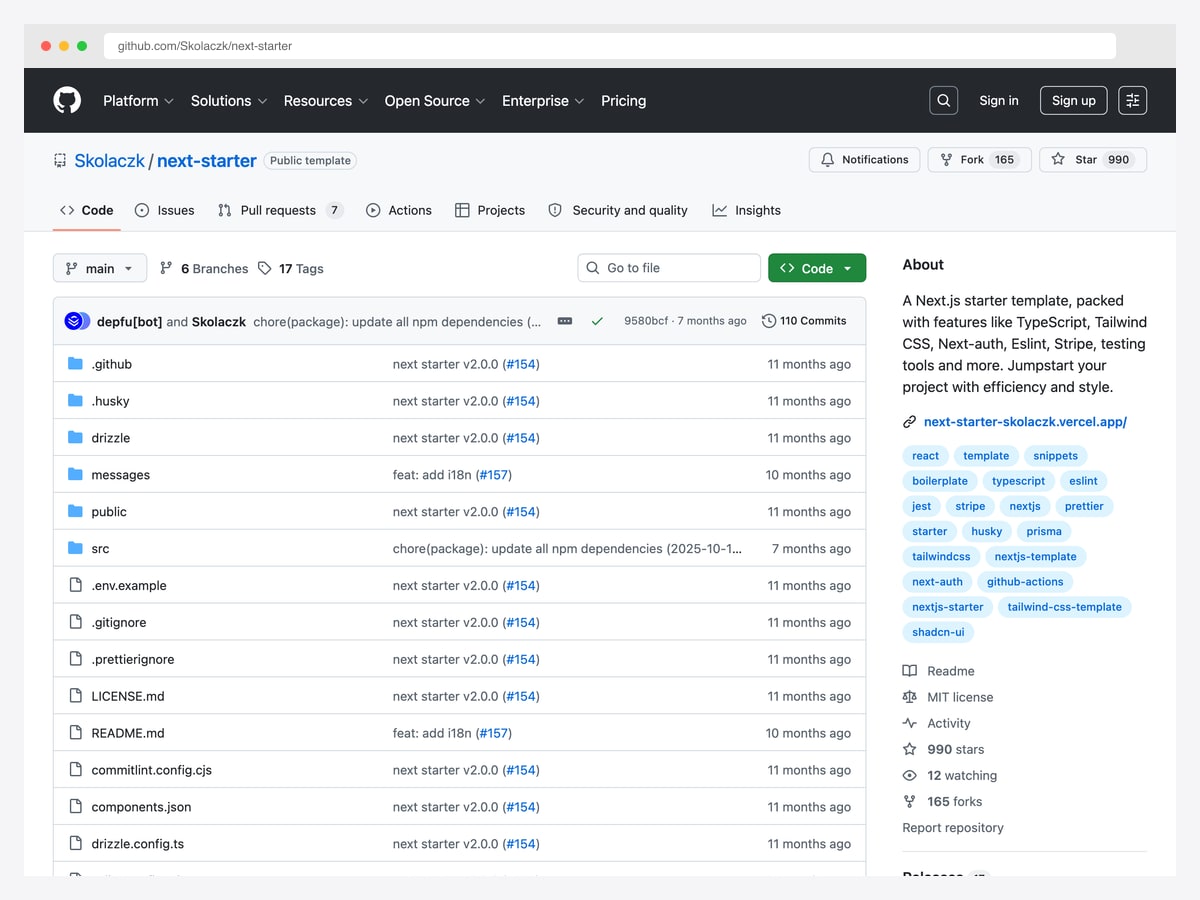
Why we like it: Cleaner minimalist alternative to ixartz/Next-js-Boilerplate — Next.js 16 with App Router and React 19, TypeScript and Tailwind CSS 4, Auth.js with GitHub provider, Stripe payments, shadcn/ui components, Drizzle ORM. Testing tools: Jest, React Testing Library, Playwright. Code quality: ESLint, Prettier, Husky, Commitlint. Internationalization with next-intl. Dark mode via next-themes.
Best free pick when you want the modern Next.js 16 + React 19 + Tailwind 4 stack without the deeper feature surface of ixartz’s boilerplate. The codebase is small enough to audit in an afternoon. MIT license.
11. hadrysm/nextjs-boilerplate
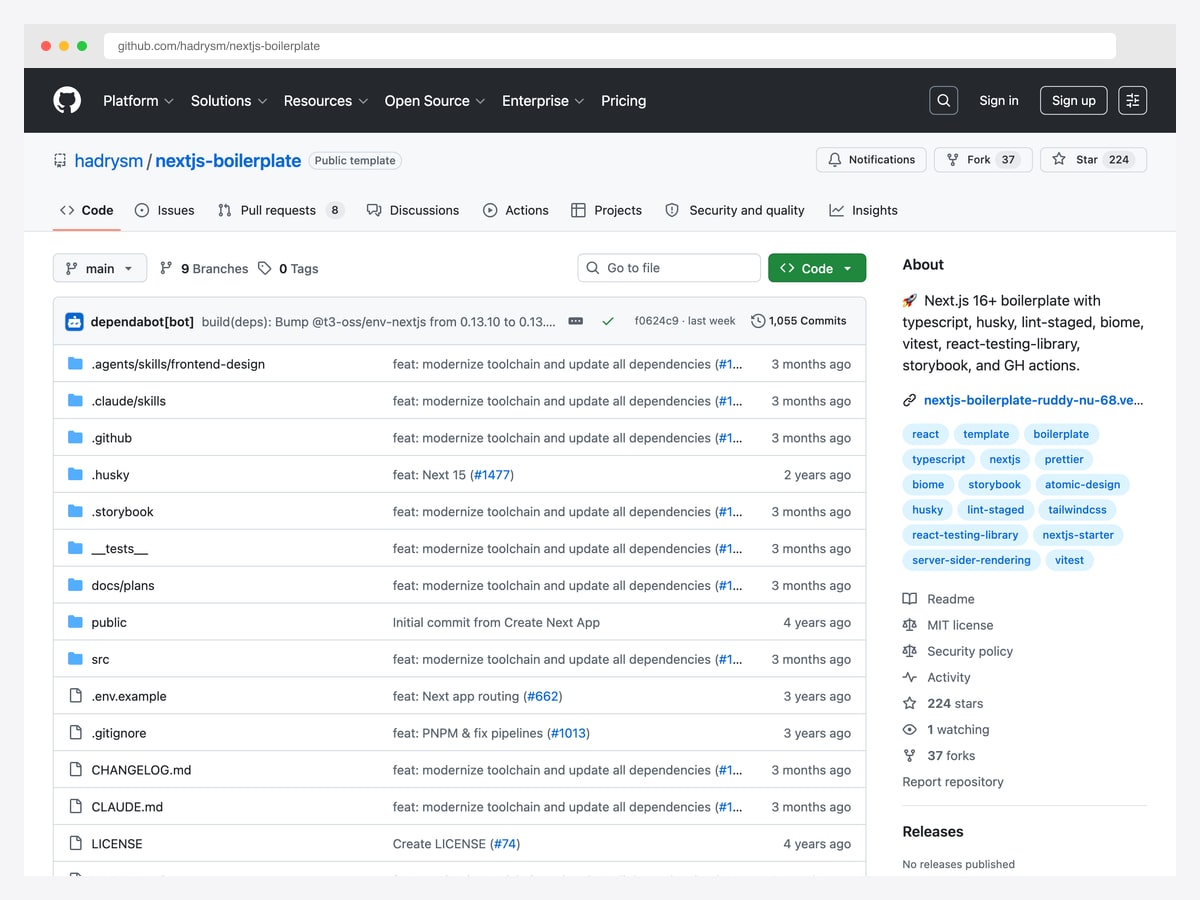
Why we like it: Next.js 16+ with App Router, TypeScript strict mode, Tailwind CSS 4 (CSS-first configuration), Vitest + React Testing Library, Biome for linting and formatting (faster ESLint + Prettier alternative), Husky + Lint-Staged git hooks, Storybook for component docs, dark mode via next-themes, CVA + Base UI for component variants, environment variable management with T3 Env, and GitHub Actions CI/CD.
The Biome adoption is the differentiator — Biome is significantly faster than ESLint + Prettier on large codebases and is increasingly the preferred tooling for new Next.js projects in 2026. Atomic design principles in the project structure. One-line install: pnpm create next-app -e https://github.com/hadrysm/nextjs-boilerplate.
12. ghbishal/nextjs-boilerplate
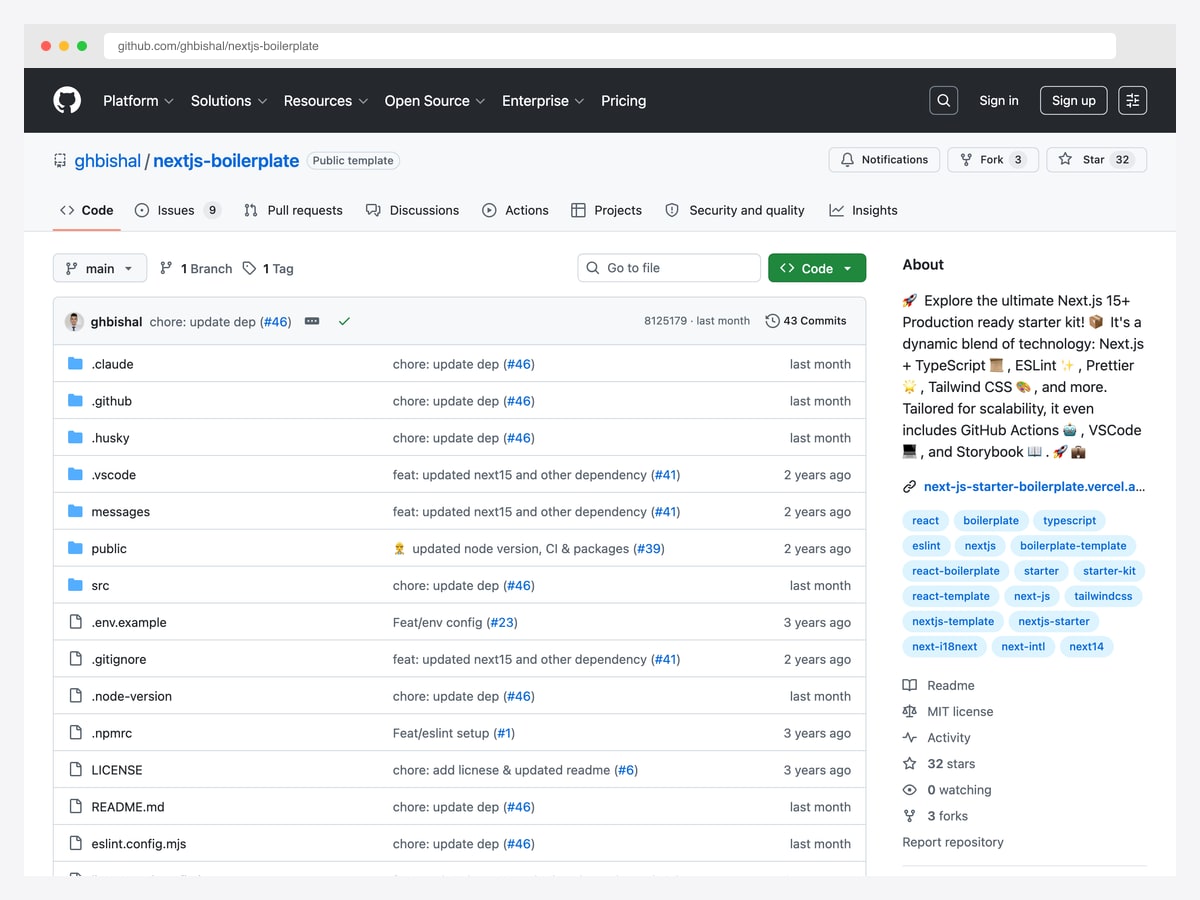
Why we like it: A community-driven starter that lands in the middle of the spectrum — more opinionated than create-next-app, less heavyweight than ixartz Next-js-Boilerplate. Next.js 16+ with App Router, TypeScript with enhanced type safety via ts-reset, Tailwind CSS utility-first, ESLint + Prettier, GitHub Actions CI/CD, next-intl for internationalization, Husky + Lint-Staged git hooks, pnpm package manager, T3 Env for type-safe environment variables, CVA for design systems.
Best when you want a minimalist starter with i18n already wired in — most starters skip internationalization, requiring you to bolt it on later. The ts-reset integration (Matt Pocock’s library that fixes TypeScript’s “any” gaps) is a quiet quality signal.
13. shadcn-ui/next-template (Archived Reference)
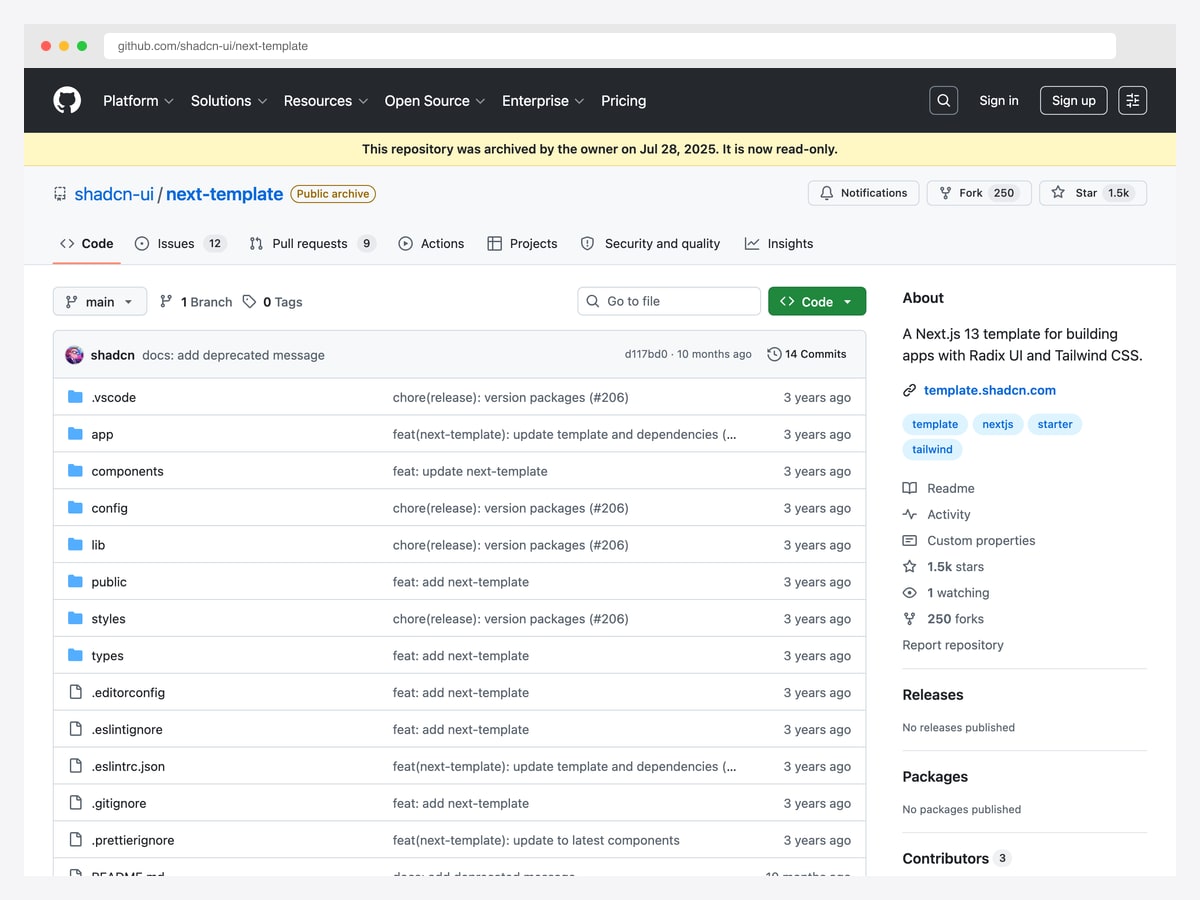
Why we like it: The original shadcn/ui in Next.js template — Radix UI primitives, Tailwind CSS, TypeScript, Lucide icons, next-themes for dark mode, automated CSS class optimization through sorting and linting. Officially deprecated in July 2025 in favor of the npx shadcn init CLI command, but still important as a reference for how shadcn/ui patterns first arrived in the Next.js ecosystem.
For new projects in 2026, use npx shadcn init (the official replacement) rather than forking this archived template. The patterns shown here still hold — the CLI just automates the setup steps. Worth knowing about for the historical context if you’re learning where shadcn/ui’s conventions come from.
How to Choose a Next.js Starter Kit
The right pick depends on what your project needs from day one:
- Want every modern tool wired in? ixartz/Next-js-Boilerplate or hadrysm/nextjs-boilerplate — both ship everything pre-configured.
- Type-safe full-stack from the start? T3 Stack — interactive CLI, you pick the stack pieces.
- Admin / dashboard / internal tools? Refine — purpose-built CRUD meta-framework.
- Maximum control with minimal opinions? create-next-app (official) — build everything yourself.
- Specific integration (CMS, auth, payments)? Vercel Next.js Examples — 100+ canonical patterns to reference.
- Curated starting point from a known practitioner? Precedent by Steven Tey — opinionated for production.
- Monorepo from day one? Saasfly — Turborepo + tRPC + Bun done right.
- Going to add Stripe billing eventually? next-saas-stripe-starter (free) or Next.js Boilerplate Pro (paid upgrade path).
- Need i18n from the start? ghbishal/nextjs-boilerplate or Skolaczk/next-starter — both ship i18n configured.
- Faster than ESLint + Prettier? hadrysm/nextjs-boilerplate — Biome configured.
Next.js Starter Kits FAQ
Starter kit vs. boilerplate vs. template — what’s the difference?
The terms are used loosely in 2026 — most projects label themselves with whichever marketing word sells. Rough definitions: Starter = minimal baseline (create-next-app, Vercel examples), used as a starting point you’ll customize heavily. Boilerplate = production-grade scaffolding with tooling pre-configured (ixartz Next-js-Boilerplate, hadrysm) — designed to save you 40-80 hours of setup. Template = product-specific (Vercel AI Chatbot, NextBlog) — comes with a complete vertical pre-built. This article covers starters and general-purpose boilerplates; product-specific templates are in our vertical roundups.
App Router or Pages Router for a new project in 2026?
App Router. Every starter on this list released or updated in 2026 defaults to App Router. React Server Components, Server Actions, and streaming are first-class only in the App Router. The Pages Router still works but is increasingly the “legacy” path. The only templates that still maintain Pages Router support (ShipFast, ixartz Next-js-Boilerplate) do so for backward compatibility — App Router is the recommended path for new projects.
How much should a starter kit save me?
A good starter saves 40-150 hours of setup work. The break-even math: ESLint + Prettier + Husky + Lint-Staged + commit hooks (4-8 hours), TypeScript strict + path aliases (1-2 hours), Vitest + Playwright + Testing Library setup (8-16 hours), Tailwind + dark mode + design tokens (4-8 hours), Storybook (4-8 hours), CI workflows (4-8 hours), auth scaffolding (12-24 hours), Stripe integration (16-30 hours), error monitoring (Sentry) (2-4 hours), i18n (8-16 hours), env validation (2-4 hours). Premium boilerplates ($200-600) save 200-400 hours of work — they typically pay back in week one if your hourly rate exceeds $50.
Biome or ESLint + Prettier for linting / formatting?
Biome is the modern Rust-based tool that combines linting and formatting in one binary — significantly faster than ESLint + Prettier (often 10-100× faster on large codebases). Hadrysm’s boilerplate is the only starter on this list that defaults to Biome. ESLint + Prettier is still the more deployed combo (every other starter uses it) because Biome’s rule coverage isn’t 100% parity yet. For new projects in 2026, Biome is increasingly the preferred choice; for existing codebases, the migration is usually deferred until Biome’s rule set fully matches your needs.
npm, yarn, pnpm, or bun?
For new projects in 2026: pnpm is the safe default — fast, disk-efficient, deterministic. bun is the speed champion (often 5-10× faster than npm) and ships its own runtime, but compatibility issues with some packages and CI systems remain. npm is the official default that always works. yarn is increasingly niche. Saasfly is the only starter on this list that defaults to Bun; most others default to pnpm or npm.
How do I handle environment variables safely?
Use T3 Env — the type-safe environment variable validation library that started in the T3 Stack and has since spread to many starters (ixartz, ghbishal, hadrysm all ship it). T3 Env validates env vars at build time, catches typos, and gives you full TypeScript autocomplete on env.VAR_NAME. The alternative — process.env.VAR_NAME directly — gives no validation and breaks silently when an env var is missing in production.
What about Turborepo / monorepo from day one?
Skip monorepo for single-product apps — premature monorepo is a common source of dev friction. Reach for monorepo (Turborepo, Nx, Moon) when: you’ll ship 2+ related apps (web + admin + mobile), you have shared packages with their own versioning needs, or you have multiple teams committing to the same repo. Saasfly is the only starter on this list that defaults to a Turborepo monorepo — every other starter is single-package. Easier to add monorepo later than to retrofit single-package out of a premature monorepo.
Free vs paid boilerplate — when to pay?
Pay for a boilerplate when: your time is worth more than $50/hour, you need multi-tenancy / RBAC / Stripe billing pre-wired (Next.js Boilerplate Pro, Makerkit, Supastarter, Achromatic from our Next.js SaaS templates roundup), or you’ll build multiple Next.js projects and want one license to cover all of them. Stay free when: you’re learning the stack, your product doesn’t yet need the premium-tier features, or you want to fully understand every line you ship. The free options in this article (T3 Stack, ixartz Next-js-Boilerplate, Refine) genuinely scale to production — they’re not “starter quality” in the pejorative sense.
For product-specific Next.js templates, see our vertical roundups: Next.js SaaS templates & boilerplates, Next.js ecommerce templates, Next.js blog templates, Next.js portfolio templates, Next.js landing page templates, Next.js AI chatbot templates, and Next.js admin dashboard templates.

You Might Also Like