
8 Best ASP.NET Core Admin Dashboard Templates 2026

The ASP.NET Core admin template market is small, and most of what search results surface is years out of date. Plenty of the “free ASP.NET admin template” repositories you will find were last touched in 2020 or target .NET Core 3.1. This list covers what is actually current — every star count and last-commit date was checked while writing — plus the honest caveat that this ecosystem is dominated by AdminLTE-based starters rather than a broad field of independent templates.
One decision comes first, because it changes everything else: MVC and Razor Pages, or Blazor? This roundup covers the former. If you are building with Blazor, its component model is different enough that you want templates designed for it — our Blazor admin dashboard templates roundup covers that side, including MudBlazor and Radzen.
For general-purpose ASP.NET website templates rather than admin panels, see our wider ASP.NET templates collection.
Quick Picks
- Best free official option: AdminLTE 4 for ASP.NET Core — .NET 10, MIT, Tag Helpers
- Best free template overall: Sneat ASP.NET Core MVC (Free) — the most-starred current option
- Best free alternative look: Materio ASP.NET Core MVC (Free) — Material-style, same maintainer
- Best premium: Sneat ASP.NET Core (Pro) — the free version plus the app screens
- Best full framework: ABP Framework — not a template; a complete application platform
- Best AdminLTE starter: AdminLTE.StarterKit — wired-up identity and layout
- Newest active project: TenonAdmin — zero-config, actively developed
- Best .NET 10 + SPA hybrid: dotnet10-vue3-admin — clean architecture with a Vue 3 front end
AdminLTE 4 for ASP.NET Core — Free & Official
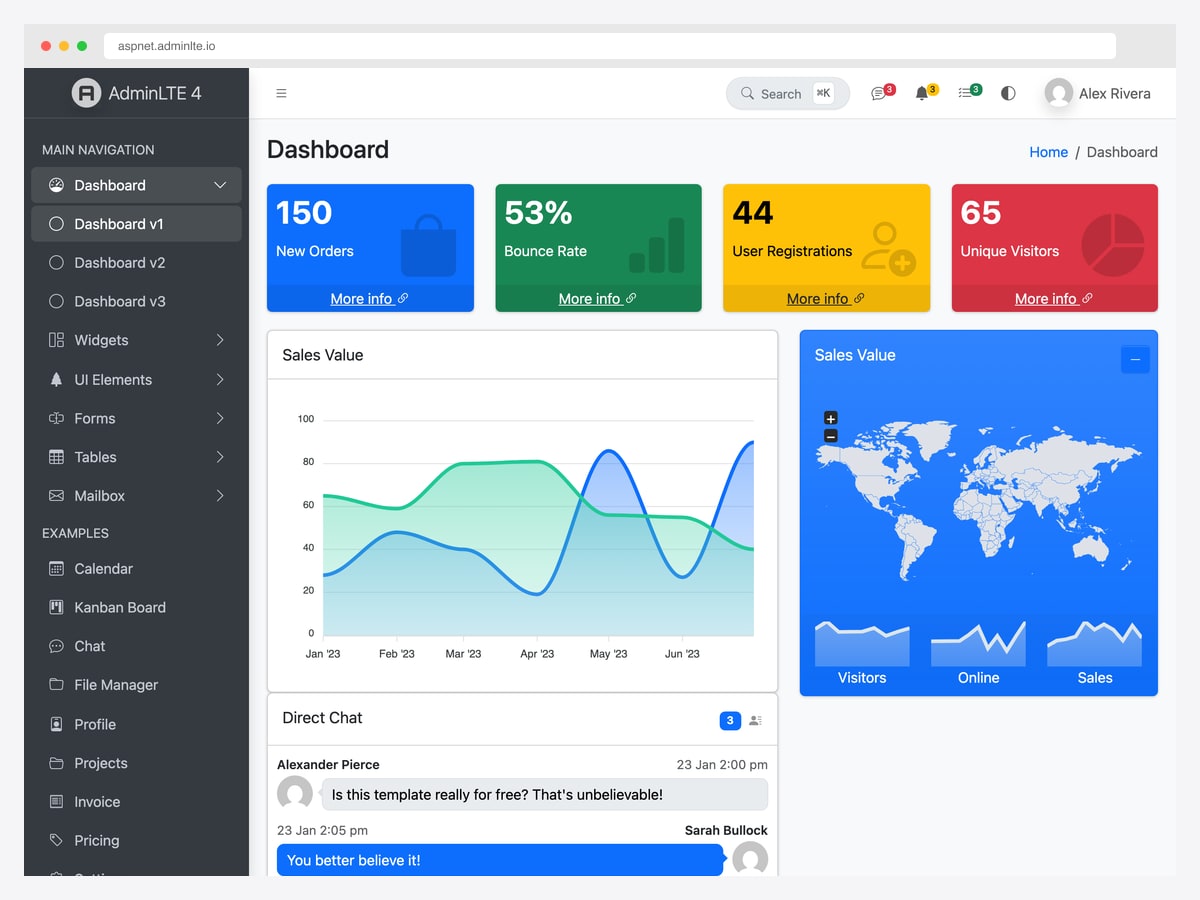
AdminLTE 4 now ships an official ASP.NET Core integration targeting .NET 10, with Blazor components and MVC Tag Helpers, free under the MIT licence. It sits alongside the official React, Vue, Angular, and Laravel editions, so a team running several stacks gets the same dashboard language across all of them.
For MVC and Razor Pages work the Tag Helpers are the point: you compose the layout, sidebar, cards, and widgets with server-side markup rather than hand-copying Bootstrap classes into every view. It is early in its life compared with the HTML original, but it is the only officially maintained AdminLTE-for-.NET option — which matters given how many of the community starters below are ports that have since gone quiet.
Free ASP.NET Core admin templates
These are the genuinely current free options. Star counts and last-commit dates were verified while writing — worth doing yourself before adopting anything in this ecosystem, because several popular results have not been updated in years.
1. Sneat ASP.NET Core MVC (Free)

Why we like it: The most-starred current free ASP.NET admin template, and the only one in this list actively maintained by a commercial vendor with a paid tier behind it.
Sneat’s free edition ships a working ASP.NET Core MVC project rather than a pile of HTML — you open the solution and run it. The analytics dashboard covers profit, sales, payments, and transactions cards with a profile-report chart, and the layout system includes the vertical and horizontal menu variants plus authentication pages.
Because a paid edition exists, several sidebar entries are marked Pro and lead to upgrade prompts. That is the honest trade for a free template with a real maintainer: the core is genuinely usable and MIT-licensed, and the gaps are visible rather than hidden.
2. Materio ASP.NET Core MVC (Free)
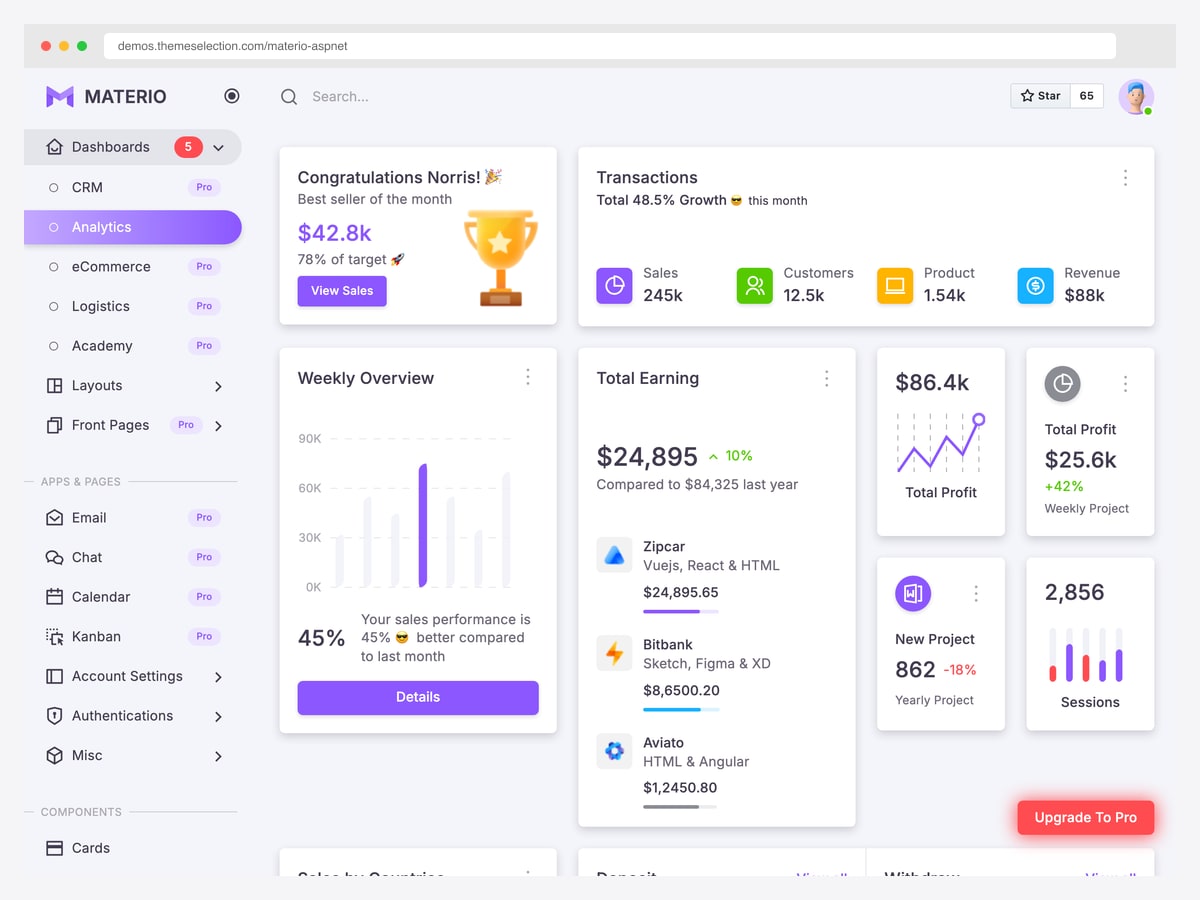
Why we like it: The same maintainer’s Material-influenced design, which is the practical alternative if Sneat’s look does not suit the project.
Materio is Sneat’s sibling from the same team, differing mainly in visual language — softer surfaces, purple accent, Material-influenced spacing. The free dashboard leads with a best-seller card, a transactions summary, a weekly overview chart, and a total-earning panel with per-project breakdown.
Choosing between the two is a design decision rather than a technical one: the underlying ASP.NET Core MVC structure, licence, and maintenance cadence are effectively identical. Open both demos and pick the one that needs less restyling for your brand.
3. AdminLTE.StarterKit
Why we like it: It is the most useful of the community AdminLTE ports because it wires up ASP.NET Identity and the layout rather than only dropping in the CSS.
This starter kit combines AdminLTE with an ASP.NET Core project that already has identity, role management, and the master layout connected — the plumbing that consumes the first day of a new admin project. It remains one of the more actively touched community AdminLTE ports.
The caveat is important and easy to miss: it was written around .NET Core 3.1, so expect to update target frameworks and packages before building anything long-lived on it. For a current AdminLTE-on-.NET foundation, the official integration above is the better starting point; this is worth reading for how it wires identity into the layout.
4. TenonAdmin
Why we like it: One of the very few ASP.NET admin projects with commits this month, which in this ecosystem is worth more than a large star count.
TenonAdmin describes itself as a zero-config, extensible ASP.NET Core admin scaffold. Its star count is modest, but it is being actively developed right now — and in a market where the highest-starred results were last touched in 2020, recency is the more reliable signal.
Treat it as a foundation to read and extend rather than a finished product. For a small internal tool where you want current .NET conventions rather than a polished visual design, that trade is often the right one.
5. dotnet10-vue3-admin (Clean Architecture)
Why we like it: It answers the increasingly common case where the API is .NET but the admin interface is a JavaScript SPA rather than Razor views.
Not every .NET team wants server-rendered views any more. This project pairs a .NET 10 backend structured with clean architecture against a Vue 3 admin front end, which is the shape a lot of modern .NET shops actually build in.
If that is your architecture, a Razor template is the wrong starting point entirely — you want a .NET API plus a front-end admin template. Our Vue admin dashboard templates and React admin dashboard templates roundups cover the interface half of that stack.
Premium ASP.NET Core admin templates
The commercial side of this market is narrow. Both current options come from the same maintainer as the free templates above — you are buying the additional app screens and support rather than a different foundation.
6. Sneat ASP.NET Core (Pro)

Why we like it: The free edition’s Pro-marked sections unlocked — eCommerce, CRM, logistics and academy dashboards plus mail, chat, kanban and invoice apps.
If you have built with the free Sneat template and hit its edges, the paid edition is the same codebase with the locked sections filled in: additional dashboards for eCommerce, CRM, logistics, and academy use cases, and the application screens — email, chat, calendar, kanban, invoice — that most admin projects eventually need.
The upgrade decision is unusually clear here because you can evaluate the real thing for free first. Build with the free version, and buy only when a specific locked screen would cost you more to write than the licence.
7. Materio ASP.NET Core (Pro)
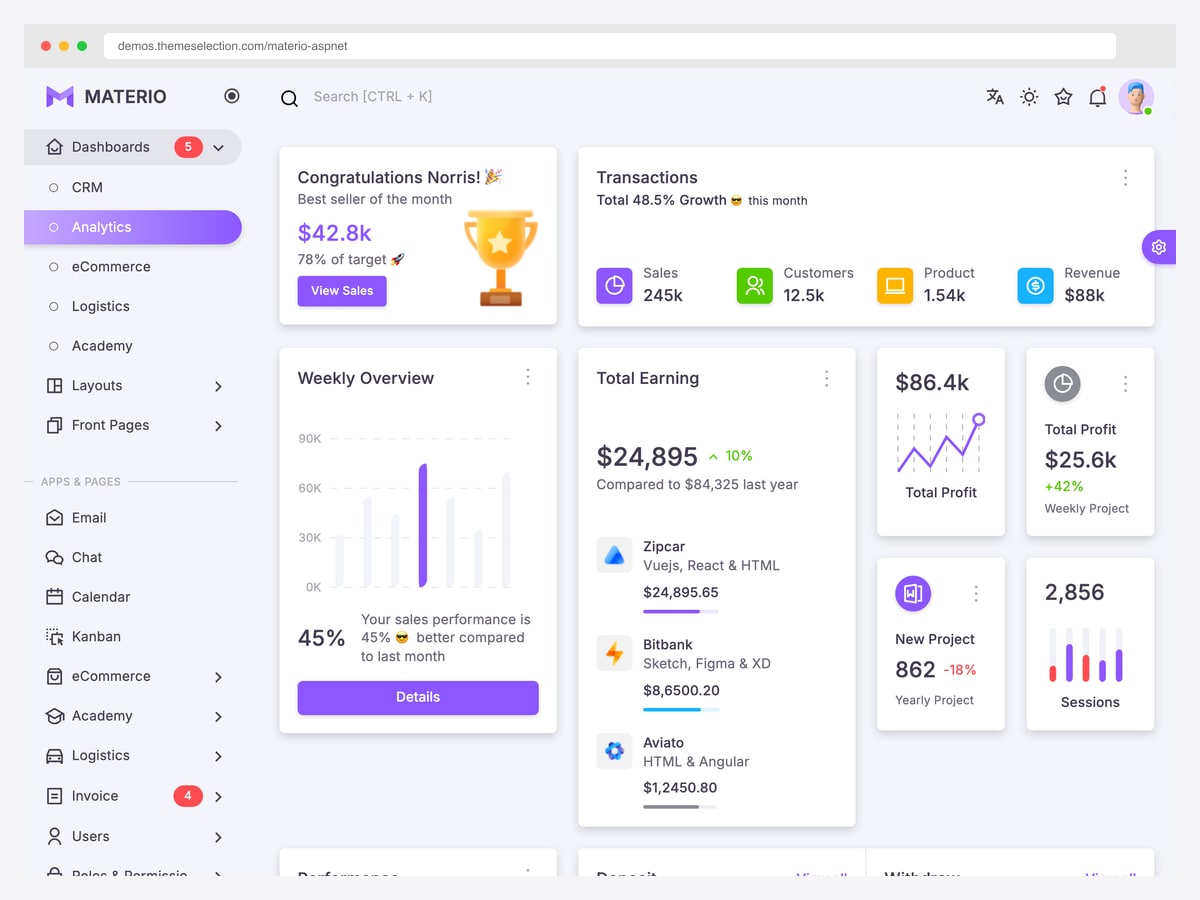
Why we like it: The same complete-the-set proposition as Sneat Pro, in the Material-influenced design language.
Materio’s paid edition follows the identical model: the free template’s Pro-marked dashboards and app pages unlocked, in Materio’s softer Material-style design. Feature parity with Sneat Pro is close enough that the choice again comes down to which visual language you would rather restyle.
Both are one-off licences rather than subscriptions, and both ship the MVC and Razor Pages project structure rather than only HTML — which is the detail worth confirming with any ASP.NET template vendor before buying.
When you need a framework rather than a template
8. ABP Framework
Why we like it: It is the largest active project in this space by a wide margin, and it solves a different problem — the application architecture rather than the interface.
ABP is not an admin template. It is a full ASP.NET Core application framework providing modularity, multi-tenancy, authentication and authorisation, audit logging, and a startup template that generates a working admin application. If your requirements include tenants, granular permissions, and audit trails, building those on top of a UI template is months of work that ABP has already done.
The trade is the usual framework trade: you adopt its conventions and its module system, and stepping outside them is harder than with a plain MVC project. It also has a commercial tier with additional modules and a themed UI on top of the open-source core. Consider it when the hard part of your project is the platform rather than the pixels.
Blazor and component suites
Two adjacent options this list deliberately does not cover. Blazor templates are a separate category — the component model differs enough that a Razor template will not simply transfer, and options such as MudBlazor and Radzen are built specifically for it. Our Blazor admin dashboard templates roundup covers those.
Commercial component suites — DevExpress, Syncfusion, Telerik — are the other route. You are buying grids, charts, and schedulers rather than a dashboard layout, and each ships dashboard demos you can assemble from. That is usually the right call when the hard requirement is a serious data grid rather than an attractive shell, and it is a common choice in enterprise .NET.
How to Choose an ASP.NET Core Admin Template
- MVC/Razor Pages or Blazor? Decide first — it splits the market cleanly, and a template from the wrong side will not transfer.
- Check the last commit before anything else. This ecosystem has an unusual number of popular-but-abandoned repositories, several targeting .NET Core 3.1. Star count is a poor proxy for viability here.
- Do you need a template or a framework? If multi-tenancy, permissions, and audit logging are requirements, ABP will save more time than any UI template.
- Is your front end actually .NET? Plenty of .NET teams now ship a React or Vue admin against a .NET API — in which case take a front-end template and skip this category.
- Free first. Both premium options here have genuinely usable free editions of the same codebase. Build until you hit a locked screen, then decide.
ASP.NET Core Admin Template FAQ
What is the best free ASP.NET Core admin template?
Sneat ASP.NET Core MVC is the strongest current free option — it is the most-starred, ships as a working MVC project rather than loose HTML, and is maintained by a vendor with a paid tier behind it. Materio, from the same team, is the equivalent choice if you prefer a Material-influenced design. For an officially maintained AdminLTE foundation, the AdminLTE 4 ASP.NET Core integration is free under MIT.
Does AdminLTE work with ASP.NET Core?
Yes, and there is now an official integration targeting .NET 10 with Blazor components and MVC Tag Helpers, free under the MIT licence. Many community AdminLTE ports for ASP.NET also exist, but a large share of them have not been updated in years — check the last commit date, since several popular ones still target .NET Core 3.1.
Should I use MVC, Razor Pages, or Blazor for an admin panel?
MVC and Razor Pages remain the pragmatic default for admin work: server-rendered, straightforward to secure, and supported by every template in this list. Blazor is compelling when you want rich interactivity without a separate JavaScript stack, but it needs templates built for its component model — a Razor template will not transfer.
Are there free ASP.NET admin templates safe for commercial use?
Yes. The free Sneat and Materio ASP.NET Core templates are MIT licensed, as is the official AdminLTE integration, so all three are usable in commercial and client work. As always the licence covers the code rather than the demo content, so replace placeholder branding and imagery before shipping.
What is the difference between an admin template and a framework like ABP?
A template gives you the interface — layout, dashboard, forms — which you wire to your own backend. ABP gives you the application architecture: modularity, multi-tenancy, permissions, audit logging, and a generator that produces a working admin app. Choose a template when your backend exists and you need a UI; choose ABP when the platform itself is the hard part.
Why are there so few ASP.NET admin templates compared with React?
Partly because much of the .NET enterprise market buys component suites such as DevExpress, Syncfusion, or Telerik rather than layout templates, and partly because a large share of .NET teams now build their admin front end in React or Vue against a .NET API. The result is a small template market concentrated around AdminLTE ports and a couple of active vendors.

You Might Also Like


