
10 Best Healthcare Dashboard Templates 2026

Looking for a polished healthcare dashboard or HMS you can deploy this month? These 10 picks cover everything from premium shadcn/ui hospital dashboards to enterprise-grade open-source EMR platforms — every demo is re-checked before we republish this page.
A 2026-grade healthcare dashboard handles five core surfaces: a patient registry with demographics and medical history, an appointment / scheduling view with calendar and provider availability, a clinical workspace with vitals / labs / prescriptions / encounters, a billing / revenue cycle view, and an admin/operations view for staff, beds, and inventory. Building all of that from scratch on top of HIPAA / GDPR constraints is months to years of work. Starting from a dedicated healthcare template — or self-hosting an open-source EMR / HMIS — gets you to a working clinical tool in weeks.
We’ve grouped the 10 picks below into premium healthcare dashboards (Shadcn UI Kit, Ember by DashboardPack, DashboardPack Hospital HTML, CoreUI Healthcare, Spike Medical), and free open-source EMR / HMIS / clinical platforms (OpenEMR, OpenMRS, Bahmni, ERPNext Healthcare, Medplum).
Related reading: our HR dashboard templates, project management dashboard templates, CRM dashboard templates and gym & fitness dashboard templates roundups.
Quick Picks
- Best premium shadcn/ui: Shadcn UI Kit Hospital Management — clean dashboard, 17 other dashboards in same Pro license
- Best full premium HMS: Ember Healthcare — DashboardPack, complete clinical management Next.js codebase
- Best framework-free option: DashboardPack Hospital HTML — Vite + Tailwind, no React runtime
- Best multi-framework option: CoreUI Healthcare — one design system across React, Vue, and Angular
- Best Vue / Nuxt option: Spike Medical Dashboard — Nuxt + Vuetify 3 medical variant by WrapPixel
- Best open-source EMR overall: OpenEMR — ONC-certified, 100+ countries, 35+ languages, GPL
- Best for global health: OpenMRS — 90+ countries, O3 React frontend, MPL 2.0
- Best low-resource HIS: Bahmni — OpenMRS + ERPNext + OpenELIS + DCM4CHEE in one stack
- Best EMR + ERP combo: ERPNext Healthcare — DIY hospital ERP on Frappe, GPLv3
- Best for developers / clinical SaaS: Medplum — FHIR-native, TypeScript + React, Apache-2.0
1. Ember Healthcare Dashboard (DashboardPack)
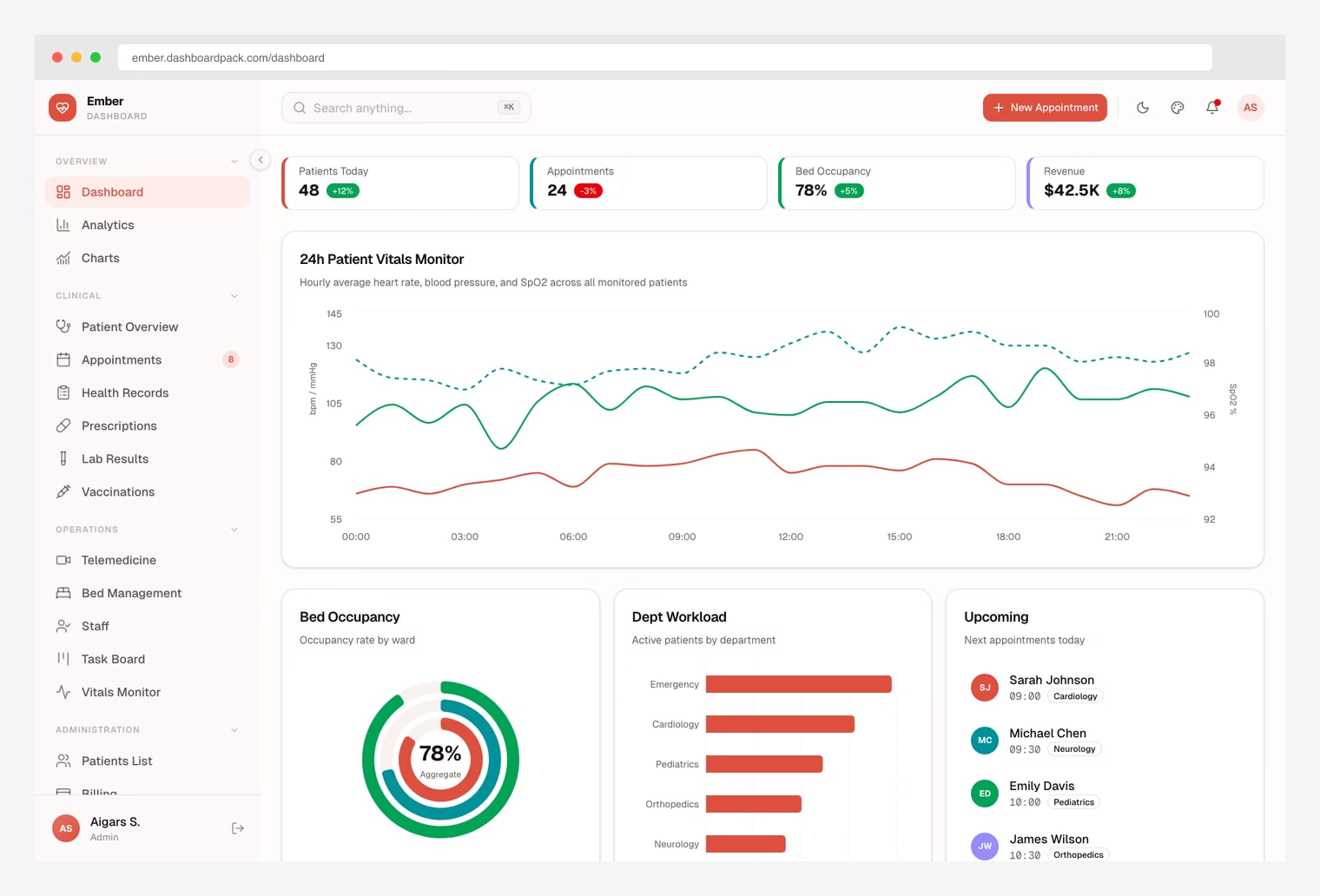
Why we like it: Typed Next.js + shadcn/ui codebase, light + dark themes, and a clinical-red palette tuned for medical contexts. Strongest pick when you’re building an actual HMS / EMR product UI rather than dropping a hospital page into a multi-purpose admin.
Standalone product (not part of a 9-in-1 kit), so the codebase stays focused on healthcare workflows. Includes telemedicine, bed management, vitals monitoring, and billing — surfaces that generic admin kits don’t ship.
2. Shadcn UI Kit Hospital Management
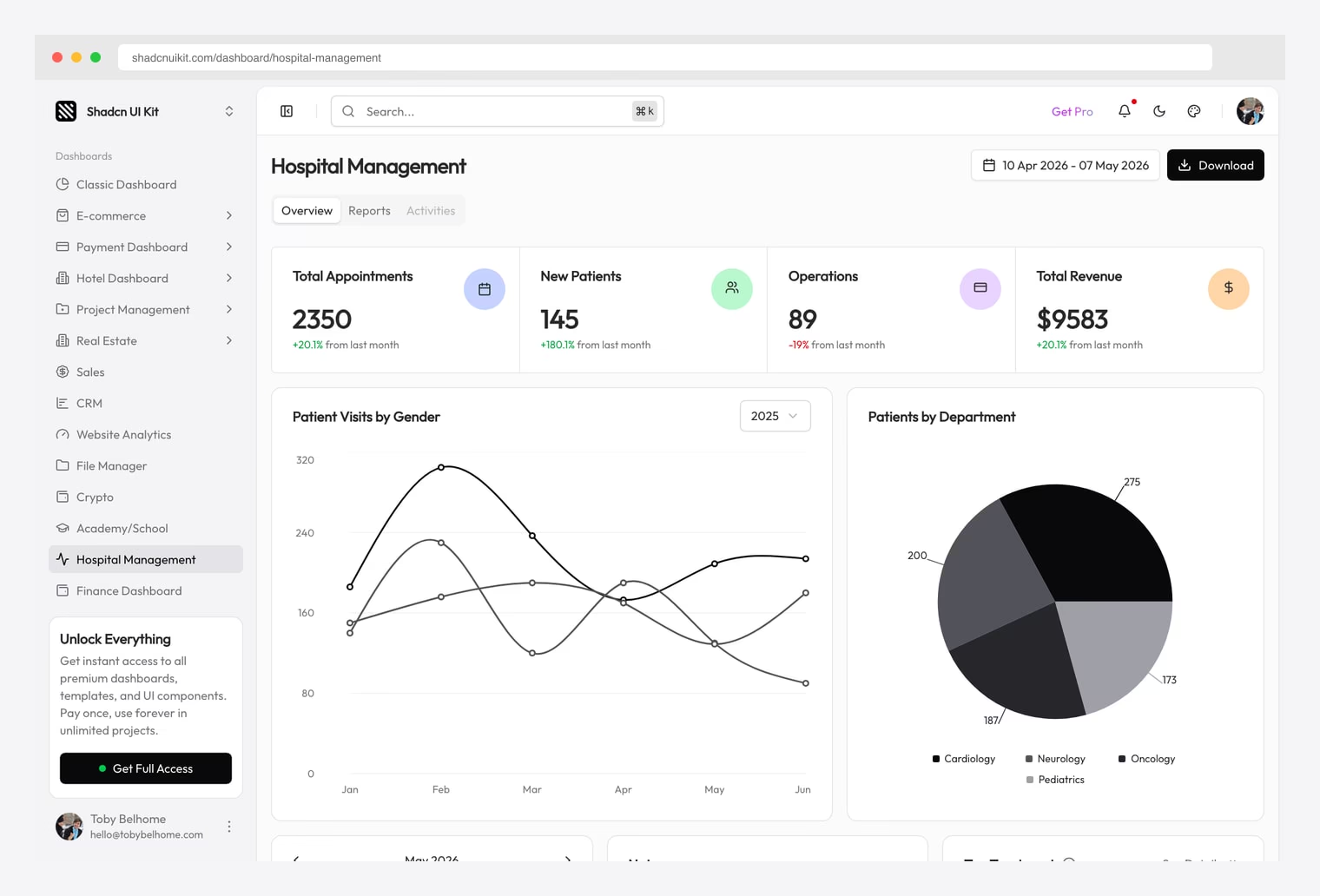
Why we like it: A single Hospital Management dashboard page inside the Shadcn UI Kit Pro catalog. One Pro license unlocks all 18 dashboards (Hospital Management, E-commerce, Project Management, CRM, Real Estate, Sales, Hotel, Crypto, Academy, Finance, etc.) with light + dark themes, lifetime updates, and unlimited project use.
Same Pro license also covered in our finance, crypto, and LMS roundups — buy once, use across every dashboard surface.
3. DashboardPack Hospital HTML Admin
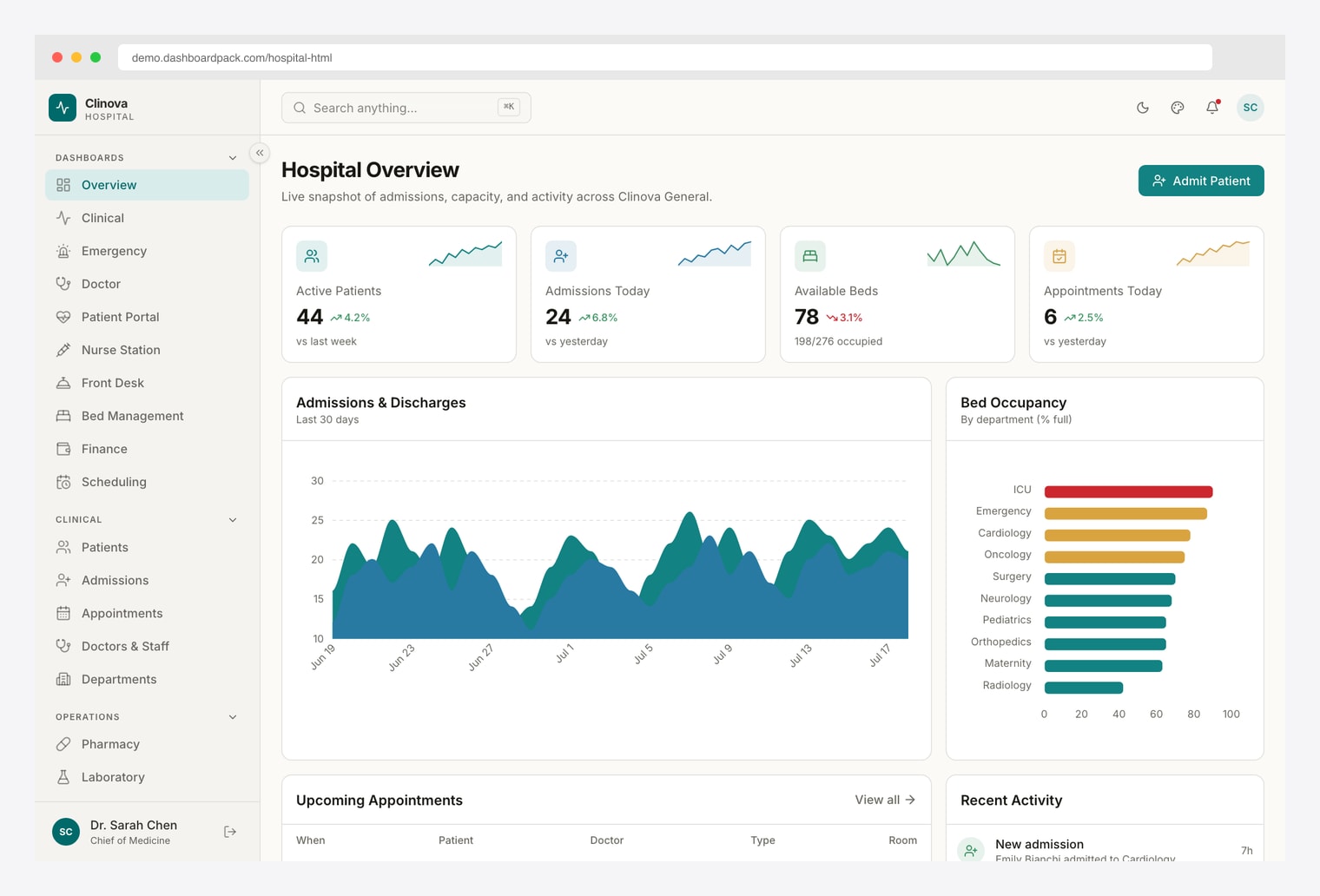
Why we like it: A vanilla-JS hospital admin built on Vite 8 and Tailwind CSS v4 — 10 role-based dashboards, a ⌘K command palette, and dark mode, with no React runtime. The compiled output drops into a Laravel Blade, Django, Rails, or PHP backend without adopting a component framework.
Same vendor as Ember above, but the framework-free edition — pick this when you want the hospital UI without a React runtime. Ten role-based views span 35 pages, with a patients table (faceted filters, CSV export), admit wizard, pharmacy, laboratory, and billing. Pair with our free Bootstrap 5 templates roundup for free alternatives.
4. CoreUI Healthcare
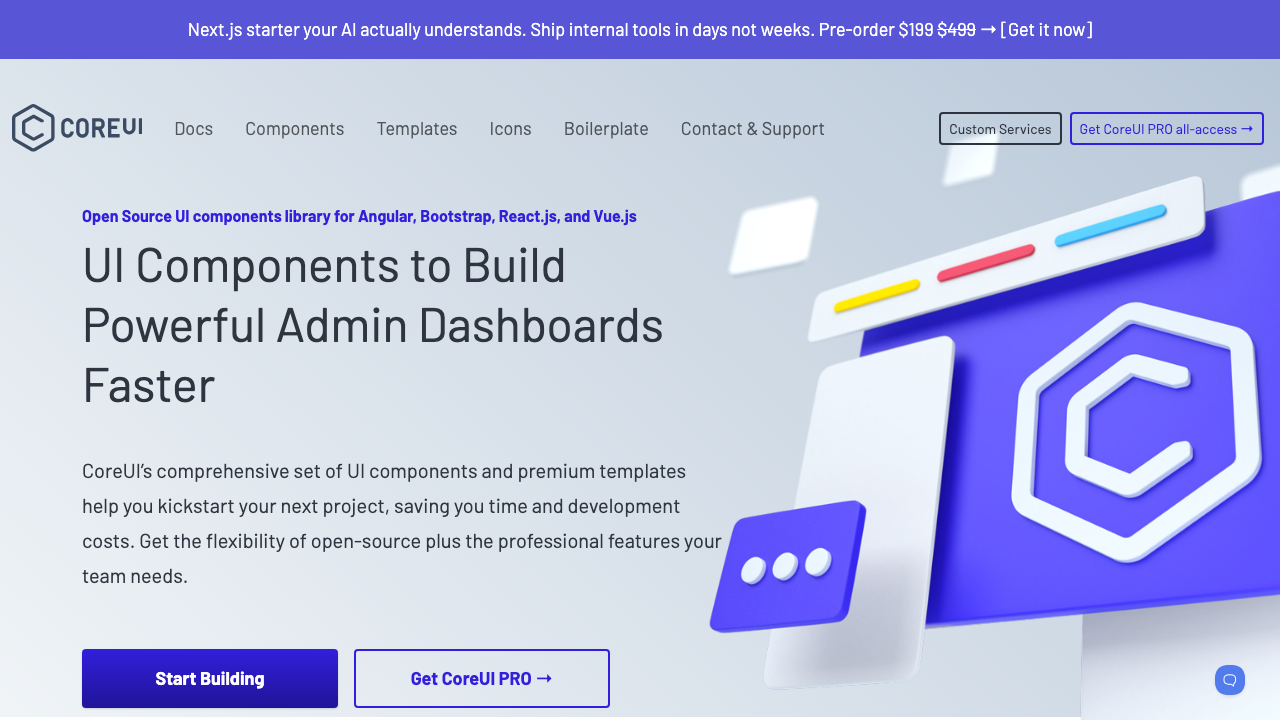
Why we like it: CoreUI ships the same Bootstrap-based component library across React, Vue, Angular, and plain HTML — one of the only healthcare-viable templates with true framework flexibility. Patient management widgets, appointment calendars, and chart components compose into clinical dashboards without reskinning between teams.
The free MIT version covers most dashboard needs; CoreUI Pro adds advanced components, premium templates, and priority support. Strongest pick for hospital groups or healthcare orgs running multiple stacks where keeping one design system across React, Vue, and Angular product teams matters more than any single template feature.
5. Spike Medical Dashboard
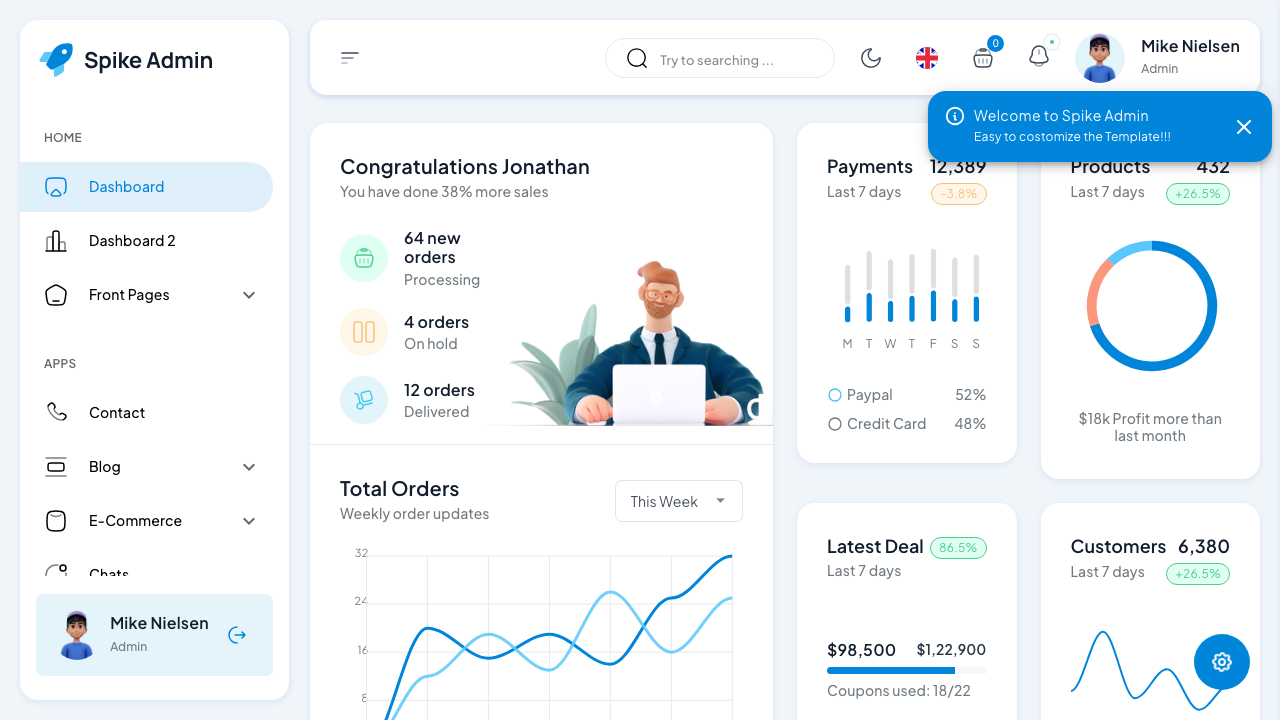
Why we like it: WrapPixel’s Spike admin ships a dedicated medical dashboard variant built on Nuxt + Vuetify 3 — patient statistics, appointment tracking, and clinical metric widgets in production-ready Material Design components. The strongest fit when your team is already on Vue / Nuxt and adapting a React-based medical template would be friction.
The premium license unlocks all Spike variants (Vue, Nuxt, Angular, React, HTML, Tailwind), not just the medical one — useful if different product lines in the hospital share the same design system but need different stacks.
6. OpenEMR
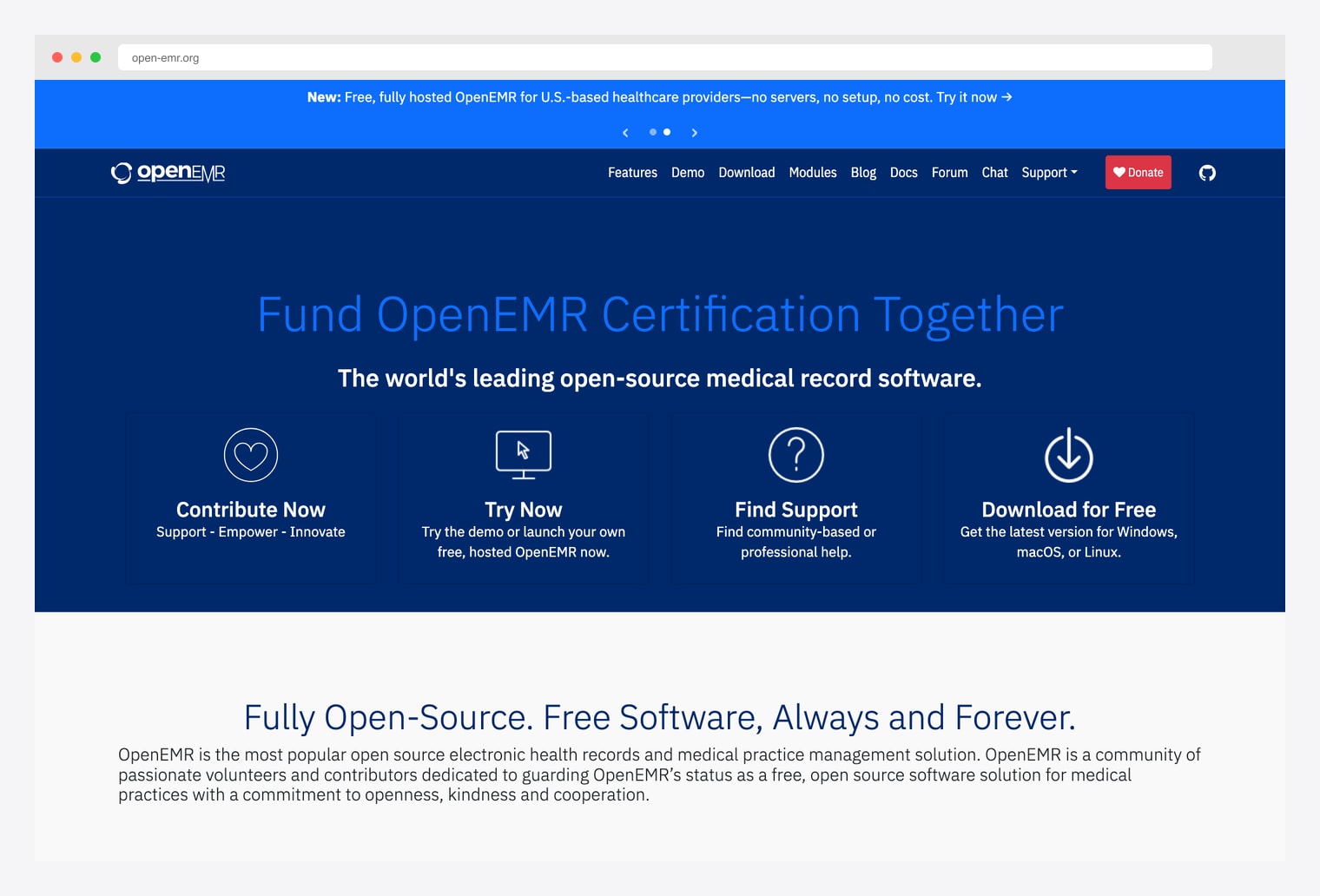
Why we like it: Patient demographics, scheduling, ePrescribing (eRx), electronic medical records, billing + revenue cycle, lab order integration, patient portal. ONC Health IT certification means it qualifies for U.S. Promoting Interoperability incentives.
Note GPLv3 license — fine for hospitals self-hosting internally, but commercial closed-source forks aren’t allowed. The free fully-hosted option for US-based healthcare providers is unusual generosity for an OSS project.
7. OpenMRS
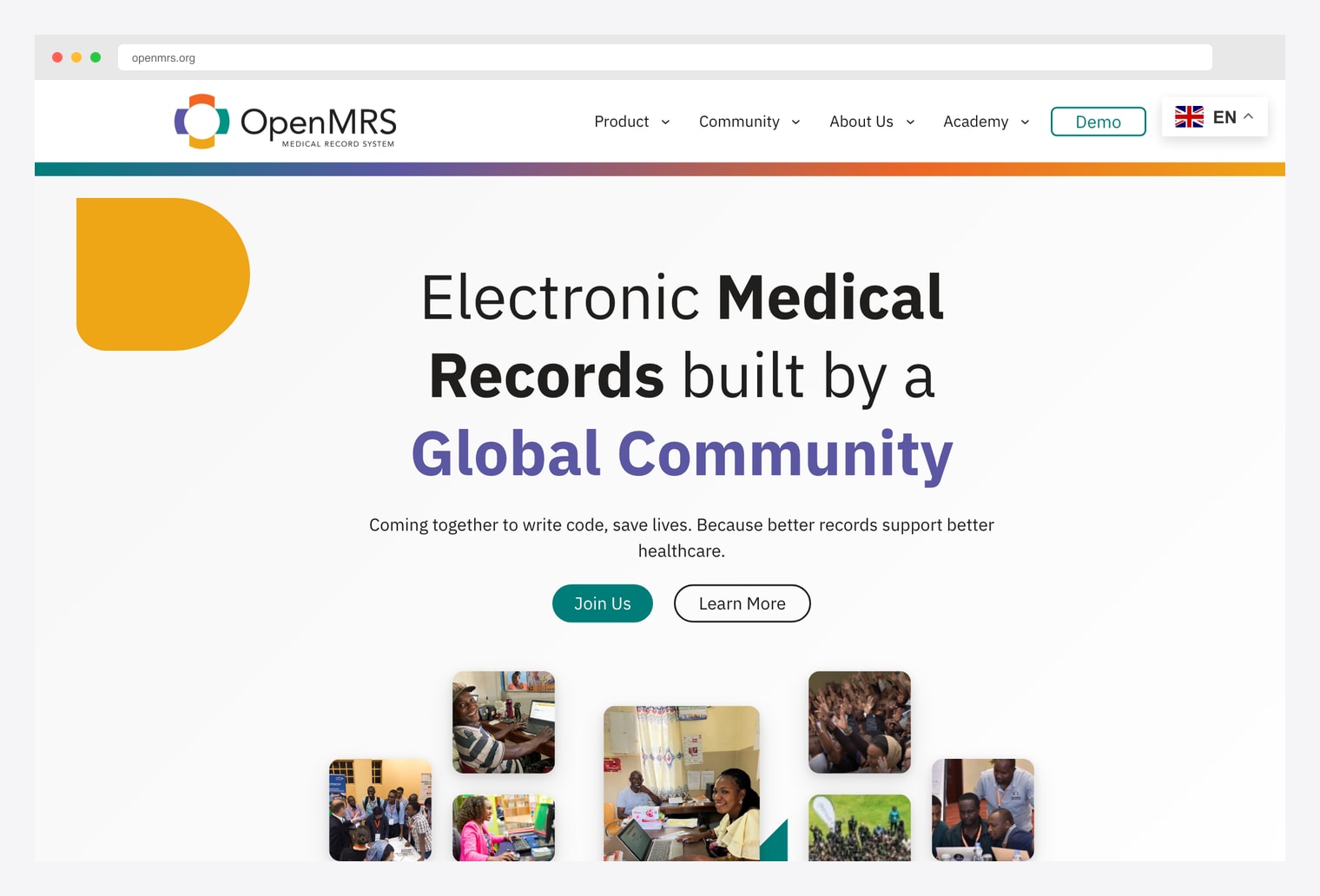
Why we like it: Built around configurable Concept Dictionary (CIEL) — the data model adapts to any specialty or country-specific data requirement. The newer O3 frontend uses React-based microfrontends, making custom modules easier to ship than the legacy reference application.
Strongest pick for global health, NGO, and ministry-of-health deployments. MPL 2.0 is more permissive than GPLv3 — you can mix MPL code into closed-source projects file-by-file.
8. Bahmni
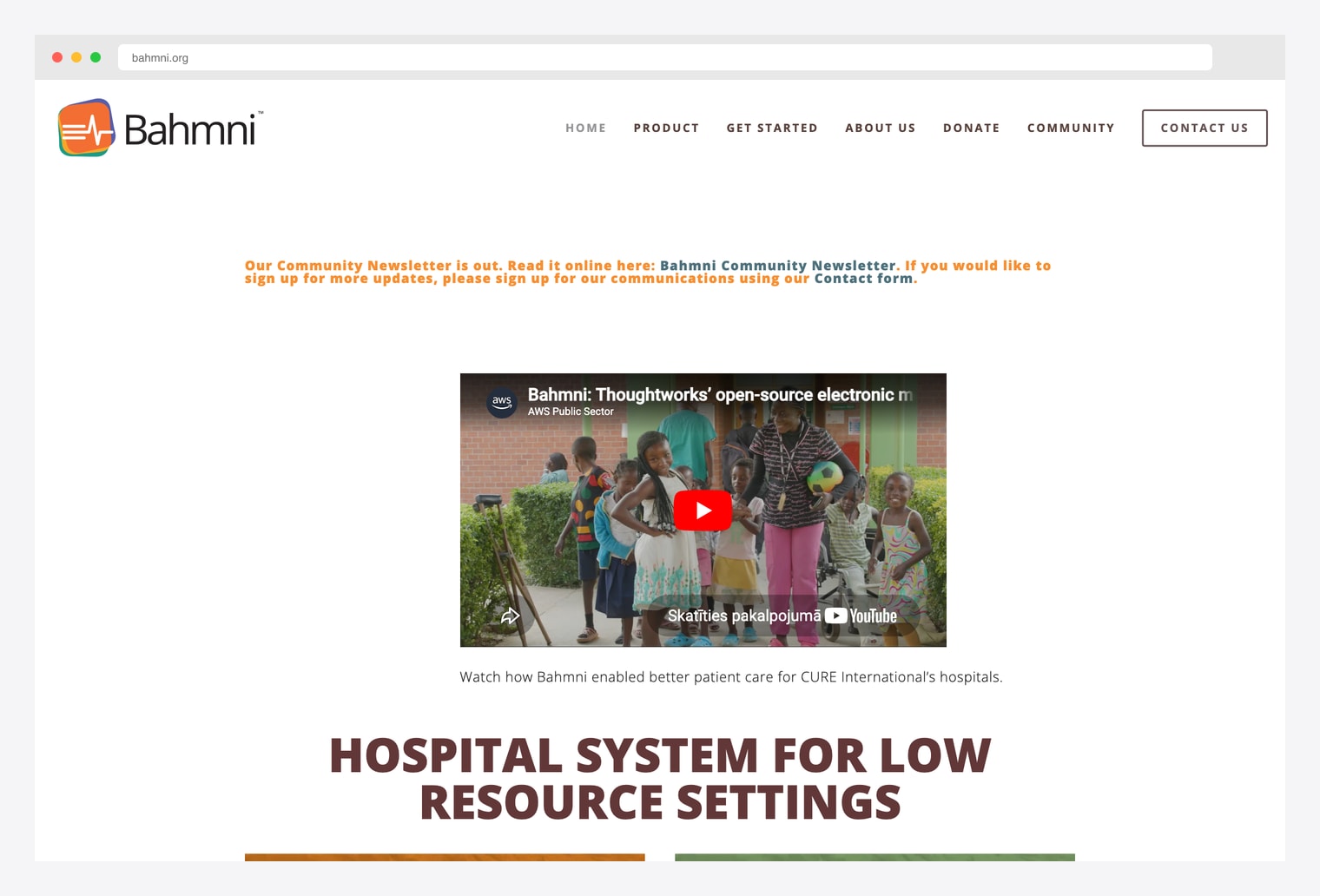
Why we like it: Bahmni isn’t a single application — it’s a distribution that integrates four OSS products into one deployment: OpenMRS (EMR), ERPNext (billing + inventory), OpenELIS (laboratory), and DCM4CHEE (radiology / PACS). Saves you from integrating these yourself.
Originally incubated by Thoughtworks for low-resource hospital settings; production users include CURE International’s children’s hospitals across Africa and the Middle East. Best fit when you need a turnkey HIS rather than building one piece at a time.
9. ERPNext Healthcare
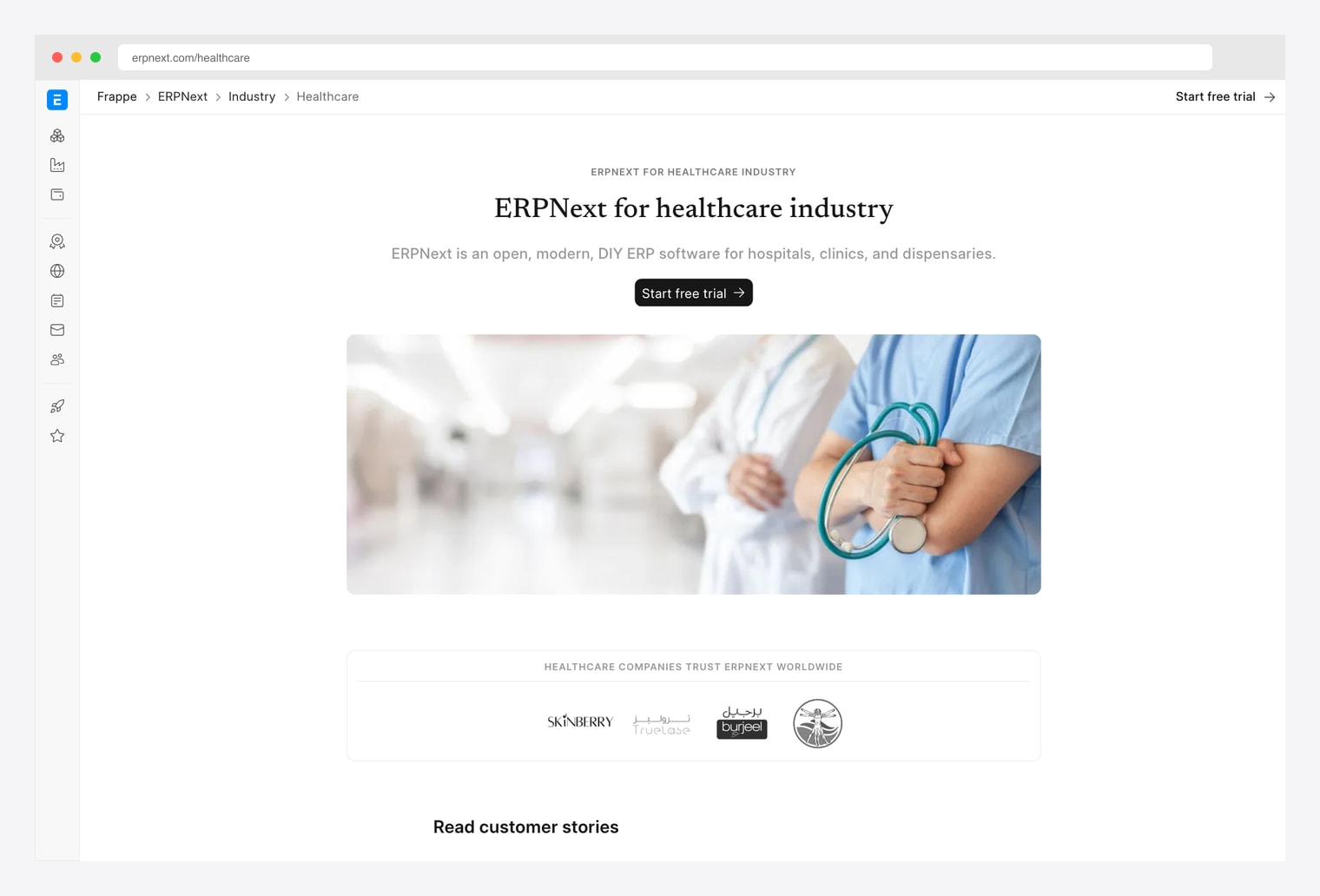
Why we like it: The healthcare module inside the broader ERPNext ERP. Patient management, appointments, encounters, lab tests, ePrescribing, drug inventory, and billing all integrate with ERPNext’s HR, Accounting, and CRM modules — useful when you want one ERP for the whole hospital, not separate tools.
Same Frappe stack also covered in our HR and LMS roundups (Frappe HR, Frappe LMS) — pick this when you’re already running ERPNext or want a single platform across HR, finance, healthcare, and learning.
10. Medplum
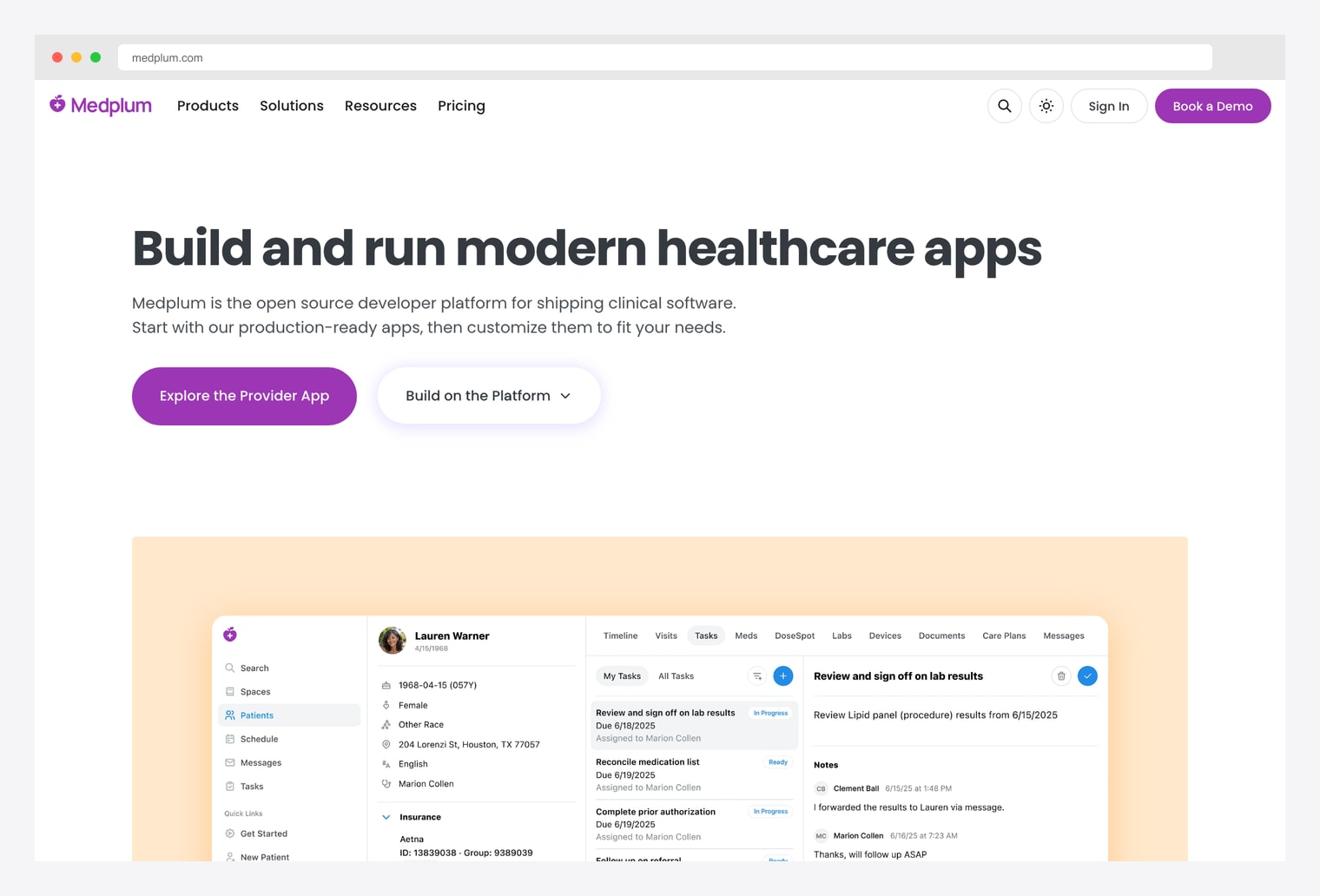
Why we like it: TypeScript + React frontend, Node.js + PostgreSQL backend, headless backend API, and a production-ready Provider App. HL7 FHIR R4 compliance means easy interop with hospital systems, lab vendors, and DoseSpot for ePrescribing.
Best fit when you’re building a custom clinical SaaS (telehealth, RPM, clinical research) rather than deploying an off-the-shelf HMIS. Permissive license + modern stack make it the natural pick for new healthcare startups.
How to Choose the Right Healthcare Dashboard Template
The 10 options split along three practical axes:
By how much healthcare you actually need
- Just the dashboard / KPI view: Shadcn UI Kit Hospital, DashboardPack Hospital HTML, CoreUI Healthcare, Spike Medical — beautiful healthcare dashboards, you bring the backend + EMR data layer.
- Full HMS template (UI + 15+ pages, no backend): Ember Healthcare — Dashboard, EMR, Telemedicine, Bed Management, Vitals, Staff, Billing — all in a Next.js + shadcn codebase.
- Full EMR / HMIS application (UI + backend + database): OpenEMR, OpenMRS, Bahmni, ERPNext Healthcare.
- Developer platform for shipping a custom clinical app: Medplum — FHIR-native API + UI library, build your own product on top.
By tech stack
- shadcn/ui + Next.js: Shadcn UI Kit Hospital, Ember Healthcare.
- TypeScript + React + Node: Medplum.
- Vanilla JS + Tailwind (no framework): DashboardPack Hospital HTML.
- Bootstrap: CoreUI Healthcare.
- Vue / Nuxt + Vuetify: Spike Medical, CoreUI (Vue variant).
- Angular: CoreUI (Angular variant).
- PHP + MySQL: OpenEMR.
- Java + React (O3): OpenMRS.
- Python + Frappe + Vue: ERPNext Healthcare.
- Multi-stack stitched (OpenMRS + ERPNext + OpenELIS + DCM4CHEE): Bahmni.
By license & deployment
- Premium one-time license: Shadcn UI Kit Pro, Ember Healthcare, DashboardPack Hospital HTML, CoreUI Pro, Spike Medical.
- Free permissive open-source (Apache / MIT / MPL): Medplum (Apache-2.0), OpenMRS (MPL 2.0), CoreUI free (MIT).
- Free copyleft open-source (GPL / AGPL): OpenEMR (GPL), Bahmni, ERPNext Healthcare (GPLv3).
A practical pattern in 2026: prototype your healthcare app with the free CoreUI components or Shadcn UI Kit Hospital if you need to validate clinician workflows fast, scale up to Ember Healthcare when you need a complete HMS UI, and either build a custom clinical SaaS on top of Medplum (Apache-2.0, FHIR-native) for commercial products OR self-host an off-the-shelf application like OpenEMR, Bahmni, or ERPNext Healthcare when you need a turnkey hospital deployment without per-user licensing.
Healthcare Dashboard FAQ
What should a healthcare dashboard include?
It depends on which of the three healthcare dashboard types you are building. A clinical dashboard serves care decisions for individual patients — vitals, results, medications, allergies. An operational one serves throughput for a unit or hospital — beds, admissions, staffing. A financial one serves the revenue cycle. The audiences barely overlap, and a screen that tries to serve two of them usually serves neither well.
Are there free healthcare dashboard templates?
Yes. OpenEMR, OpenMRS, and Bahmni are complete open-source clinical systems you can deploy and study, and Medplum provides an open-source developer platform for building healthcare applications. For the interface layer specifically, several free admin templates ship healthcare or hospital dashboard variants you can adapt.
Do these templates make my application HIPAA compliant?
No — and no template can. Compliance is a property of your whole system: access control, audit logging, encryption at rest and in transit, business associate agreements, and operational policy. A template gives you the interface, and it can help by making role-based sectioning natural, but the compliance work sits in your architecture and processes rather than in the front end.
What is the difference between an EHR and a healthcare dashboard template?
An EHR, such as OpenEMR or Medplum, is a complete clinical system that stores and manages patient records. A dashboard template is front-end code — layouts, charts, and app screens — that you connect to your own backend. Choose an EHR when you need the clinical data model itself; choose a template when you are building a healthcare product and need the interface.
Which stack is best for a healthcare dashboard?
The stack matters less than the domain screens you get for free. Vitals charts with clinically normal bands, bed and ward management, appointment scheduling with practitioner columns, and role-grouped navigation are all tedious to build from a generic admin theme. Pick a template that already ships those, then match the framework to what your team maintains.
Where can I see real healthcare dashboard designs?
OpenEMR runs a public demo of its full application, which is the most honest reference for how much information a real clinical interface carries. Our healthcare dashboard design examples article studies that demo alongside several commercial products and templates, focusing on the density, urgency, and PHI patterns worth reusing.

You Might Also Like


