
7 Best shadcn/ui Mobile Templates 2026

Want shadcn/ui on mobile? shadcn itself is web-first — but the React Native ecosystem has built several solid ports of the same copy-paste philosophy. These 7 picks cover React Native Reusables (the most direct port), NativeCN UI (zero-dependency mobile components), expo-nativewind-template (full Expo starter), NativeWind (the styling foundation), Tamagui (the performance pick), gluestack (universal RN + web), and the shadcn.io React Native catalog. Every demo is re-checked before we republish this page.
shadcn/ui doesn’t officially support React Native — the upstream library is React DOM with Radix UI primitives that don’t exist on mobile. But the ecosystem has solved this two ways: direct ports (React Native Reusables, NativeCN — same component names, mobile-native primitives, same copy-paste philosophy) and universal libraries (Tamagui, gluestack — shared component code that targets web and native from one codebase). All of them use NativeWind (Tailwind for React Native) as the styling layer.
We’ve grouped the 7 picks below into two direct shadcn-to-RN ports (React Native Reusables, NativeCN UI), one full Expo starter (expo-nativewind-template), one styling foundation (NativeWind — used by everything else), two universal libraries (Tamagui for performance, gluestack for shared web + native code), and one catalog (shadcn.io React Native category). React Native Reusables is the right starting point if you already use shadcn on the web; Tamagui is the right starting point if performance is the primary constraint.
Related reading: our shadcn/ui marketing templates for the web companion to your mobile app (we covered Magic UI Pro Mobile for the App Store landing surface), SaaS starter kits for the full-stack web side, auth templates for the signup surface that will need a mobile mirror, and our shadcn/ui templates pillar.
Quick Picks
- Best direct shadcn-to-RN port: React Native Reusables — same components, mobile-native
- Best zero-dependency RN components: NativeCN UI — own the code, no lock-in
- Best complete Expo starter: expo-nativewind-template — routing + dark mode + components
- Best styling foundation: NativeWind — Tailwind for React Native
- Best performance pick: Tamagui — optimizing compiler, zero runtime overhead
- Best universal RN + web: gluestack — shared component code
- Best discovery catalog: shadcn.io React Native
1. React Native Reusables (founded-labs)
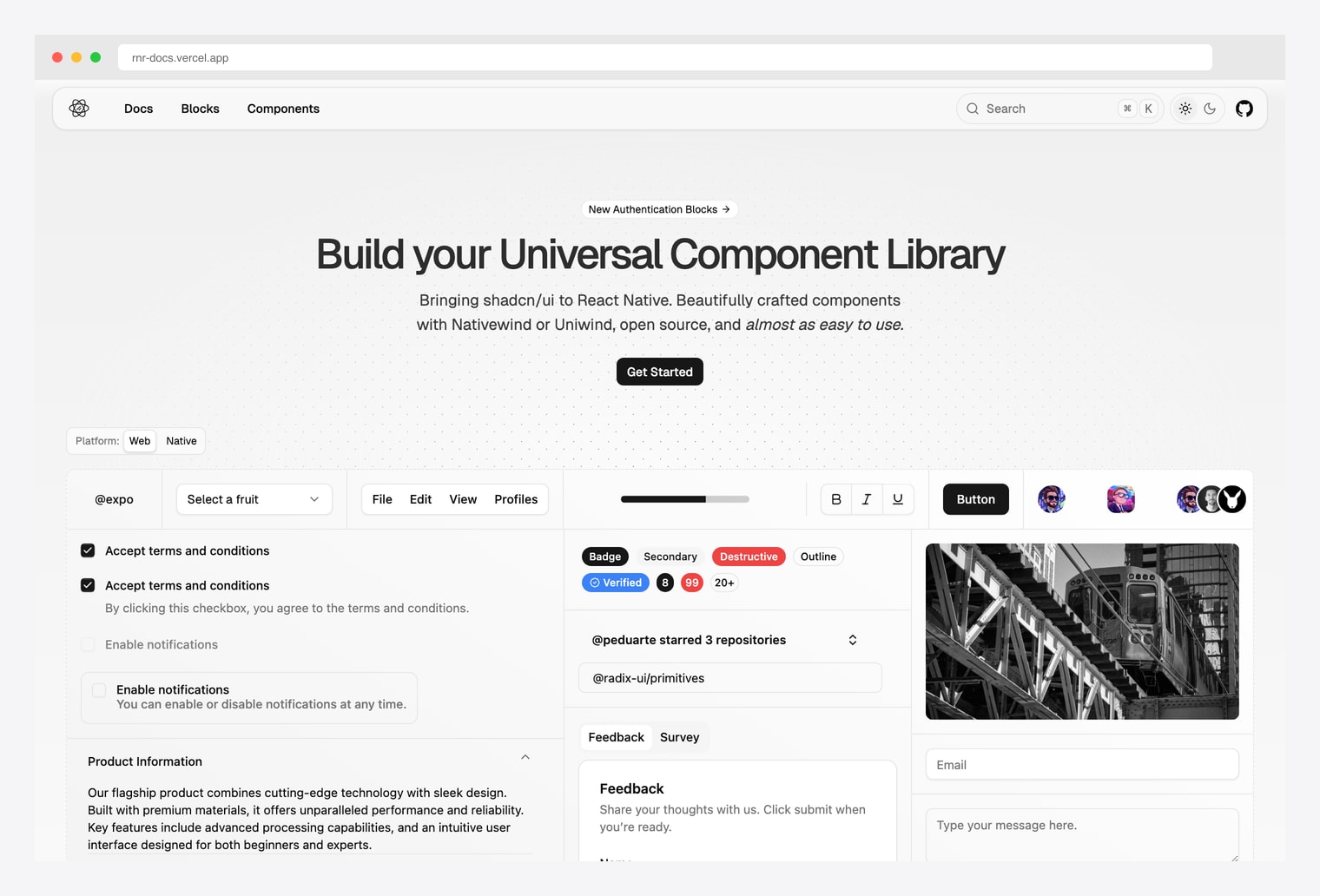
Why we like it: A universal component library that brings shadcn/ui to React Native with Nativewind (or Uniwind) for styling. Beautifully crafted components, open source under MIT, almost as easy to use as the web shadcn — same component names, same copy-paste model, same dark mode and theming patterns.
Pick React Native Reusables when your web app uses shadcn and you want the mobile app to match. The Web / Native platform switcher in the docs lets you see each component working on both targets — meaning you can prototype on the web and ship the same component on iOS and Android.
2. NativeCN UI
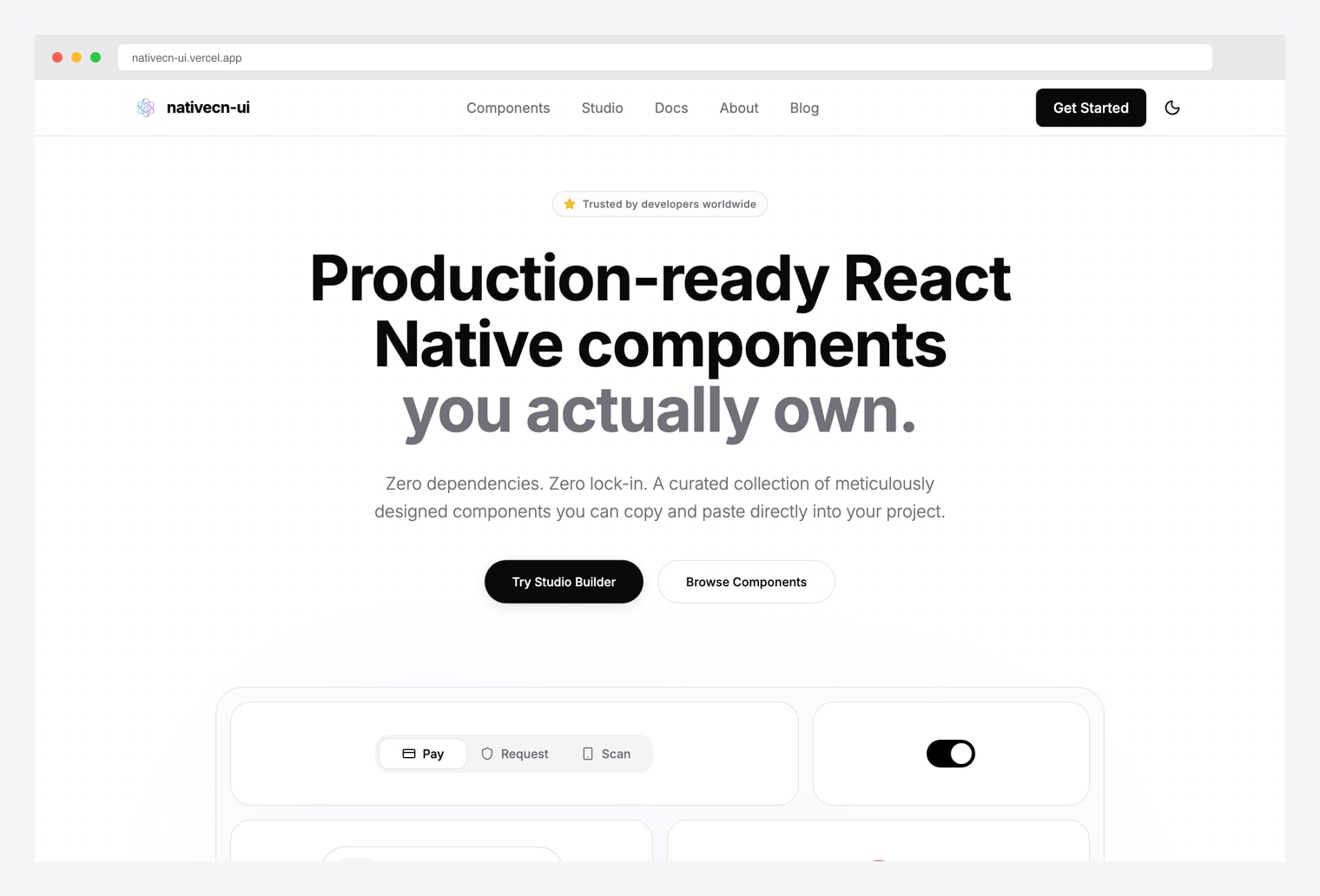
Check the commit history before adopting: the repository has had no commits since September 2024, so treat it as a source to copy components from rather than a project to depend on. What it offers is React Native components inspired by the shadcn/ui copy-paste philosophy. Zero dependencies, zero lock-in — the components land in your repo as code you fully own and can edit freely. 40+ components covering Avatar, Badge, Button, Card, Checkbox, Dialog, Input, Progress, Radio Group, Skeleton, Switch, Tabs, Toast, Dropdown, Select, and more.
Pick NativeCN when you want the shadcn philosophy applied independently for mobile rather than the direct port. The zero-dependencies guarantee means upgrades won’t break because there’s nothing to upgrade — the components live in your codebase like any other file.
3. expo-nativewind-template (chvvkrishnakumar)
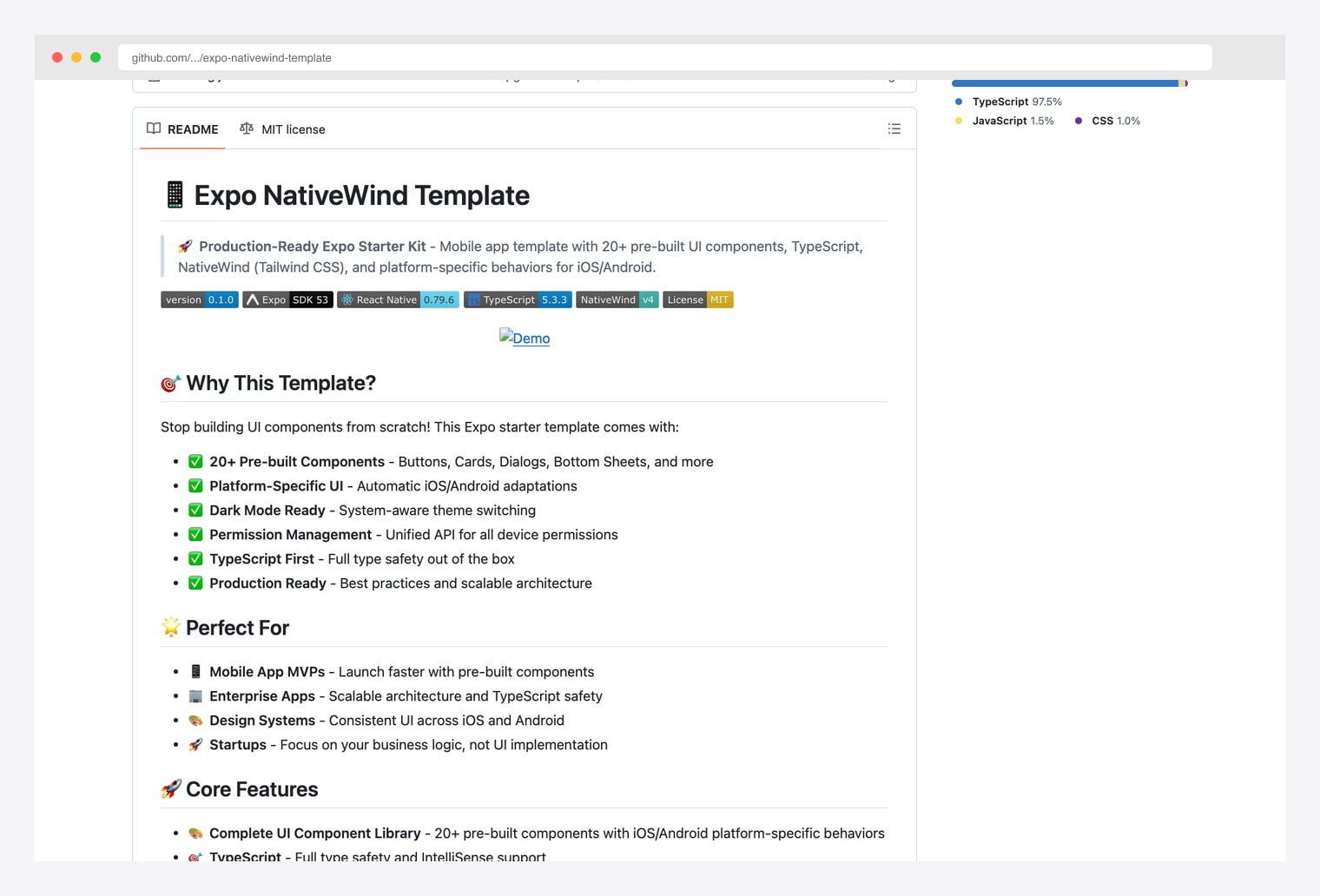
Why we like it: A production-ready Expo + React Native + TypeScript starter kit with NativeWind for Tailwind styling, pre-styled UI components, dark mode support, and Expo Router for navigation. Designed for shipping cross-platform iOS and Android apps quickly with shadcn-style component architecture baked in from the start.
Pick this template when you want a complete deployable Expo skeleton rather than just a component library. Routing, dark mode, and the Tailwind styling layer are wired together — you start with a working app shell, not a blank page.
4. NativeWind
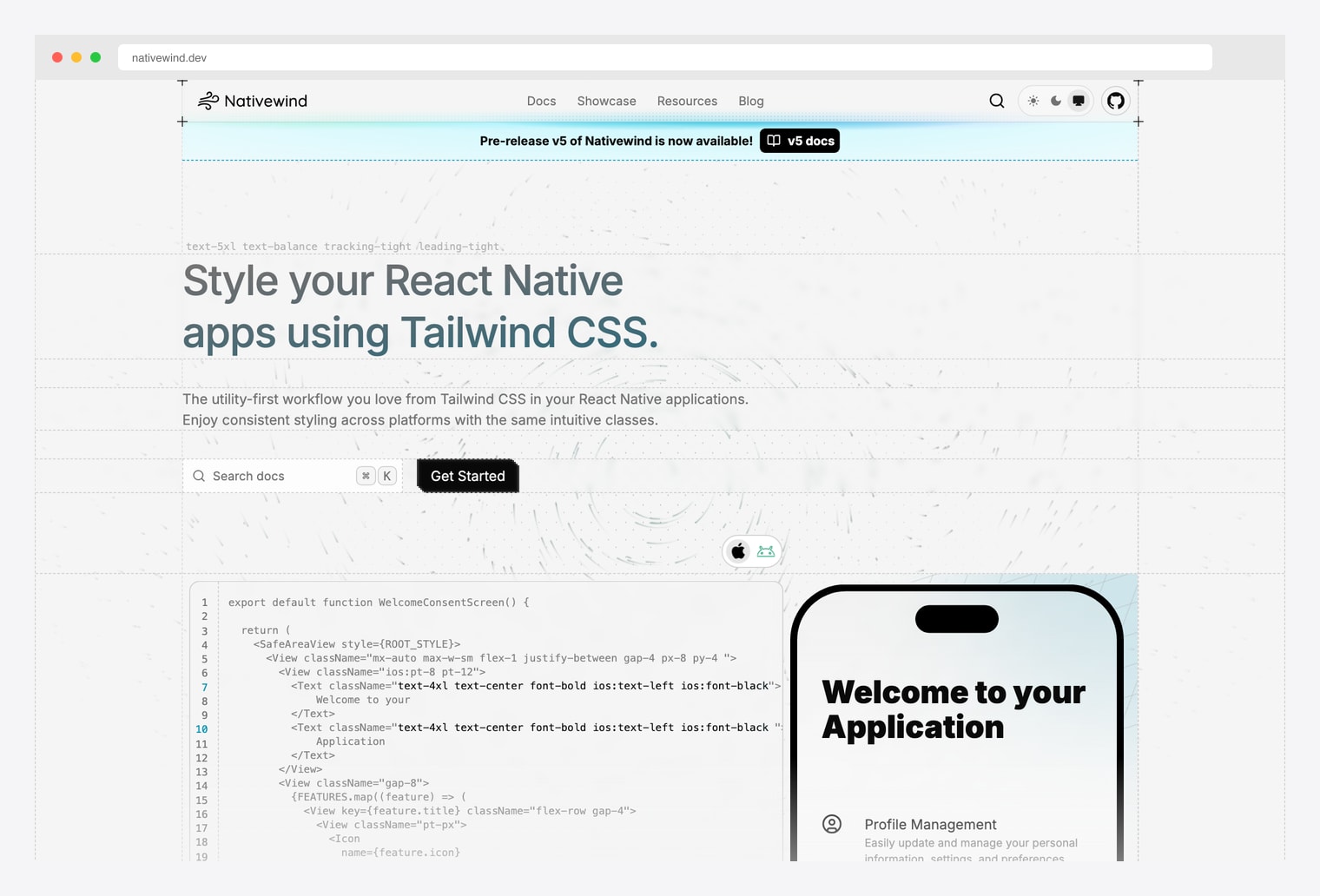
Why we like it: Tailwind CSS for React Native — the primary way to use Tailwind utility classes in Expo and React Native CLI projects. Highly optimized for performance, works seamlessly with Expo and the React Native CLI. NativeWind is the foundation layer most shadcn-for-React-Native projects (including React Native Reusables and NativeCN above) build on top of.
Pick NativeWind when you want Tailwind in mobile but don’t want a shadcn-inspired component layer on top — you’ll style components from scratch using utility classes. Most teams adopt NativeWind first and add a component layer (React Native Reusables / NativeCN) afterward.
5. Tamagui
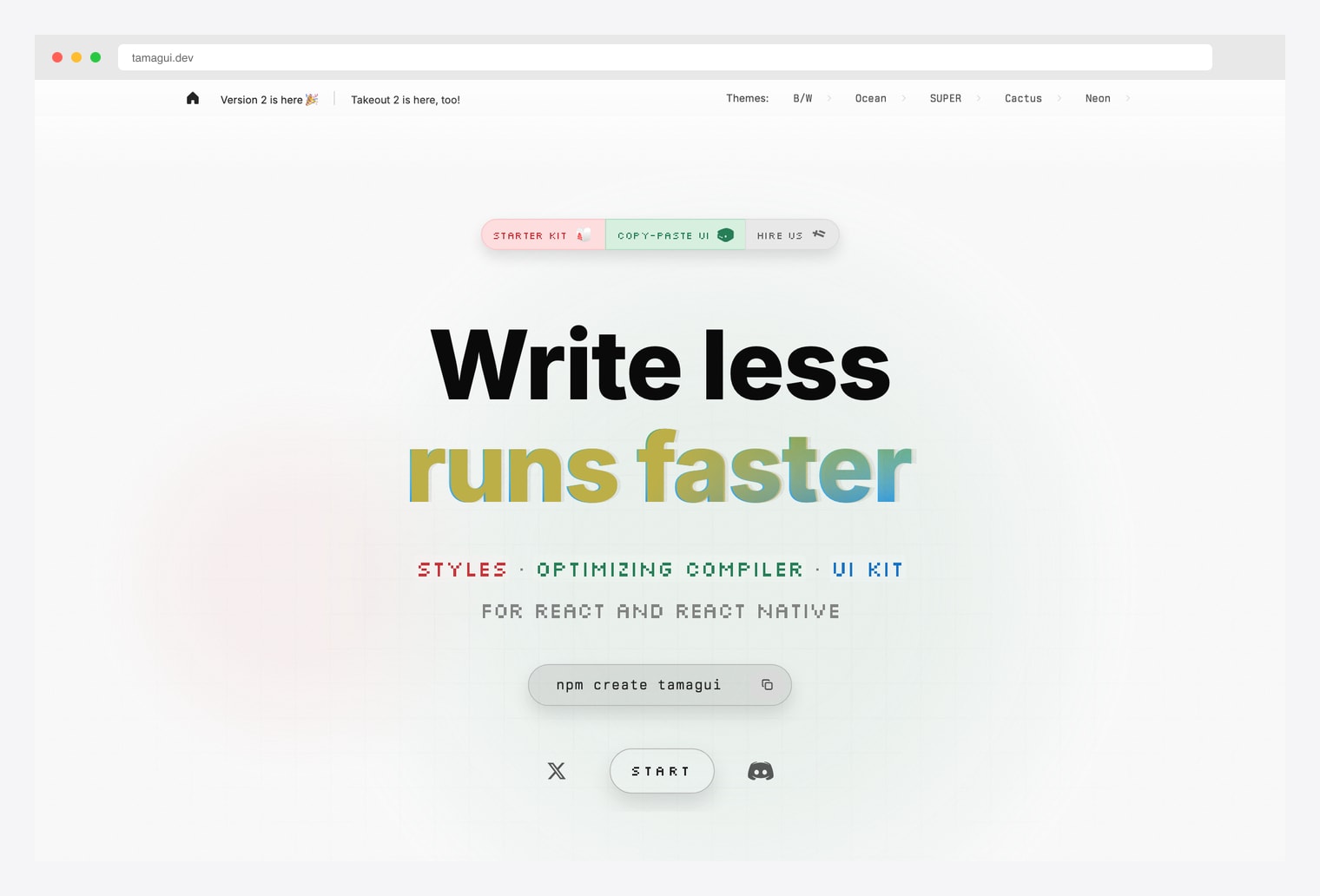
Why we like it: A universal UI kit for React and React Native with an optimizing compiler that flattens styles into the most efficient native code. Type-safe styling with zero performance overhead at runtime. Same component code targets web and native from one codebase.
Pick Tamagui when performance is your primary constraint — animations, complex layouts, or large component trees that would otherwise re-render on every prop change. The compiler does at build time what other frameworks do at runtime. Trade-off: it’s a framework choice, not a copy-paste library; you commit to the Tamagui design system.
6. gluestack
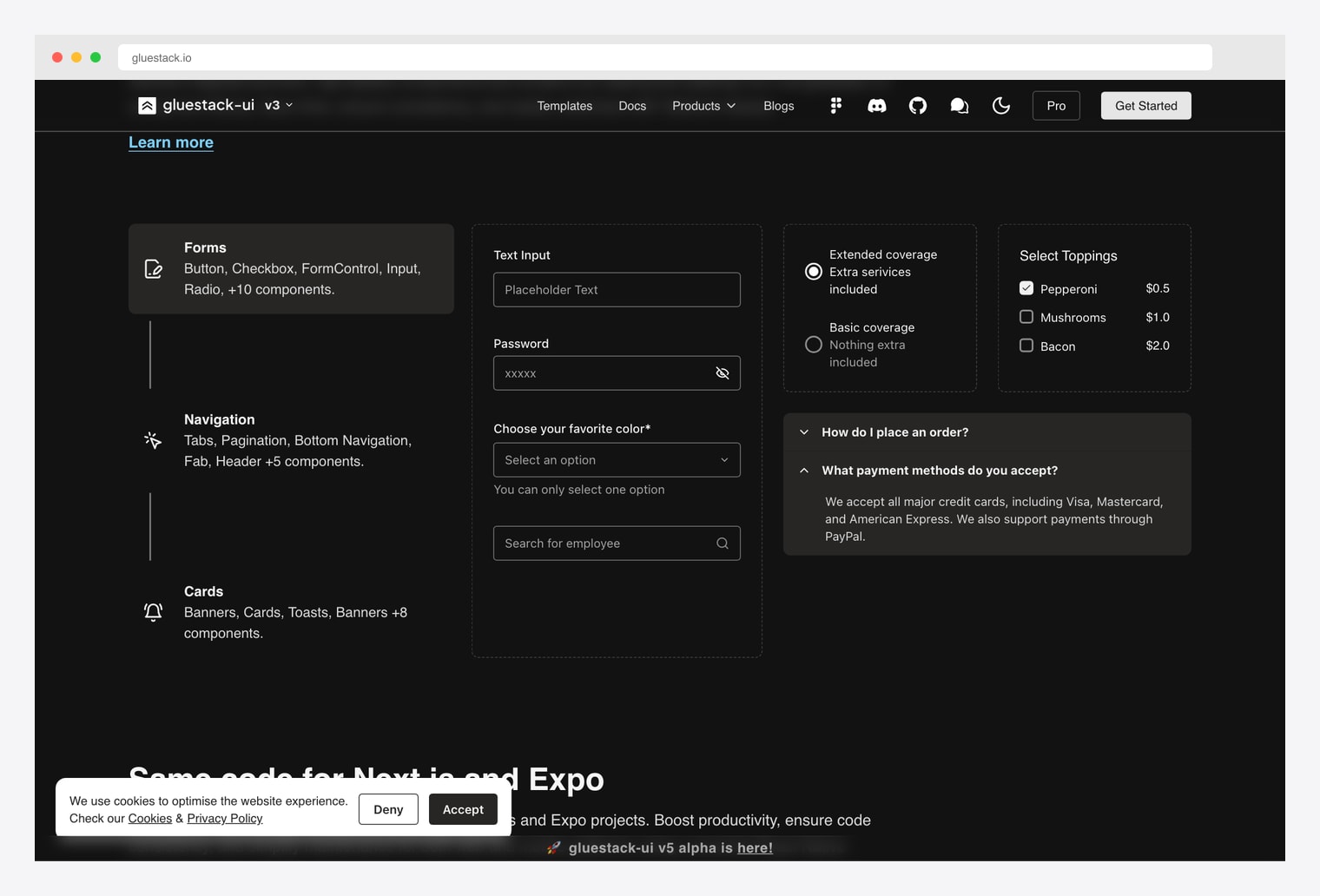
Why we like it: A universal React and React Native UI component library with copy-paste shadcn-inspired component philosophy, NativeWind styling, and shared component code between web and native targets. Larger component catalog than React Native Reusables, broader ecosystem (formerly NativeBase), commercial backing.
Pick gluestack when you want a universal component library with a larger component catalog than React Native Reusables and don’t mind the slightly less shadcn-purist design language. The shared web + native component code is the differentiator versus pure-RN libraries like NativeCN.
7. shadcn.io React Native Category
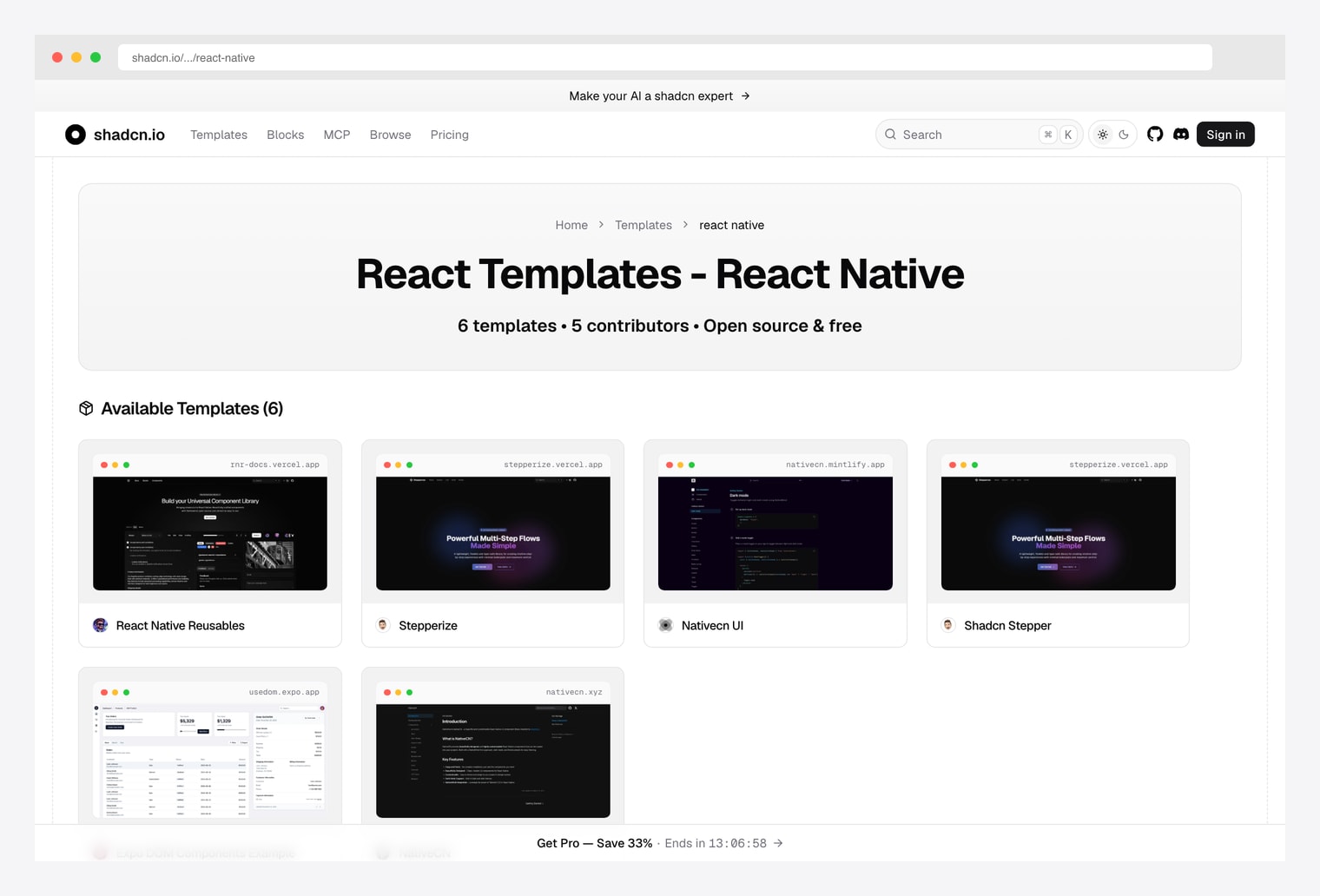
Why we like it: shadcn.io’s curated React Native template category with templates from across the ecosystem in one place. Same vendor we recommended across our pricing, charts, forms, portfolio, blog, onboarding, and settings roundups.
Pick this catalog as the “did I miss anything?” check after the picks above. New community-built shadcn-inspired React Native templates land here as developers ship them — useful for finding niche templates (auth flows, onboarding, marketplaces) that the larger libraries don’t ship out of the box.
How to Choose the Right shadcn Mobile Source
The 7 picks split along three practical axes:
By approach
- Direct shadcn-to-RN port (same component names, philosophy, copy-paste model): React Native Reusables, NativeCN UI.
- Universal component library (shared web + native code): gluestack, Tamagui.
- Foundation styling layer (without opinionated components): NativeWind.
- Complete starter template (app shell with routing + dark mode): expo-nativewind-template.
By primary constraint
- Visual consistency with web shadcn: React Native Reusables — most direct port.
- Code ownership (no NPM lock-in): NativeCN UI.
- Build-time performance: Tamagui — optimizing compiler.
- Shared web + native codebase: gluestack, Tamagui.
- Fastest path to deployed mobile app: expo-nativewind-template.
By stack you already run
- Already using shadcn on web: add React Native Reusables + NativeWind — same mental model.
- Already using Tailwind on RN: add NativeCN or React Native Reusables on top.
- Already using Expo + Expo Router: start from expo-nativewind-template.
- Greenfield, no constraints: evaluate Tamagui if performance matters or React Native Reusables if shadcn familiarity matters.
A practical pattern in 2026: if your team already uses shadcn on the web, install NativeWind for styling and React Native Reusables for components — the mobile app then matches the web app visually with the same copy-paste workflow. Switch to Tamagui when performance becomes the bottleneck (heavy animation, large component trees). Pick gluestack when you want one component codebase shared across web and native. Use expo-nativewind-template as the starting skeleton regardless of which component library you settle on.
shadcn/ui and React Native FAQ
Does shadcn/ui work with React Native?
Not directly. shadcn/ui is built for the web — its components rely on Radix UI primitives and Tailwind CSS rendering to the DOM, none of which exist in React Native. What does work is the shadcn approach: several projects apply the same copy-the-code-into-your-repo philosophy to React Native components. React Native Reusables is the most active of them.
Can I use Tailwind CSS in React Native?
Yes, through NativeWind, which compiles Tailwind class names into React Native styles at build time. It is the foundation nearly every shadcn-style React Native library builds on, including React Native Reusables, so if you want the shadcn workflow on mobile you are almost certainly using NativeWind underneath.
What is the closest thing to shadcn/ui for React Native?
React Native Reusables. It follows the same model — you copy components into your project and own the code rather than installing a component dependency — and it is built on NativeWind so the styling conventions carry across. It is also the most actively maintained option in this space, which matters more than component count.
Should I use Tamagui or gluestack instead?
They are different trades rather than worse options. Tamagui optimises hard for performance with a compiler that flattens styles at build time, and is the strongest choice when you are targeting web and native from one codebase. gluestack offers a broader, more conventional component library. Both are dependencies you install rather than code you own, so you get more out of the box and less control over it.
Can I share components between my web and React Native app?
Not the components themselves, since the rendering primitives differ — a web div has no React Native equivalent. What you can share is everything underneath: design tokens, colour scales, spacing scales, validation schemas, API clients and business logic. Teams that try to share the component layer usually end up with a lowest-common-denominator UI on both platforms.
Are these React Native component libraries free?
The open-source ones on this page are, under permissive licences, and because they follow the copy-into-your-repo model the components become your code. Check each project’s commit history before you commit to it, though — activity varies widely across this category, and one option on this list has not been updated since 2024.

You Might Also Like


