
11 Best Filament Admin Panel Templates, Plugins & Themes (2026)

Filament is the Laravel admin panel most new projects start with — we cover the framework itself in our Laravel admin dashboard templates roundup. This page is what you add to it: the official demo app to clone, the plugins that supply the screens every real panel needs, and the small set of theming tools that exist. Every entry was checked against its repository and licence file; one plugin most roundups still recommend is deprecated and is named below.
A note on what is not here: Filament’s theme ecosystem is thin. Beyond one maintained theme package and one visual editor, “Filament themes” on GitHub are dead or single-digit-star projects, so the honest answer to a branded panel is a custom Tailwind theme — which the plugins below do not prevent.
Quick Picks
- Start here: Filament Demo App — the official shop and blog admin, with login credentials
- Access control: Filament Shield — roles and permissions for every resource
- Account screens: Filament Breezy — profile pages and two-factor auth
- Page building: Filament Fabricator — block-based page builder skeleton
- Charts: Filament Apex Charts — ApexCharts as dashboard widgets
- Multi-tenant SaaS: Filament Companies — organisations and team membership
- Theming: Filament Studio — visual theme editor
Filament starters, plugins and themes compared
| Name | Type | Licence | Adds |
|---|---|---|---|
| Filament Demo App (official) | Laravel · Filament · MIT | Free (MIT) | Learning the patterns by reading working code |
| TomatoPHP Filament CMS | Laravel · Filament plugin suite | Free (MIT) | Turning a Filament panel into a content site |
| Filament Shield | Filament plugin | Free (MIT) | Any panel with more than one kind of user |
| Filament Breezy | Filament plugin | Free (MIT) | Shipping the account screens you would otherwise build |
| Filament Fabricator | Filament plugin | Free (MIT) | Editor-composed pages inside a Filament panel |
| Filament Apex Charts | Filament widget plugin | Free (MIT) | Dashboard pages that need real charts |
| Filament Excel | Filament plugin | Free (MIT) | Panels whose users live in spreadsheets |
| Filament FullCalendar | Filament widget plugin | Free (MIT) | Bookings, schedules and events in the panel |
| Filament Companies | Filament plugin | Free (MIT) | SaaS panels where users belong to organisations |
| Themes by Hasnayeen | Filament plugin | Free (MIT) | Letting users pick a theme and accent colour |
| Filament Studio | Web tool | Web tool (see site for terms) | Designing a panel theme without writing Tailwind |
Starters and demo apps
Working panels to clone or learn from, rather than components to assemble.
1. Filament Demo App (official)
A realistic admin to clone, not a hello-world
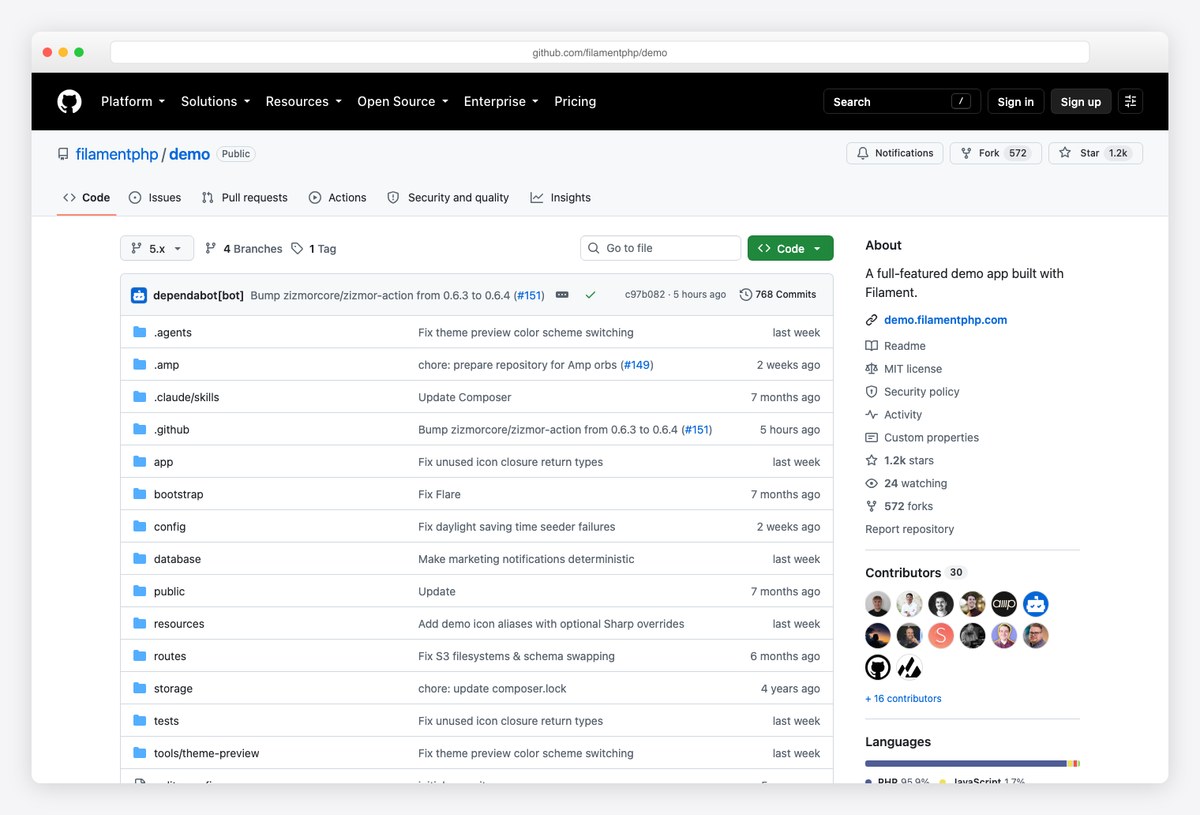
Why we like it: The official full-featured demo: an e-commerce shop, a blog and a third module built the way the Filament team builds them — products, orders, customers, brands and categories, with a multi-step order wizard that creates a customer inline.
If you want a Filament panel that looks like a real business admin on day one, clone this before any template. The shop module is the reference for CRUD-heavy resources; the order wizard shows how multi-step forms and inline relationship creation are meant to be done.
It is also the only entry here with published demo credentials, so you can inspect the finished panel before running a single command.
2. TomatoPHP Filament CMS
A whole CMS on top of Filament
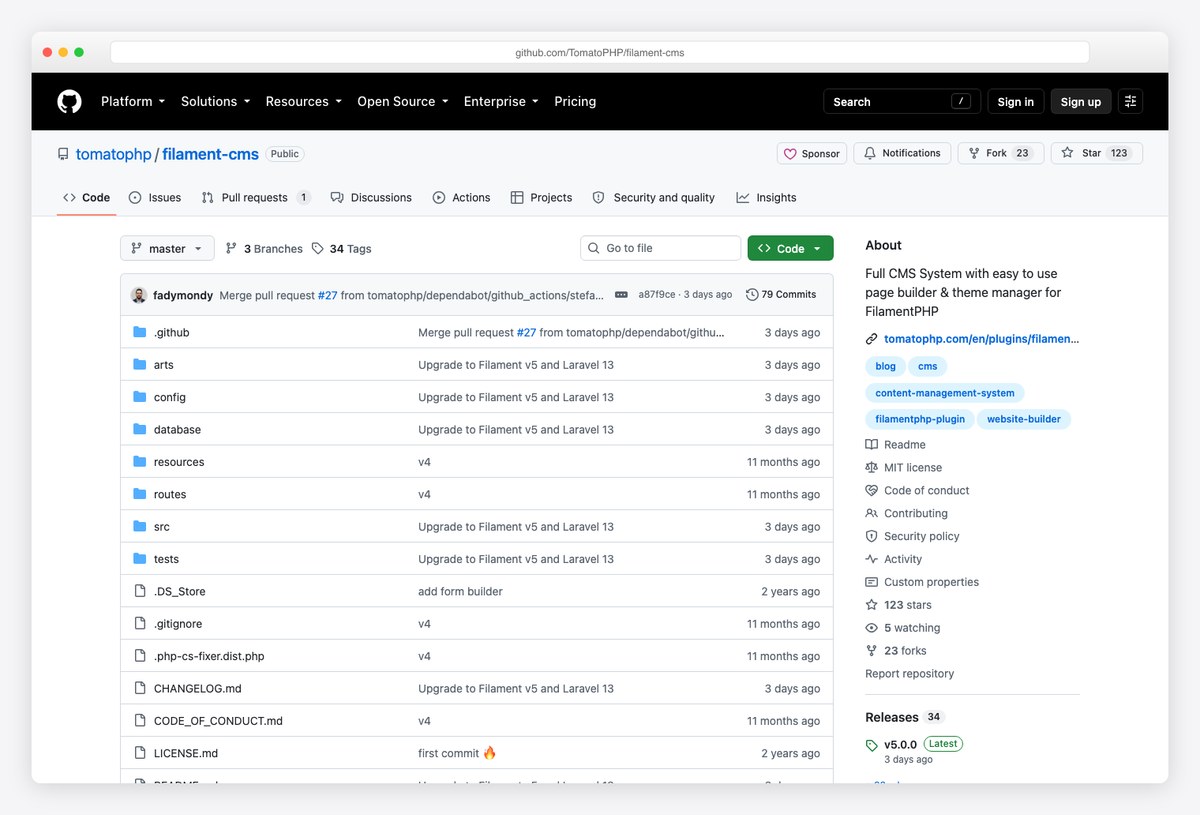
Why we like it: A full CMS system for Filament with a page builder and a theme manager — the fastest route from “admin panel” to “we also publish pages”, without leaving the Filament UI.
Most Filament projects start as internal tools and then need a public site. TomatoPHP’s CMS package supplies the missing half — pages, a builder, themes — as Filament resources, so editors work in the same panel as everything else.
Smaller and younger than the plugins below; check its release cadence against your own timeline before building a client site on it.
Plugins that add admin screens
Each of these is a Composer install and a line in your panel provider, and each removes a screen you would otherwise build.
3. Filament Shield
Roles and permissions, generated for every resource
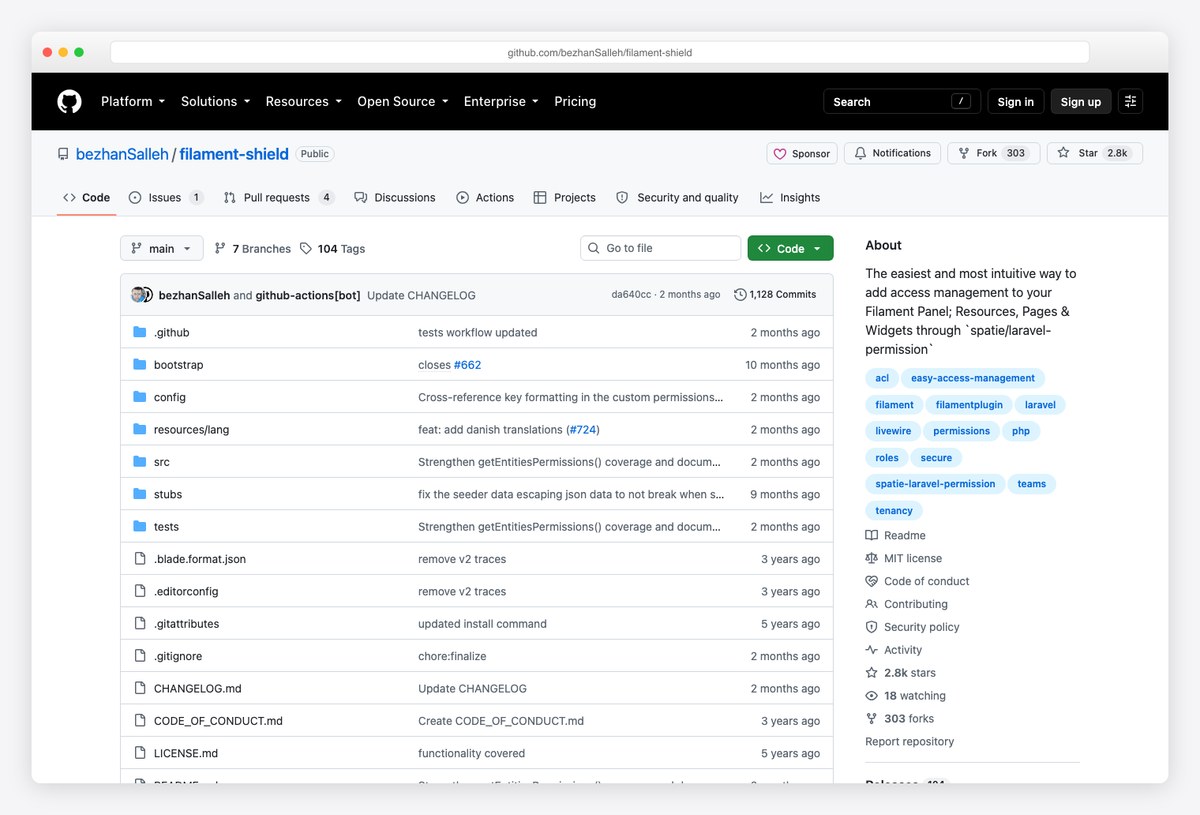
Why we like it: The standard way to add access management to Filament: roles, permissions and per-resource policies, with a panel UI to manage them — the plugin almost every production Filament app ends up installing.
Shield’s job is the one Filament leaves to you: who may see and do what. It generates permissions for your resources, pages and widgets and gives administrators a role-management screen inside the panel, so access control stops being a hand-maintained policy file.
The most-adopted plugin in the ecosystem, and the first one to reach for on a multi-user panel.
4. Filament Breezy
Profile pages and two-factor auth, done
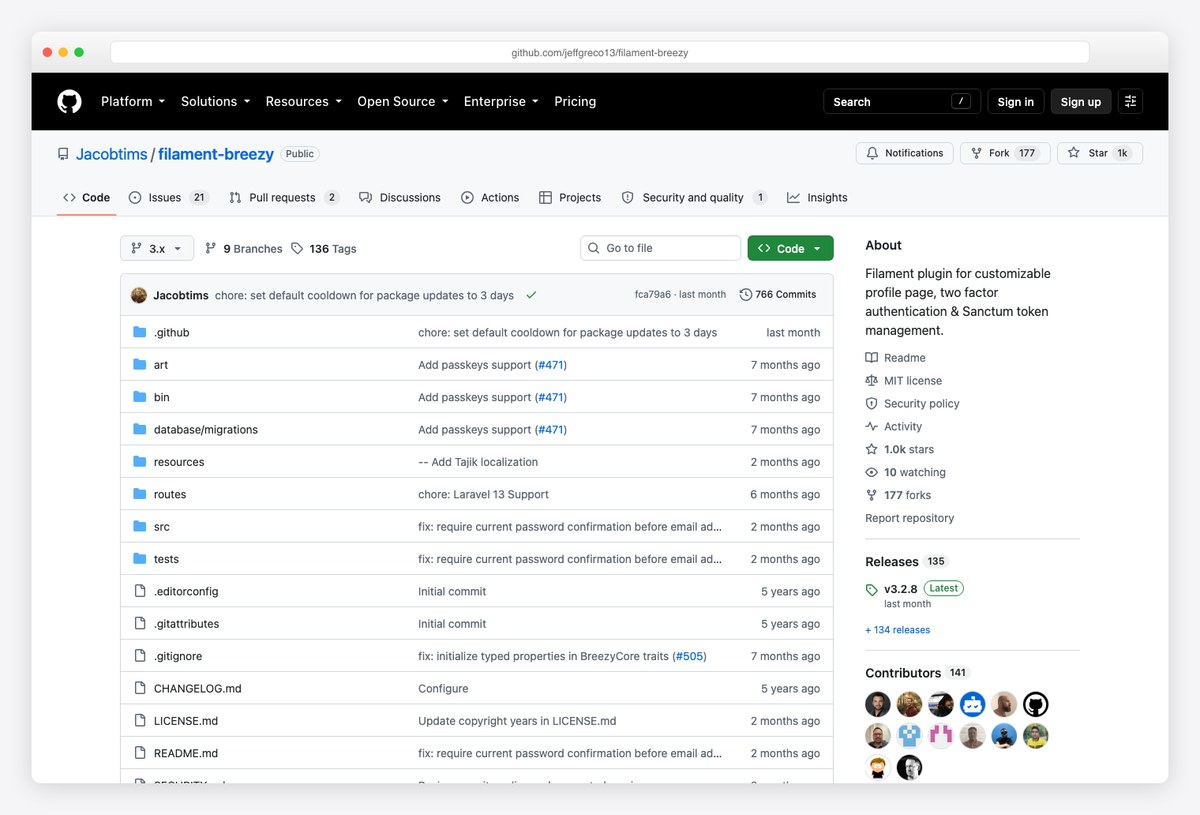
Why we like it: A customisable profile page, two-factor authentication and the surrounding account flows as a plugin — the screens every panel needs and nobody wants to write.
Breezy covers the user-facing edge of an admin panel: updating a profile, changing a password, enabling 2FA. Each piece is a Filament page you can restyle or extend, rather than a black box.
Pair it with Shield: Shield decides what a user may do, Breezy handles who the user is.
5. Filament Fabricator
Block-based page builder skeleton
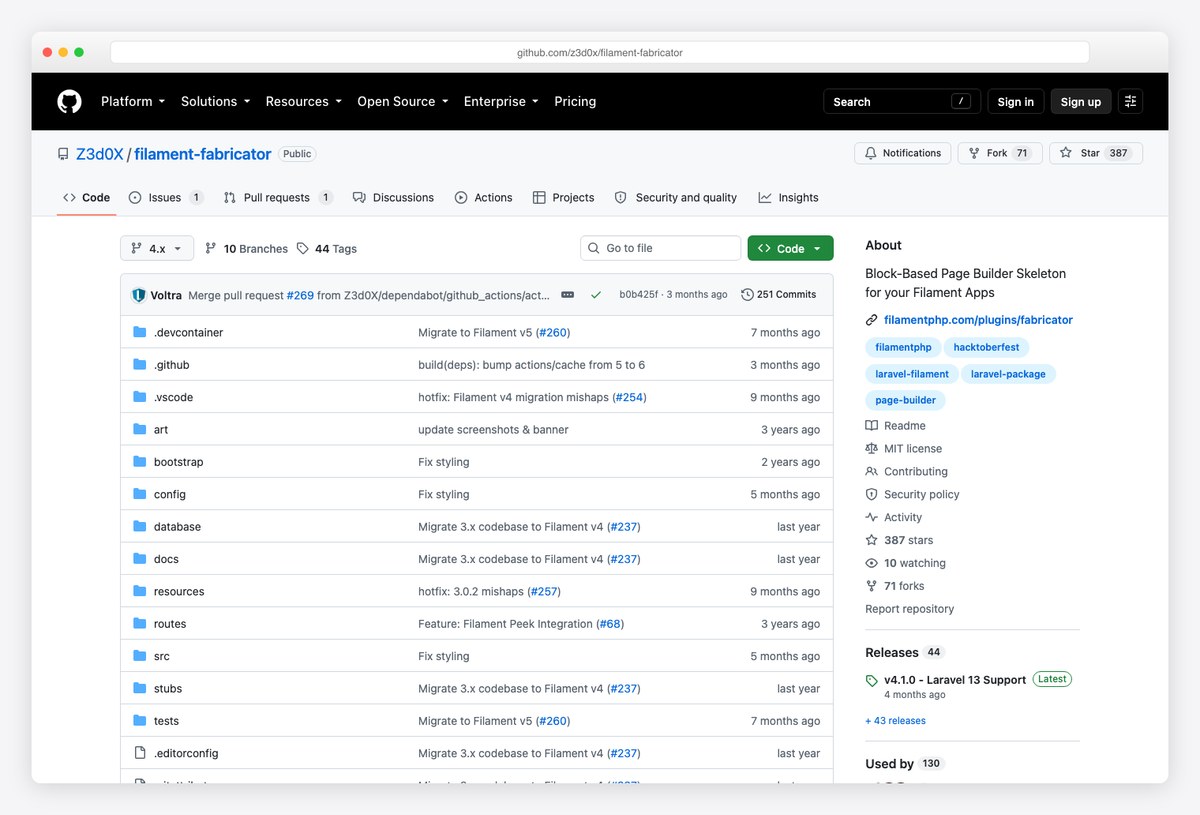
Why we like it: A block-based page-builder skeleton: it provides the page resource and rendering plumbing, you define the blocks — the Filament answer to StreamField-style composition.
Fabricator deliberately ships a skeleton rather than a finished CMS. You get a PageResource, layouts and the block infrastructure; the blocks themselves are Filament form components you write for your content. That keeps it small and keeps the design yours.
Choose it when editors need to compose pages from your components; choose TomatoPHP’s CMS when you want the whole publishing layer pre-built.
6. Filament Apex Charts
Dashboard widgets on ApexCharts
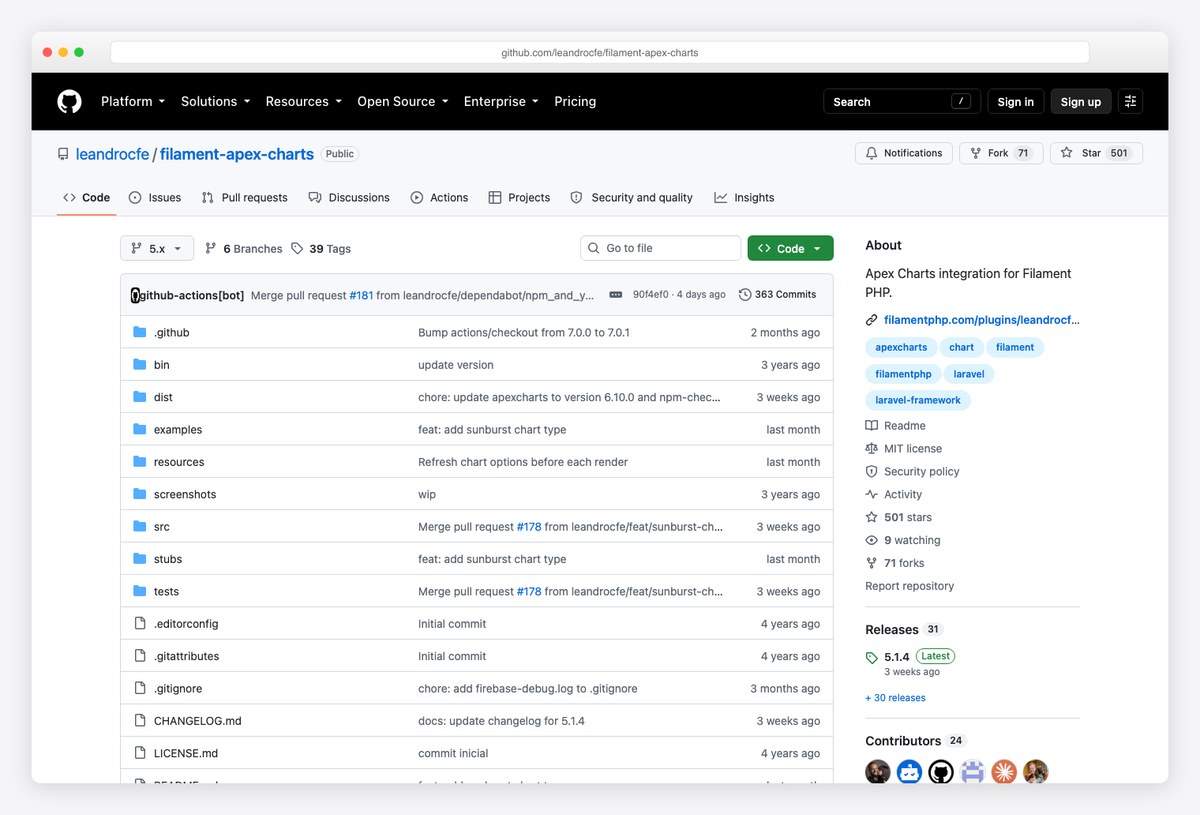
Why we like it: ApexCharts as Filament widgets — register the plugin on a panel and build chart widgets with the full ApexCharts option set, with a companion demo repository showing the results.
Filament’s built-in charts cover the basics; this plugin is where dashboard pages get the mixed, annotated and themed charts a stakeholder-facing panel needs. Widgets are ordinary Filament widgets, so they sit on any dashboard or resource page.
The maintainer’s demo branch is the quickest way to see the widget catalogue before installing.
7. Filament Excel
Export any resource table to Excel
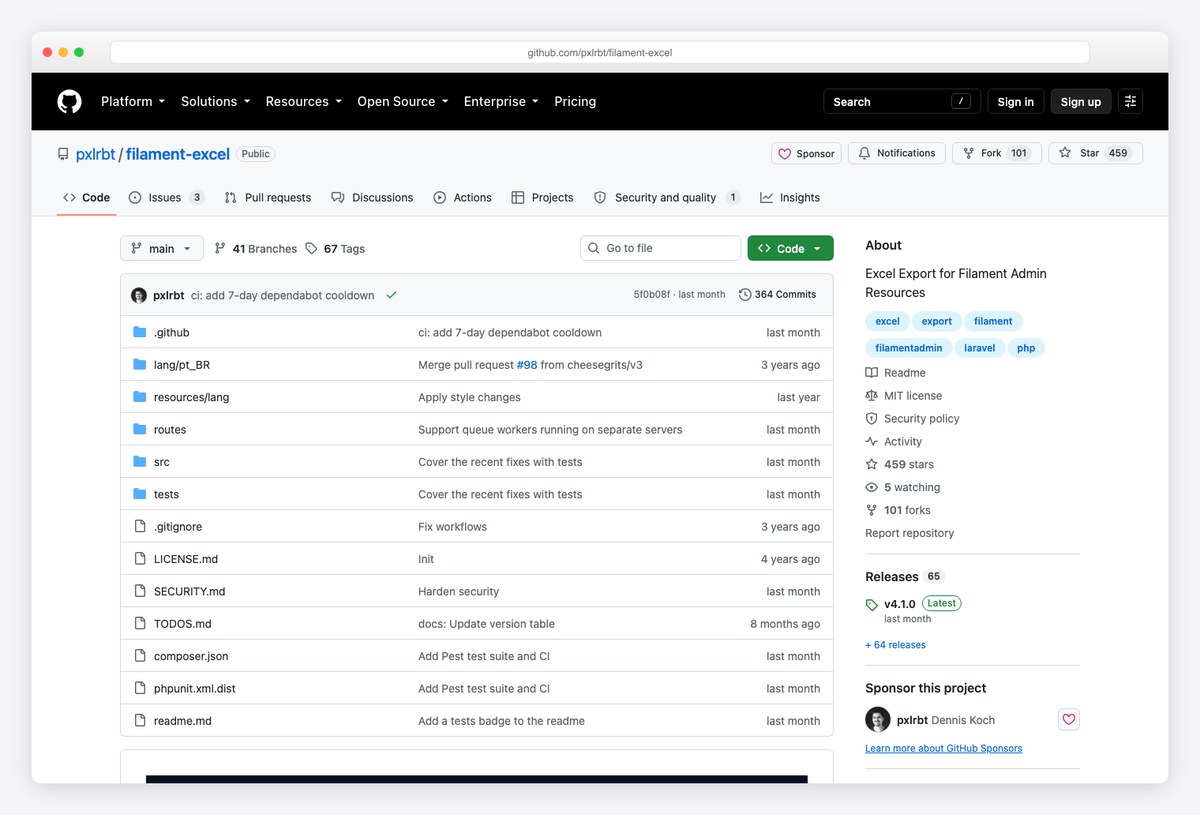
Why we like it: Excel export for Filament resources as a table action — the request that arrives in week two of every admin project, solved as a plugin.
Adds export actions to resource tables so users get the filtered, sorted view they are looking at as a spreadsheet. Column selection and formatting are configurable per resource.
Small, focused and widely used; there is no reason to build export by hand on Filament.
8. Filament FullCalendar
The standard JavaScript calendar as a widget
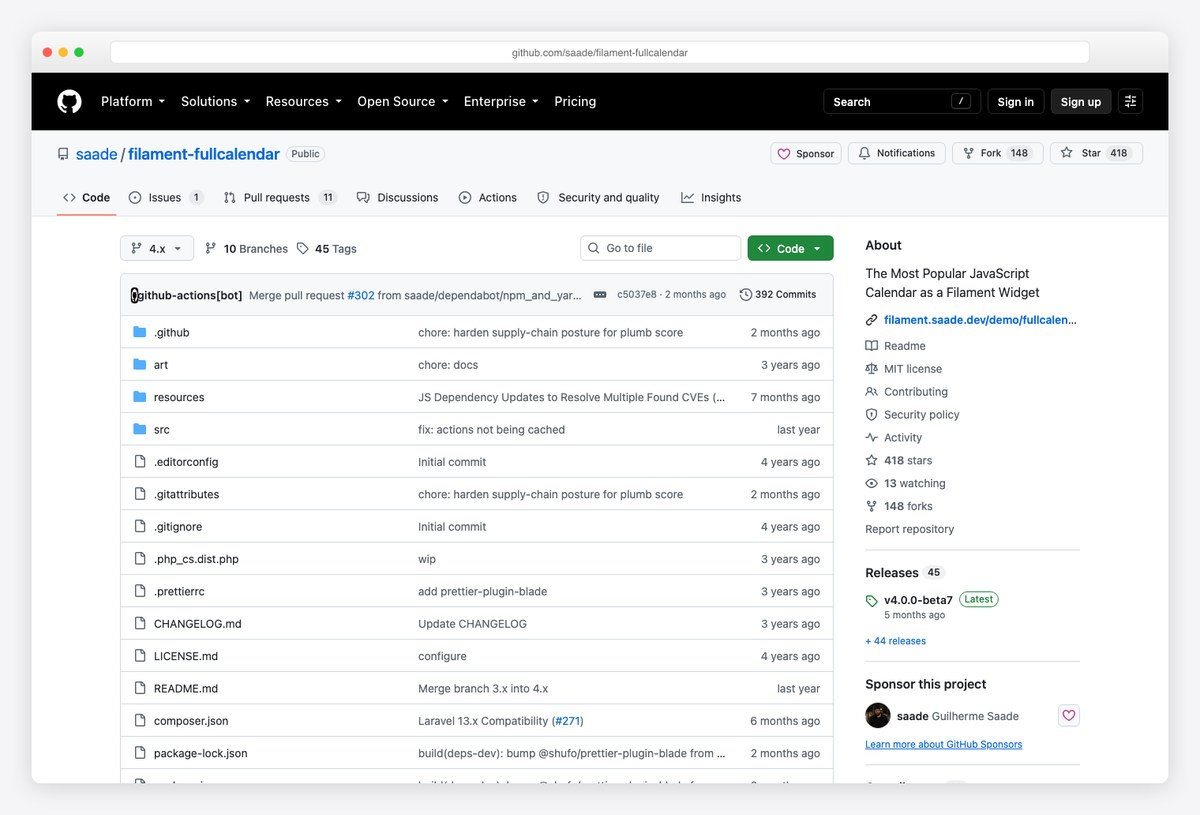
Why we like it: FullCalendar wrapped as a Filament widget, with modals for viewing, creating, editing and deleting events powered by Filament Actions — so the calendar behaves like the rest of the panel.
Return events from your models, and the widget renders them on the calendar most web developers already know. Because the event modals are Filament Actions, validation, forms and permissions work the same way they do on any resource.
The obvious pick for any panel with appointments, shifts or deadlines.
9. Filament Companies
Teams, companies and multi-tenant auth
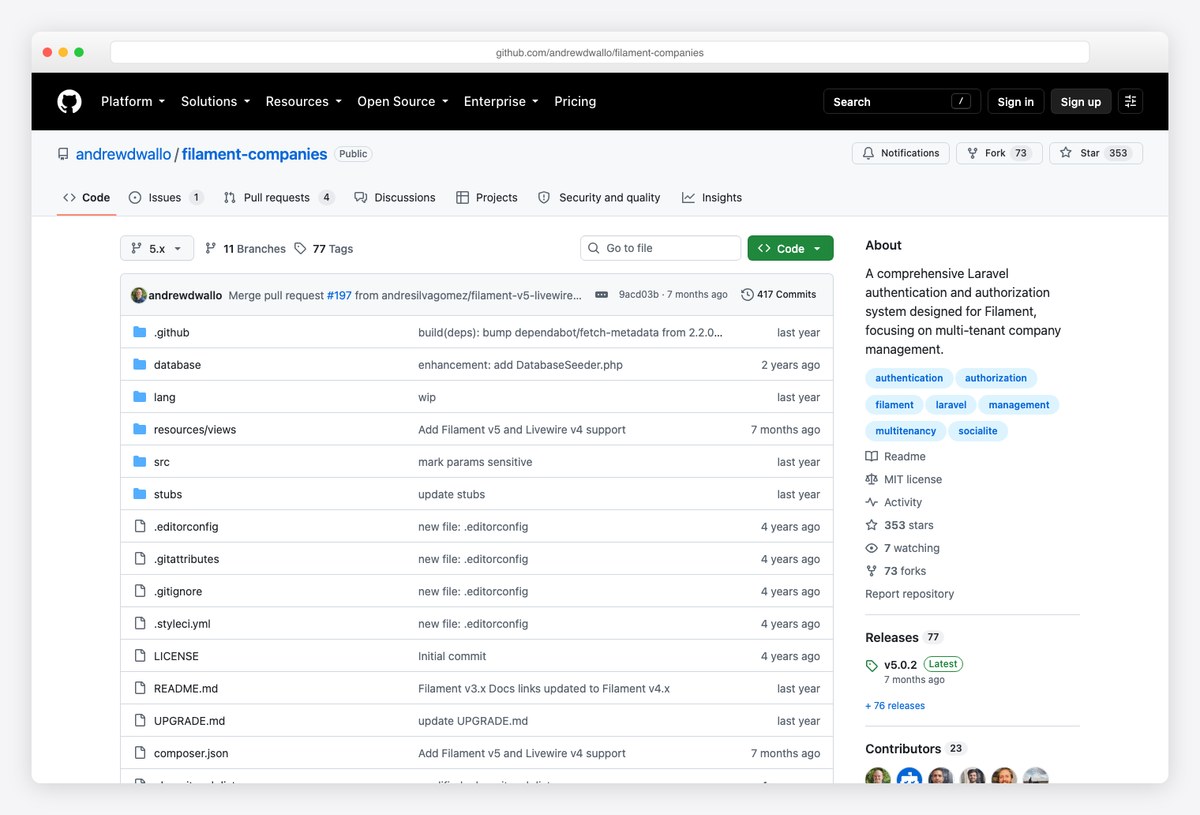
Why we like it: A comprehensive authentication and authorisation system for Filament built around companies — the team/organisation layer a SaaS panel needs before it can invoice anyone.
Where Breezy handles one user’s account, Companies handles the group: organisations, membership, roles within a company and the switching between them. It is the piece that turns a single-tenant admin into a product.
Its release cadence is slower than the plugins above, so pin a version and test the upgrade path before relying on it.
Theming
The short list, because the honest state of Filament theming is a custom Tailwind theme.
10. Themes by Hasnayeen
Switchable themes with a colour picker
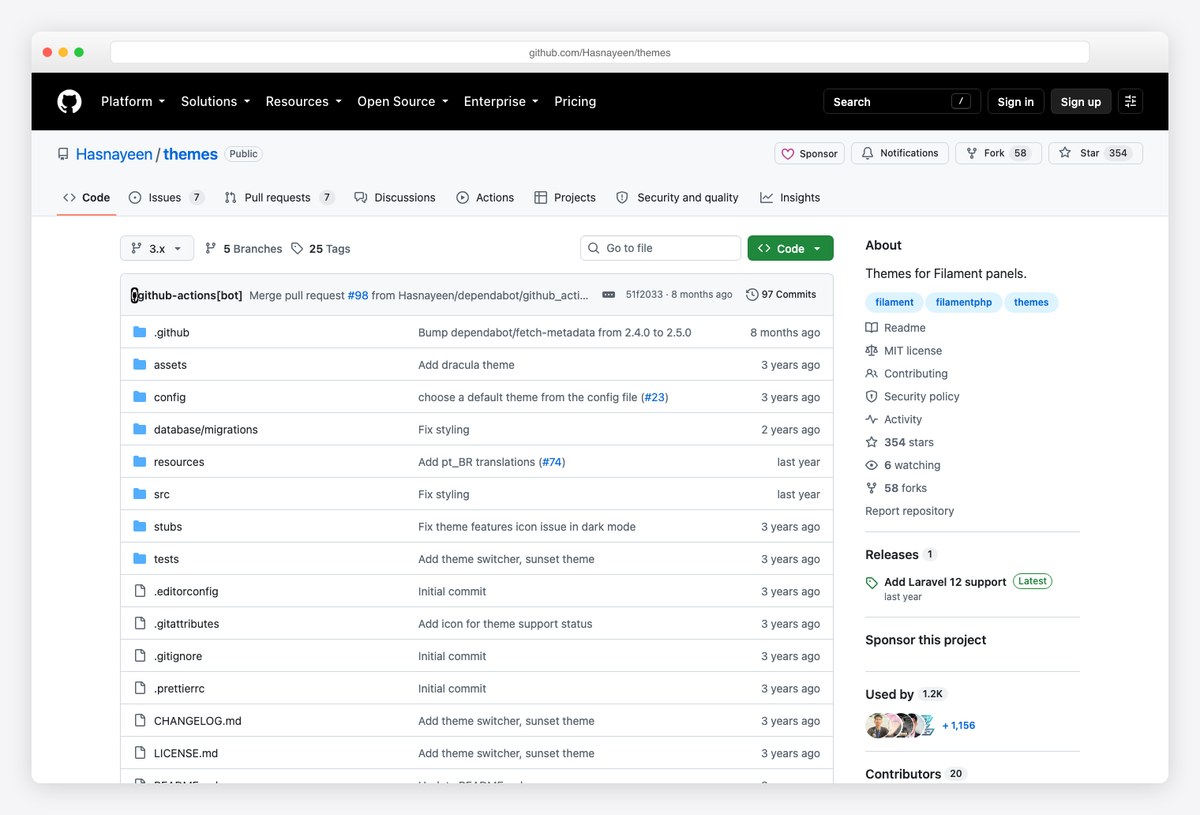
Why we like it: A theme collection for Filament panels that lets users choose a theme and customise its colour from the panel itself — the only maintained theme package of any size in the ecosystem.
Install it, publish the assets, and the panel gains a theme switcher with a colour control per theme. It is the closest thing to a “skin” system Filament has.
It has not shipped a release for most of this year, so confirm it runs on your Filament major before committing; theming in Filament otherwise means a custom Tailwind theme, which the docs cover.
11. Filament Studio
A visual theme editor for Filament panels
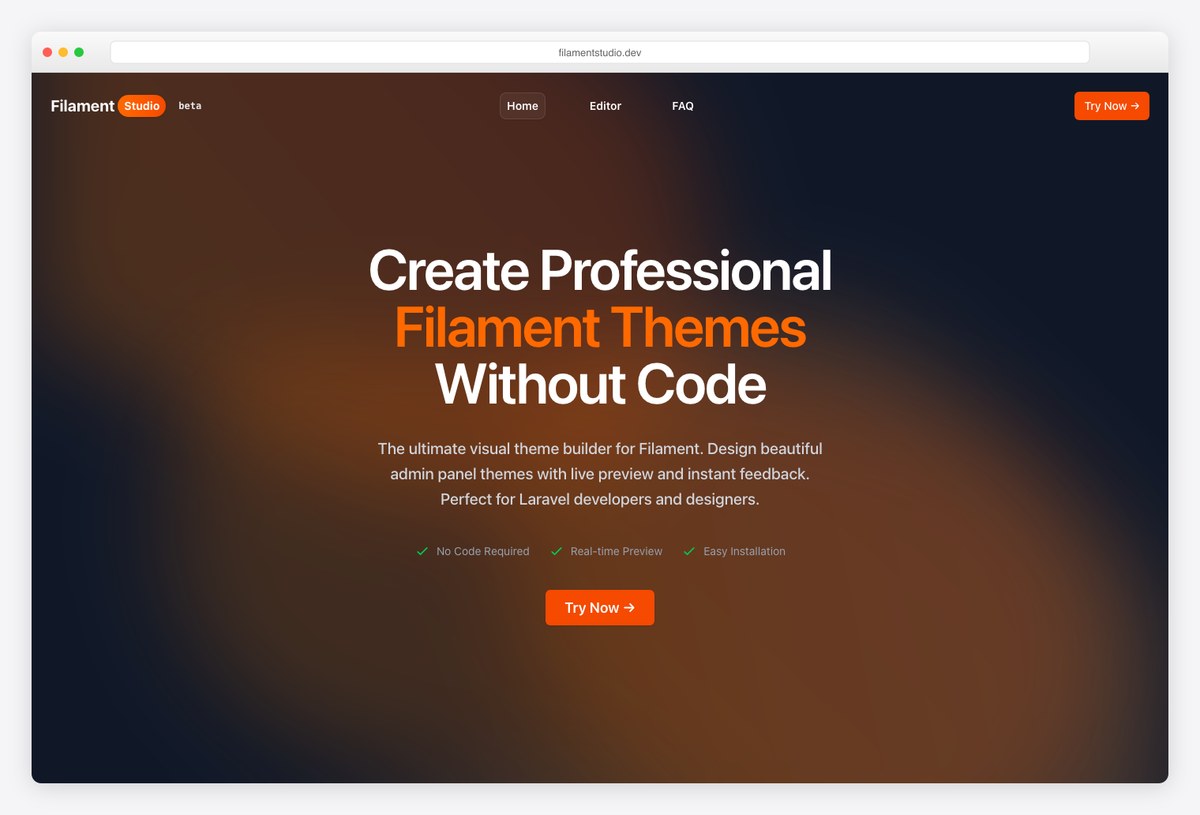
Why we like it: A visual builder for Filament themes: create, customise and preview a panel theme in the browser and export it for a current Filament major — the no-code path to a branded panel.
Custom themes in Filament are a Tailwind build step and a set of CSS variables; Studio puts a UI on that so a designer can set colours, radii and typography and hand developers the output.
Treat it as a design tool feeding your theme file, not a runtime dependency.
Checked and left out
- Filament Tiptap Editor — its own README now says the package is deprecated: from Filament v4 the native rich editor covers the use case. Roundups still list it as the rich-text answer; do not install it on a new project.
- 3x1io/filament-themes — a front-end theme manager with no commits since 2024.
- filament-themes-manager — a single-digit-star theme installer; not enough track record to recommend.
- Filament itself — deliberately not an entry here. It is the framework these run on, and it is covered with the other Laravel admin options in our Laravel roundup.
Where to find more
Two official-adjacent resources are worth more than any third-party list: the Filament plugins directory, which is filterable by field type and includes the community starter kits, and Filament Examples, a gallery of complete projects — inventory systems, construction management, dashboards with external data — with source you can read.
How to put these together
- New panel: clone the official demo to learn the patterns, then start your own project and add Shield before the second user exists.
- Users manage their own accounts: Breezy. Users belong to organisations: Companies as well.
- The panel needs a dashboard: Apex Charts for the widgets, Excel for the inevitable export request, FullCalendar if anything is scheduled.
- The panel also publishes pages: Fabricator if you will write the blocks, TomatoPHP CMS if you want the publishing layer pre-built.
- It has to look like the brand: a custom Tailwind theme per the docs, designed in Filament Studio; Themes if users should switch skins themselves.
Frequently asked questions
Is there a Filament admin panel template I can download?
The closest thing is the official Filament demo app: a full e-commerce and blog admin built by the Filament team, MIT-licensed, with published login credentials so you can inspect it first. Beyond that, Filament panels are assembled from plugins rather than bought as templates — which is what this page lists.
Are Filament plugins free?
Every plugin on this page is MIT-licensed and free. Filament itself is also open source. The only entry with commercial terms is Filament Studio, a separate web tool for designing themes, whose pricing is on its own site.
How do I theme a Filament panel?
Officially, with a custom Tailwind theme — Filament’s docs walk through generating one and registering it on the panel. Themes by Hasnayeen adds switchable skins with a colour picker inside the panel, and Filament Studio is a visual editor that produces the theme for you. There is no large marketplace of Filament themes; most “theme” repositories on GitHub are abandoned.
Which rich text editor should I use in Filament?
Filament’s built-in rich editor. The widely recommended Tiptap plugin is deprecated by its own author because the native editor now covers the use case; installing it on a new project adds a dependency you will have to remove.
Filament or a Laravel admin template?
Filament when you are building the panel from your models and want generated resources, forms and tables; a Laravel admin template when you want a designed front end and are happy to wire it to your own views. The two are compared, with the other Laravel options, in our Laravel admin dashboard templates roundup.
Not settled on Filament? Compare it with the rest of the field in Laravel admin dashboard templates, or start from a designed front end with Laravel templates and our AdminLTE + Laravel guide.

You Might Also Like


